
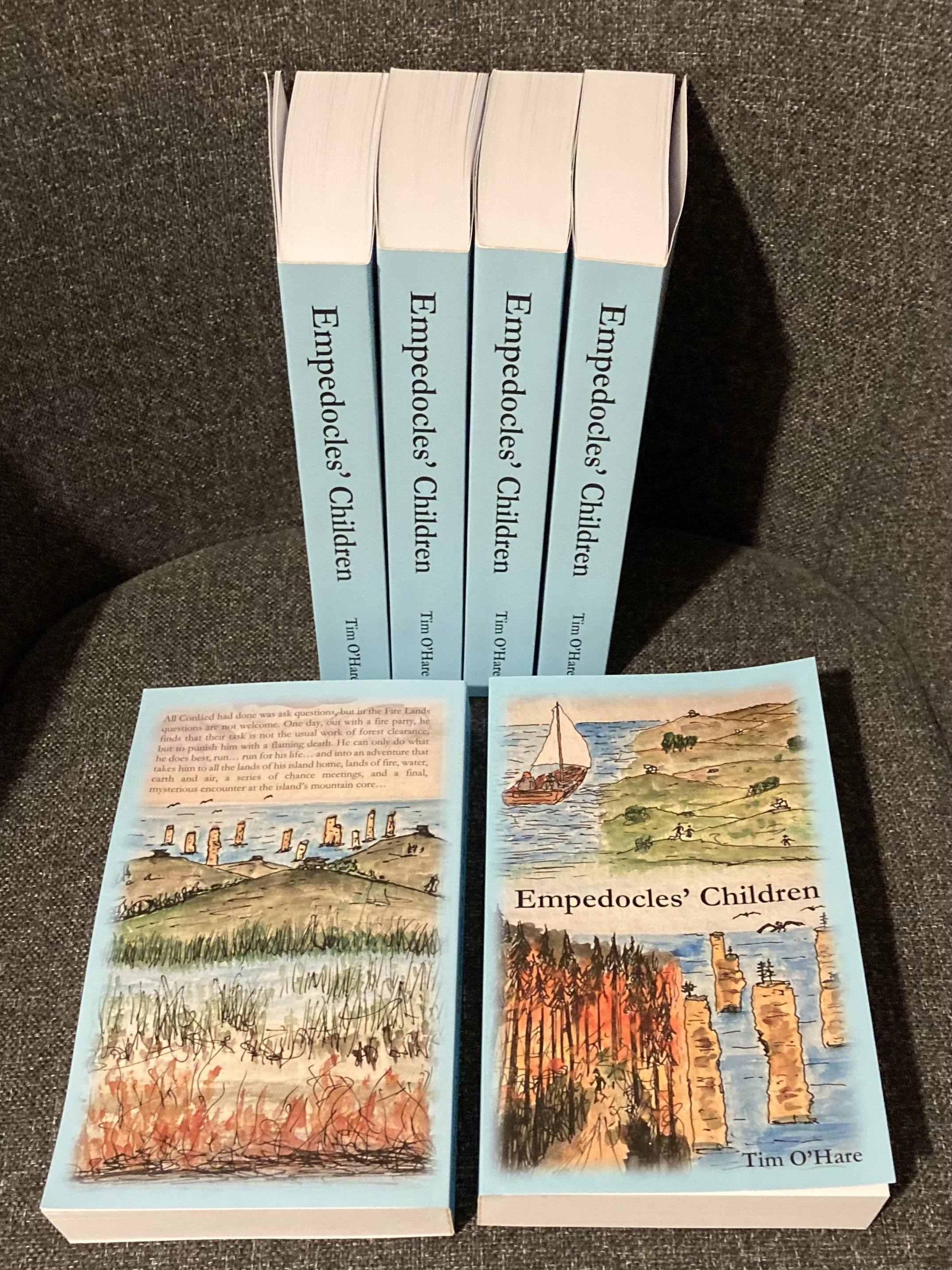
Since I finished writing my children’s adventure story, Empedocles’ Children, earlier this year, I have been exploring the various avenues through which I might eventually get it published. By far the most likely is that I will end up self-publishing Empedocles’ Children as an eBook and print-on-demand paperback, largely because to get a book out into the world via a traditional publishing route you have to first be successful in gaining the interest of a Literary Agent and, by all accounts, the chances of that happening are pretty minimal… As a result, I am adopting the working assumption that the doors to traditional publishers will remain firmly closed to me, but that doesn’t mean that I am not going to give that route to publication a try, in fact I have already started, having worked my way through an online course from Jericho Writers called ‘How To Get A Literary Agent’. About a month ago, following the approach suggested in that course, I sent off ‘query letters’, accompanied by a one-page synopsis and whatever portion of the manuscript the agent requested querying authors to send (usually the first three chapters), to eight Literary Agents. My plan is to send off a further set of query letters to another group of eight agents sometime in September, and then complete a final set of eight submissions in November(ish). The logic of this staged approach to submissions is that it provides the opportunity to modify the submission made to the later groups of agents on the basis of any responses (or lack of responses) received from the earlier one.
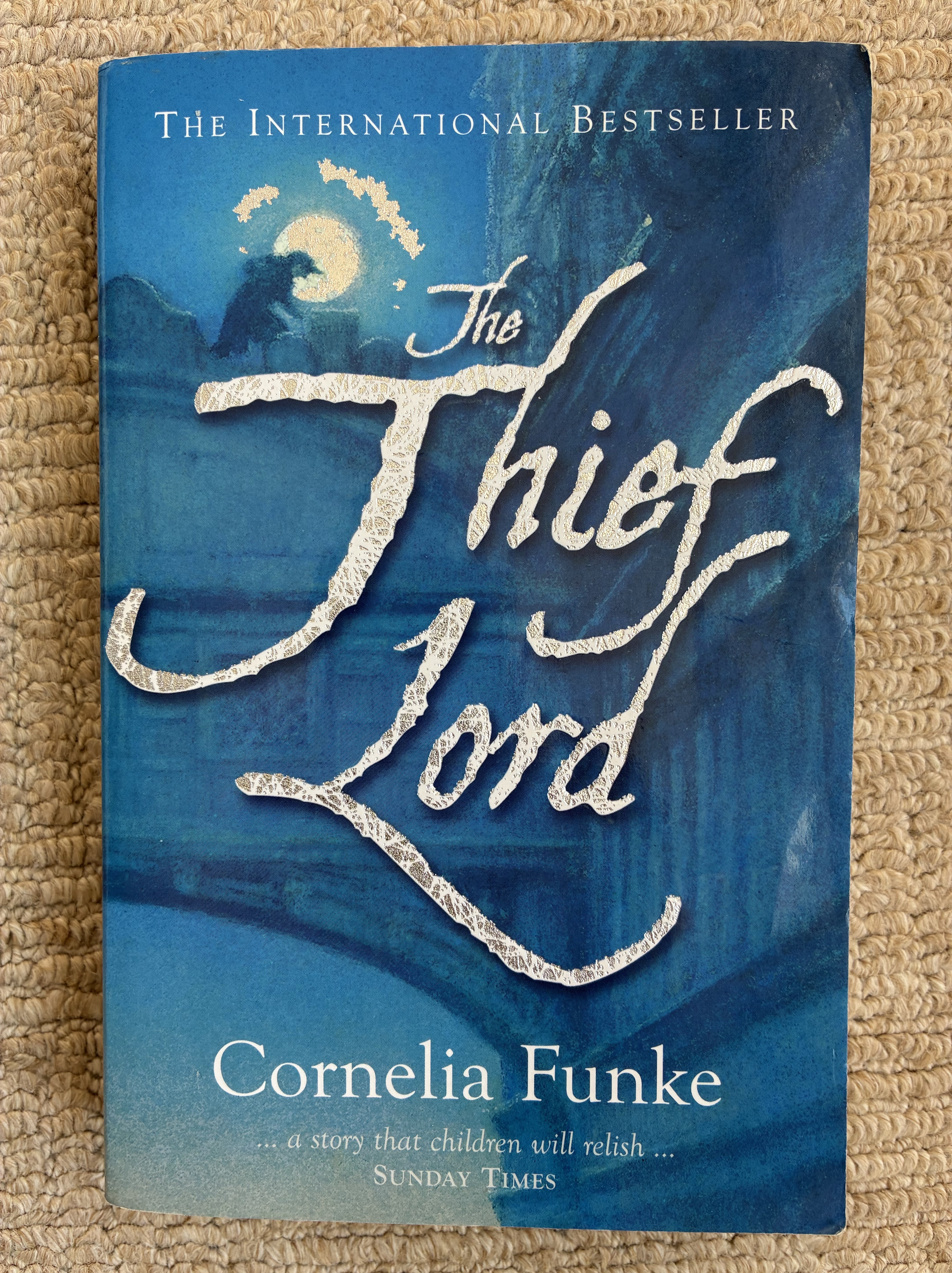
But what has any of this got to do with Cornelia Funke’s children’s novel The Thief Lord? The answer is that one of the things Literary Agents generally ask is that authors liken their work to what are termed ‘comparative titles’ (or ‘comps’). This is supposed to be a good way of the author showing where their book fits into the market (and that they know where their book fits into the market), and so help the agent decide whether or not it might be the kind of book that they want to represent and think they can sell to a publisher. With this in mind, before I could finalize my submission package I had to try to come up with a few such comps. Since I don’t routinely read children’s fiction, I spent a long time perusing the shelves of the local bookstore, but this didn’t really help me much because it seems to me that almost all new children’s books now feature magic, witches and wizards, dragons and suchlike. I also decided that I should try to get into the habit of reading some children’s fiction, and so when I stumbled upon a copy of The Thief Lord in a charity shop, I grabbed the opportunity to read a title by one of the most successful writers for children of recent decades.
The story of The Thief Lord is set, rather randomly, in Venice, and follows two orphaned boys, Prosper and his younger brother Boniface who have travelled from Germany after escaping from the clutches of their rather severe aunt who only wants to adopt the younger Boniface. In Venice, the two boys fall in with a group of street children led by the super confident, and extremely talented ‘Thief Lord’, Scipio. The first half of the book sees Prosper and Boniface become steadily more drawn into the group and their schemes to steal items to sell on, often to a corrupt antique dealer Barbarossa. The story hangs together pretty well and I found it a fairly enjoyable read…
…but then in the second half of the story, everything turns a bit weird. The group of children, rather improbably end up being befriended by a woman, Ida Spavento, whose house they were trying to rob, and then the plot suddenly takes Prosper and Scipio to an island where they find a merry-go-round that magically changes the age of those who ride it. I won’t spoil the story by saying who rides it and the extent to which they become younger or older, suffice to say that two of the main characters undergo contrasting permanent transformations after the merry-go-round breaks, trapping them at their new ages. I found the whole of this section of the book to be rather random – as if Funke knew that she wanted (or needed) to put a surprise twist into the book but hadn’t really worked out how to embed it into the story that she was in the process of writing. However, I’m an almost-60-year-old adult and The Thief Lord clearly wasn’t written for someone like me. Perhaps younger readers like (or liked, The Thief Lord was published in 2002) stories that change tack quite radically partway through. Who knows?
Overall, I quite enjoyed reading The Thief Lord, but I didn’t find it particularly satisfying. Interestingly, according to the Wikipedia entry for the book, a review in Publishers Weekly ‘found fault with the pacing’, a comment which matches up well with my own feelings about the story. In the end, I wasn’t left much the wiser in terms of finding a comp for my own book, although there is some similarity in the way that our stories unfold as they go along rather than following some obvious up-front structure or plot. I think there is also some similarity in the way that the stories bring together a group of children with different backgrounds and attributes. But in most respects the two books are very different, not least because Funke’s book has been published, translated into different languages, turned into a film (albeit apparently not a good one) and sold many thousands of copies, whereas my book hasn’t been published, hasn’t been translated, hasn’t been turned into the film and hasn’t sold a single copy…
…yet!

 Tim O'Hare