
The Wisdom of Groundhog Day – Paul Hannam #reading

I first read Paul Hannam’s ‘The Wisdom of Groundhog Day’ (TWoGD) back in October 2022. It was one of a number of occasions when I have listened to an episode of a podcast on my walk home from work and been so taken with the content being discussed that I placed an order for the book as I walked along and before I had even arrived home. In this case, the podcast episode was an interview with the author about his book from the ever excellent ‘Art of Manliness’ podcast (Episode 828: The Groundhog Day Roadmap for Changing Your Life).

In the 2.5 years that have passed since that reading, I have held a really positive memory of TWoGD. I was drawn to the way in which Hannam teases his message out of the story of the ‘Groundhog Day’ film – ostensibly just a routine comedy about a grouchy weatherman who gets stuck in a small town having to live the same day of his life again and again and again. The heart of the message is that to find happiness and fulfilment in life it is necessary to change yourself on the inside and this happiness can only arise when you are fully present and focused at all times on being true to yourself, open to experience, and appreciative of the world and the people around you. Based on this memory, I breifly mentioned TWoGD at the end of a meeting of the Book Club associated with Mike Vardy‘s Timecrafting Trust Community and with others intrigued by the idea of the book, it was chosen to be our February read.

So, I came back to TWoGD for a second reading with high hopes and also a little trepidation… What if everyone else hated the book? As I worked my way through it for a second time I found myself with very mixed feelings. I could still see, and appreciate, the cleverness that lay behind it, but I also couldn’t help feeling that it was all a bit forced – a neat idea stretched out to a length many times greater than necessary. I found that there were certain stylistic aspects about the writing that I really disliked – the way that it was written in what seemed to be a series of ‘sound bite’ paragraphs one after the other with not much flow when read together, and the fact that at every turn the example given for how such and such a principle idea had made an impact on someone was taken from Hannam’s personal experience.

As it turned out, most other members of the book club community had fairly similar issues with TWoGD as I did, but the message of the book was well received and we had a lively and interesting discussion nevertheless.

If I was going to sum up the message in TWoGD in one phrase then I think I would struggle to do better than to use the same quote that Hannam uses in the book’s conclusion, taken from the second volume of Marcel Proust’s epic ‘Remembrance of Things Past’ (1924):

We are not provided with wisdom, we must discover it for ourselves, after a journey through the wilderness which no one else can take for us, an effort which no one can spare us.’
Meditation 241022

I used to have a strong, more-or-less daily, journaling practice. This would usually take place as part of my morning routine and involved me writing out by hand into a notebook whatever thoughts were running through my head. This would typically take me around 30 minutes (although sometimes it would be a much longer session) and in the process I would work through issues that I was facing, collect fresh ideas and reflect on how I was progressing in life. I found it very useful practice – one of what I called my ‘Things That Help’ – but gradually I got a sense that my daily journaling session had become an impediment to me actually getting on with whatever it was I wanted to, or should have been, doing. I couldn’t escape the feeling that journaling had become a displacement activity that helped me to avoid getting on with the day. It was perhaps one part of what made me a Master Procrastinator.

A few months ago I made the bold (for me) decision to switch things around, moving away from writing by hand in favour of typed entries in my Obsidian-based Life-Management-System, and if that wasn’t enough I shifted the timing of my journaling sessions to mid-evening. In addition, based on countless recommendations that I had read telling me that it was a good idea to adopt a structured approach to writing journal entries, I picked a series of prompt questions (‘What went well today?’, ‘What could have gone better today?’, ‘What could I do differently?’ etc.) and then wrote responses to these based on the day that I had just experienced. After I made these changes things started quite well and I wrote entries on most week days for the best part of a couple of months, but after a while, and I can’t really believe that I am writing this, I found that all I could write in response to my second question, ‘What could have gone better today?’ was something along the lines of ‘well nothing really’. After a week or two of writing such entries I reached the conclusion that I was done with typing structured journal entries each evening and, in fact, I was done with the practice of journaling, full stop.

Walking home from work this evening, after having had a brief conversation about the value of journaling within an online community that I am a member of, I started to think again about whether there was any other way that I could incorporate something akin to journaling back into my life. Alongside this, I have been wanting for some time to try to get back into some kind of reasonably regular pattern of writing entries for this blog and so my brain threw the two tasks together and came up with the idea that I could (sort of) journal by writing (hopefully) regular (sort of) blog posts.

This is my first attempt – a blog post in which I reflect on some aspect of my life, some issue that I am grappling with, some idea that I have had or… well who knows? I certainly don’t. I don’t even know whether I will write any more such posts after this one – it seems like an interesting idea right now but I know what I am like and so I know that it is quite likely that things won’t turn out as I think they will. We will see I guess (or I will see at least, because I don’t know whether anyone will ever read this and turn my I into our we!)

There’s one final point I ought to acknowledge… that yes, it is just a little pretentious to call these entries and the section of the blog that they sit in ‘Meditations’ because I really cannot claim to be anywhere near as wise as the writer of the original ‘Meditations’, the Roman Emperor Marcus Aurelius. But who knows? Marcus Aurelius wrote his daily journal entries for one person only – writing them was his personal process for keeping himself on track with the Stoic principles he held dear. He wasn’t trying to be profound or to instruct or inspire others, he was just working through his thoughts and reminding himself of important principles. So I will try to adopt the same principle – at least I will aim write for myself, to help myself navigate life’s challenges, and if along the way there is a reader, or even readers, who enjoy or find anything of interest in my writings then that’’ll just be a bonus!

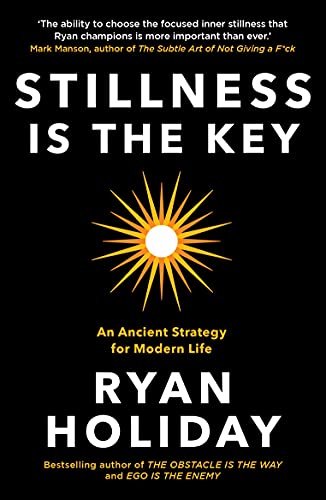
Stillness Is The Key (Ryan Holiday)

Stillness Is The Key was the third of author and modern-day purveyor of Stoic wisdom Ryan Holiday’s original set of books about the application of practicing Stoicism in everyday life. I read (actually listened to) the first two – Ego Is The Enemy and The Obstacle Is The Way – back in late 2017 soon after I started to become interested in Stoicism. Since then I have worked my way through the rest of his more recent output such that I would now probably have to label myself as a committed Ryan Holiday disciple. In 2018 I read The Daily Stoic one day at a time (something I am in the process of repeating this year) and then I listened to the first two volumes of his ongoing Stoic Virtues series – Courage Is Calling and Discipline Is Destiny – in 2021 and 2022 respectively. Last year I completed Lives of the Stoics and I have the third installment of the Stoic Virtues series (Right Thing, Right Now – Justice In An Unjust World) on pre-order for its release later this year. So with all of that in mind it is somewhat odd that it is only now that I have gone back to complete the original trilogy by listening to Stillness Is The Key.

With Ryan Holiday’s work I have always particularly enjoyed listening to the audiobook versions. Not all readers are the right person to narrate their own words but I find that Holiday’s narration brings the words to life and always keeps my attention (usually I am walking to or from work when I listen to audiobooks).

As with all of his other books I enjoyed this dose of Stoic wisdom. Holiday makes the simple wisdom contained in the ancient writings of Epictetus, Seneca and, of course, Marcus Aurelius relevant to life in the present day, treating them like mentors who we can lean upon for advice whenever we feel in need of a slight nudge or some help to become unstuck. The general theme of Stillness Is The Key is, naturally, one of slowing down a little, considering, maintaining a sense of balanced calm and, let’s face it, we could all do with some of that at times (or even often!).

I don’t think Stillness Is The Key is Holiday’s best work. In fact, I think his more recent Stoic Virtues series books are much better crafted than his earlier ones, but then that is surely to be expected as he has lived, practiced and absorbed Stoicism for longer and, I tentatively suggest, become a better writer too as the years have passed. But Stillness Is The Key is still worth reading (or listening to) because above all else it is important to remember that Stoicism is a more than a philosophy – it’s a way of approaching life and something that needs to be practiced, practiced and practiced, day in and day out. Anything that sets out Stoic ideas as clearly as Holiday’s writing and puts them in the front of my mind for a bit is going to help ensure that all of that practice helps to push me a little closer to that impossible to find place where practice makes perfect!