I do not know if my poems are any good, but it seems they help my essence to be understood, whether by others or simply by myself, this last, of course, itself essential for my health.
I do not know if my poems are enjoyable to read, but it seems that crafting them fulfils some vital need, and that allowing thoughts and feelings to gush forth provides a compass I can use to find my north.
It seems as if through searching for each rhyme I’ve stumbled on a way to slow down time, and that now, through sculpting syllable-istic rhythm, I see the world in multitudinous ways – split infinite like sunlight passing through a prism.
And so, once more, I drop into the mine, to chip away and work the line, to trace the seam right to its core, and scrape out all the mineral ore. I hammer hard to split a rock, in hope it is a nugget-bearing block, in hope it might just be the one to hold a precious, piece of sparkling gold.
I do not know if my poems hit the mark, but certainly they’ve lit a spark. So now the flames inside me roar, and I can ask for nothing more.
Here goes… First, time slows, an idea flows, like water spurting from a hose. The seedling grows. The petals unfurl upon the rose.
I take my chance… Falling deep into the trance, where visions glance, words prance, and rhythms dance. And then I emerge, life enhanced.
In those moments, my whole world collapses onto a single spot. So much energy compressed into a tiny dot- freezing cold yet furnace hot. I do not know if my poems are any good. I do not know if my poems are enjoyable to read. I do not know if my poems hit the mark. It matters not.
(c) Tim O’Hare, July 2023
POETRY: I had some nice feedback on the first few poems that I wrote, but as this all came from people that knew me well it was impossible not to feel that it must be biased, even if only subconsciously. I began to think about whether my poems really were any good. This is the kind of thinking that usually drains my motivation and stops me in my tracks. But I have changed a bit in recent months, and pondering this a little more, I was able to acknowledge that whether or not anyone else liked my poems, I enjoyed the process of creating them, and was learning about myself as I did so.
A couple of weeks ago we paid a visit to Make Southwest, an exhibition space for contemporary craft and design and a leading charity for craft education located in the small town of Bovey Tracey on the southern edge of Dartmoor, about 25 miles from our home in Plymouth. It’s a venue that we have visited a few times before – there is always some kind of special exhibition (this time it was a exhibition of contemporary bells called Sound and Silence) and an interesting array of local artwork, books and assorted items to look at in the shop. On this occasion, the reason for our trip was to see a smaller exhibition of wood engraved prints and, in particular, the printmaker Molly Lemon, who had travelled down from her base in Gloucestershire to demonstrate her work. We have encountered Molly at several Craft/Art Events in the last couple of years and always enjoyed viewing, and chatting to her, about her work. We also enjoyed seeing her compete in, and reach the semi-finals of, the Sky Arts TV Series Landscape Artist of the Year a few weeks ago.
Since I started painting about a year ago, whenever I go to any kind of art gallery or art/craft event I particularly enjoy scavenging the work that is on display or sale for ideas that I can try out for myself. Looking at the various pieces of artwork for sale in the shop at Make Southwest, I was particularly enamoured by some tiny pieces of work created by the printmaker Mike Tingle (also here). These were very small (just a few centimetre) square prints on slightly larger squares of rough-edged paper, with a title and the artist’s name written in pencil around the picture (there is an example of a similar kind of picture just below the centre in this piece of work: Dartmoor Box No 1). I really liked the miniature size and somewhat ‘rough’ nature of the pieces and I immediately thought that it would be fun to try to produce something similar using one of my own small Dartmoor Scenes watercolour paintings.
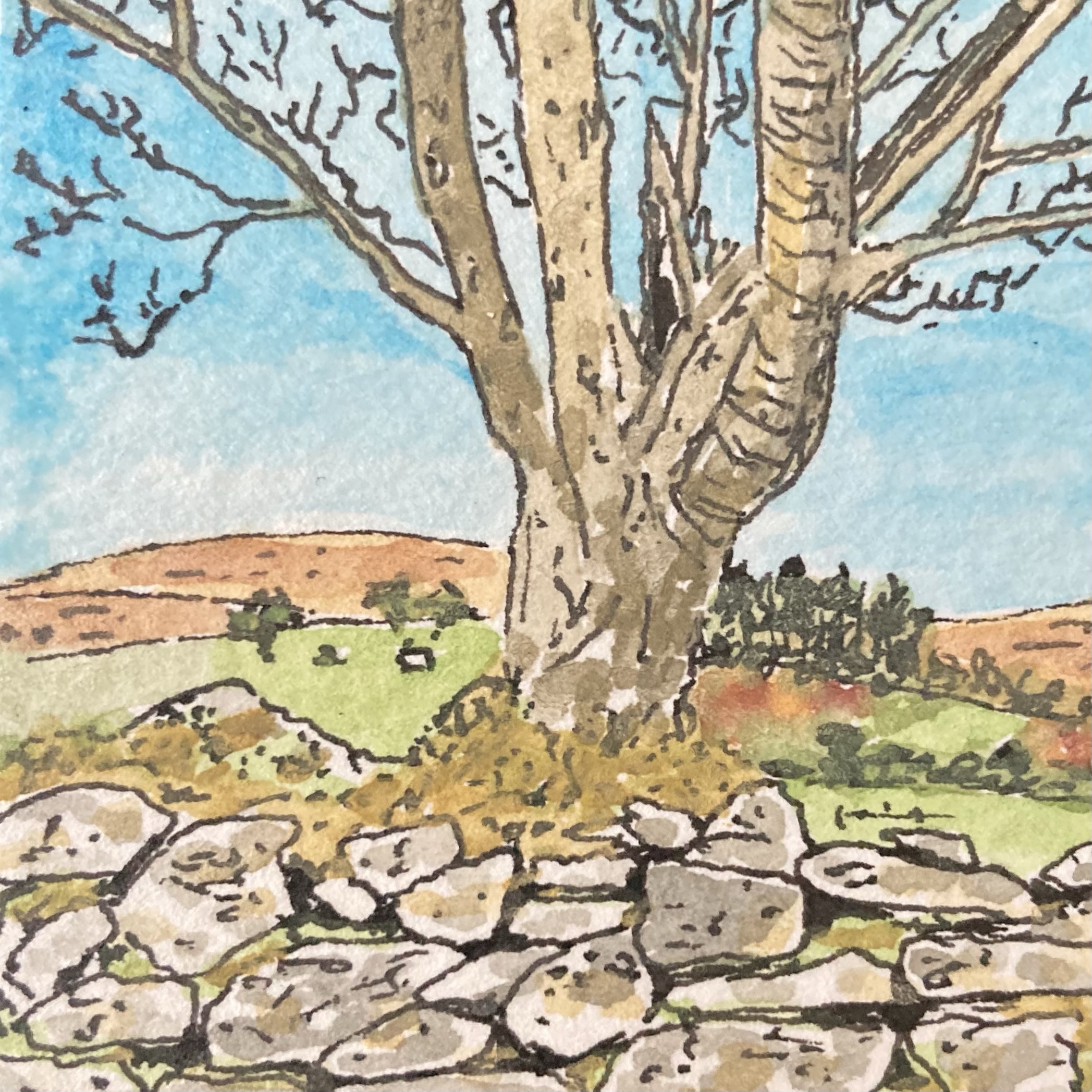
After returning home, I set about seeing what I could produce. First, I selected one of my pictures, opting for this one of a tree growing out of a typical Dartmoor dry-stone wall:
The original picture is a 4.5 cm square ink and watercolour sketch, and my intention was to use our home inkjet printer to make the best quality colour photocopy of it that I could, printing onto a sheet of watercolour paper so that the texture of the original was preserved. I’d already played around with making copies of some of my paintings in this way and so I knew that although the copied versions weren’t quite the same as the originals, with the paler colours tending to wash-out a bit, the process worked pretty well. So far so good.
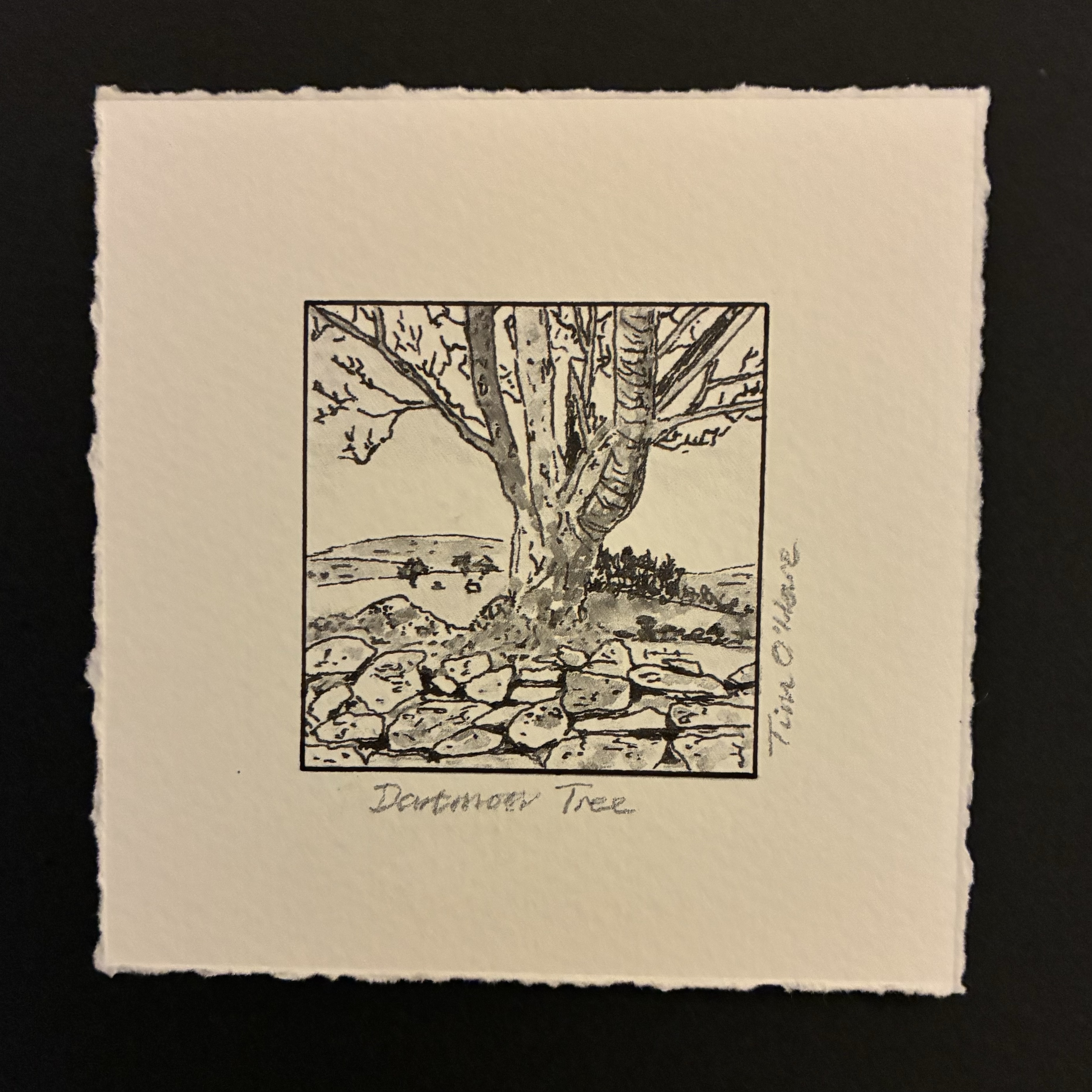
This is the point at which I made my mistake. In the process of making the copy I somehow selected black-and-white printing, and so when I saw what the printer had spat out into the print tray I was instantly annoyed and frustrated. To make matters worse, because the original picture was on a small square of fairly thick paper, as the scanning light moved below the copier glass a dark shadow line was cast on one side of the copied picture. Not only did I only have a black-and-white copy, but I had a black-and-white copy that had a dark line along one of its edges. What a waste of a sheet of paper and ink…
However, once I had overcome my initial disappointment and self-censure, I decided to press on with the rest of my production process and see what the end result looked like. I had intended that there would be no border between the picture and the surrounding area of paper, but now there was that dark line along one side spoiling that design idea. What could I do? Well, go with the mistake of course. I took my drawing pen and with the aid of a straight edge and a lot of care, I inked in a similar line on the other three sides. Hmmm… it didn’t look as I had planned but I liked the result. Then I measured out a wider border, and again aided by a straight edge, I tore the paper down to size. This part of the process is something that I have found takes a lot of care… if the tear is too sharp you don’t get the nice rough edge I was after, but if you are at all rushed and loose you end up with something that looks clumsy and careless. Fortunately, I managed to do a good job. Finally, I grabbed a soft pencil and quickly wrote a title below the bottom edge and my name on the right-hand side…
The result of this endeavour was the small picture shown at the top of this post and, despite my black-and-white and shadow mistakes in the copying process, I’m really pleased with the end result, so much so, in fact, that I intend to take the rest of my Dartmoor Scenes pictures and treat them in the same fashion. Even better, not only did I end up with a new picture that I really liked and the discovery of a new way to transform existing pictures into a different, somewhat distinctive, form, but I also gave myself a great reminder that making mistakes in life is not always a bad thing. In fact, sometimes, as in this case, a mistake can open up a different path from the one that was intended that leads you towards an unexpected but interesting, exciting or enjoyable destination!
At work, I am part of the supervisory team for a part-time PhD student who is trying to explain the relatively recent (2001) appearance of a tree bumblebee Bombus hypnorum in the U.K. My involvement in the project arose because one possibility for explaining how these bees made the hop across the English Channel from mainland Europe is that they might have been carried over be easterly or southeasterly winds. As the only person who teaches some meteorology in my department I was drawn into discussions at the outset of the project about 5 years ago, and my involvement has continued ever since.
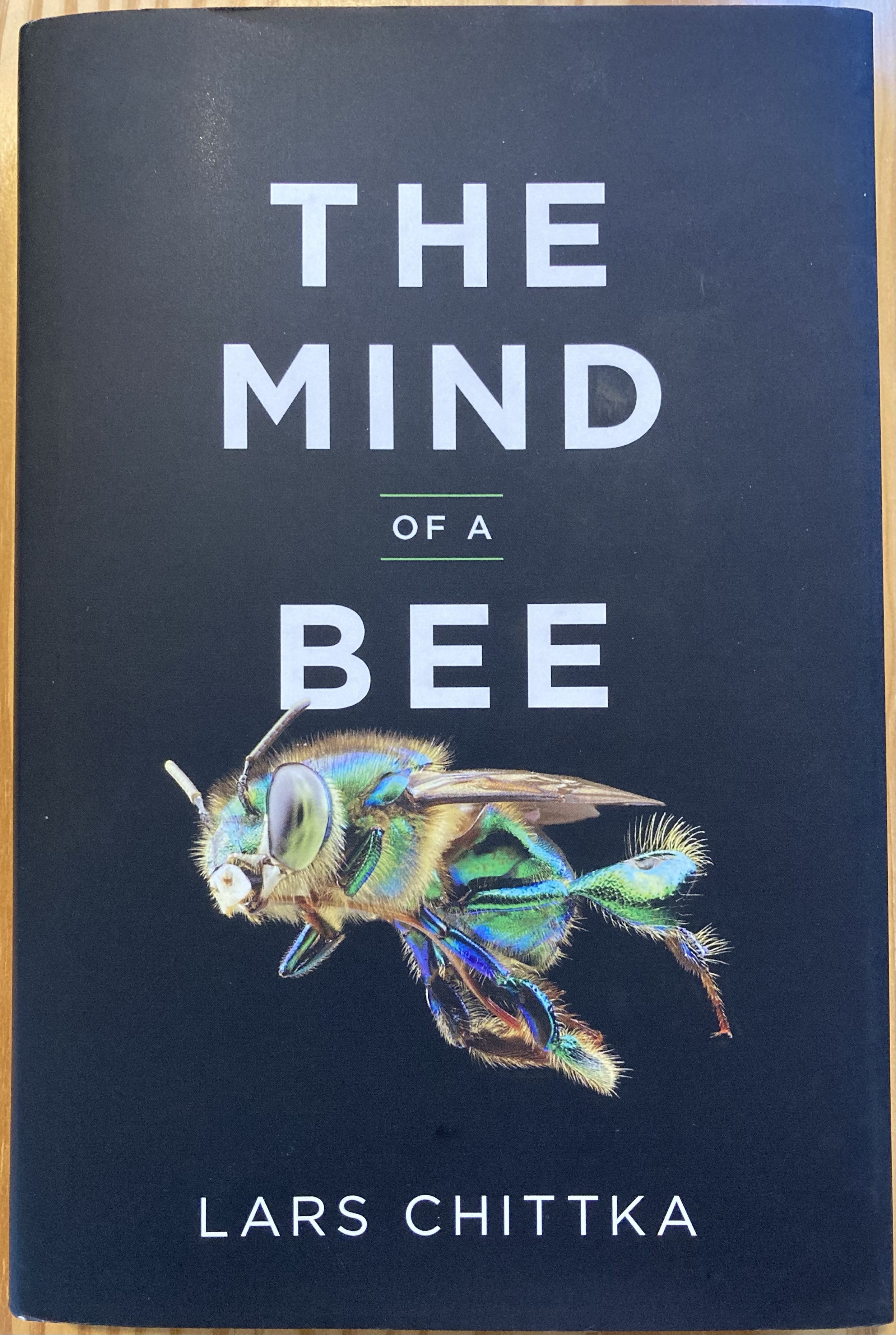
What do I know about bees? Almost nothing… I completed an ‘O’ Level in Biology back in 1981 but I don’t recall bees ever being a topic that we learned about. Since then, although I have a general interest in natural history, I can’t say that I have thought about bees very much. But sometime around 2017 or 2018, the bird box in our garden was taken over by bees, I mentioned this to my the Head of School (who does know about bees), learned that most bumblebees nest in holes in the ground but that some, like my ones, were tree bumblebees, and from there I gradually became enmeshed in the ongoing attempt to explain why one type of these tree bumblebees had suddenly appeared in the U.K. Eventually, I decided I really should get to know a bit about more about bumblebees and that led me first to read Dave Goulson’s book ‘A Sting In The Tale’ (in June 2022) and then at the start of this year, Lars Chittka’s book ‘The Mind of a Bee’.
‘The Mind of A Bee’ was a fascinating book, covering bees’ sensory capabilities, instinctual behaviours, intelligence, communication systems, spatial memory and navigational capabilities, learning, brain structure, personality and consciousness. Packed with easily understandable summaries of a huge of scientific experiments and interesting background information about the scientists that conducted them, ‘The Mind of a Bee’ leaves no room for doubt that despite their small size, bees brains are capable of many astounding feats and that the bees themselves are highly complex animals with many sophisticated behaviours and skills.
The part of the book that interested and intrigued me most was the section early on about sensory capability and, in particular, bee vision. Bee vision is shifted to shorter wavelengths than human vision which means that bees can ‘see’ in the ultra-violet part of the electromagnetic spectrum and are effectively red-blind (which explains why red flowers are relatively rare in European fauna [research has also shown that flower colours have adapted to match insect vision and not the other way around as would perhaps seem more intuitive]). Bee vision is also trichromatic (UV, blue, green) and bee brains mix these three colours in the same way that human brains mix red, green and blue, ending up with a mixed colour that is indistinguishable from pure light at the relevant frequency. Apparently, this is unusual… and it is also very different from the way that we perceive sound, where we can perceive many frequencies at the same time so that we hear chords, harmony and dissonance. This difference arises because we have thousands of auditory receptors responding to different frequencies. I found it fascinating to think about what sound would be like if we could only sense three frequencies and mixed them to make a single note and what vision would be like if we saw objects as chords of different coloured lights. To be honest, my mind was a bit blown by thinking about all of this!
Reading ‘The Mind of a Bee’ certainly gave me a lot of insight into the brains, behaviours and learning capabilities of bees. It’s certainly a book that opens up the mind of the human that reads it and makes that mind think about just how different the game of life can be for different animals.
 Tim O'Hare