
Some time ago, something like 10 years ago to be more precise, the basic idea for a children’s adventure story popped into my head. It was really just the bare bones of a story – a title (Empedocles’ Children), an underlying basis for the story, a vague idea of the way that it would conclude, and a fairly detailed visual image of the event that would launch the reader into the action. At some point, fairly early on, I wrote out a version of the first chapter, but once those words were out of me, I didn’t do much to make further progress. In the meantime, fragments and ideas for the story would pop into my head at random moments, often resulting in me excitedly exclaiming to whoever was in the vicinity that: “I have just had a great idea for my book when I write it”. I think this must have happened quite a lot and over an extended period (years) because eventually, after one such utterance, my younger daughter (who would have been in her late teens at the time) responded with the rather cutting, but entirely fair, response: “Well that will never happen.”
But, eventually, I did begin to make progress, producing several more chapters in 2021 and then, in a series of bursts of creativity that became gradually longer, more frequent and more reliable, I found myself approaching the end of the story. Along the way I found the process of writing the story an absolutely fascinating one. Whether it is the ‘right’ or ‘best’ way to approach things or not (and it is probably not), I wrote the story without any kind of outline or plan, other than knowing a little about where the main characters in the story (four children called Conlaed, Yara, Tal and Karin) had to end up, and a final climax to the story that became gradually sharper in my mind as it approached. Instead, I simply sat myself down and let the story emerge. When I talk to people about this process I usually use one of two analogies – that story writing is like find a seam of precious ore and then chipping away to follow it through the surrounding rock, or that it is like gently pulling on a thread to tease it from a knotty bundle. I also tended towards thinking that even though I didn’t know how the story would unfold, I could trust my characters to show me. In that sense, I was simply following them on their journey, and describing the events that befell them as I did so. At times, it was hard to escape the feeling that the story (stories in general) are already ‘out there’ and that the task of a writer is to find (not create) one and then reveal it to others.
A couple of months ago I reached the point where I had a full draft of the story, and I then spent some time reading it through to check for errors, omissions and inconsistencies and to make any corrections and revisions that were necessary. I spent quite a lot of time going and back and forth with the dialogue, struggling a bit to work out the best way to format this (which I found difficult because there does not seem to be a standard method for presenting dialogue, something that surprised me a lot). Then, with a final draft version completed I was left wondering what, exactly, I should do next with all of those words. And there were a lot of them, a whopping 110,000 or so in fact, because the final version came at with 48 chapters (plus a prologue, interlude and epilogue).
I’m still not quite sure what I will do next with my manuscript. I know that I can go down a self-publishing route fairly quickly and easily – I have already got the text in a ‘flowable’ format suitable for e-readers. I also know that to try to get a book published by a traditional publisher first requires gaining the interest of a Literary Agent, something that seems to be incredibly difficult – so I know that that route is both difficult and unlikely to be successful. My instinct is that I want to at least try to go down the traditional publishing route and see what happens, and so at the moment I am working my way through various materials that should help me engage with that process. At some point, I might actually get to the stage of having written a synopsis, a query letter, identified comparative titles (‘comps’), drawn-up a long-list of suitable agents to query, and a short list for a first batch of submissions. Then all it will take is a bit of bravery and a willingness to suffer rejection…
In the meantime, I decided that one of the issues with writing (certainly these days when writing on a computer) is that once you have finished your story you have nothing physical to show for your efforts. With this in mind, I spent a week or two putting my text into an attractive, ‘proper’ book format, painted some pictures to use as cover art, and then I sent it off to a printing company to get a few copies of it as a properly printed paperback book. Now, even if I make no further progress towards publishing it at all, I can, at least, glance at my bookshelf and see a nice fat paperback sitting there that I produced. Just that thought is rather satisfying and it allows me to inwardly respond to my daughter’s statement, “that will never happen”, with the words “but look, it did!”
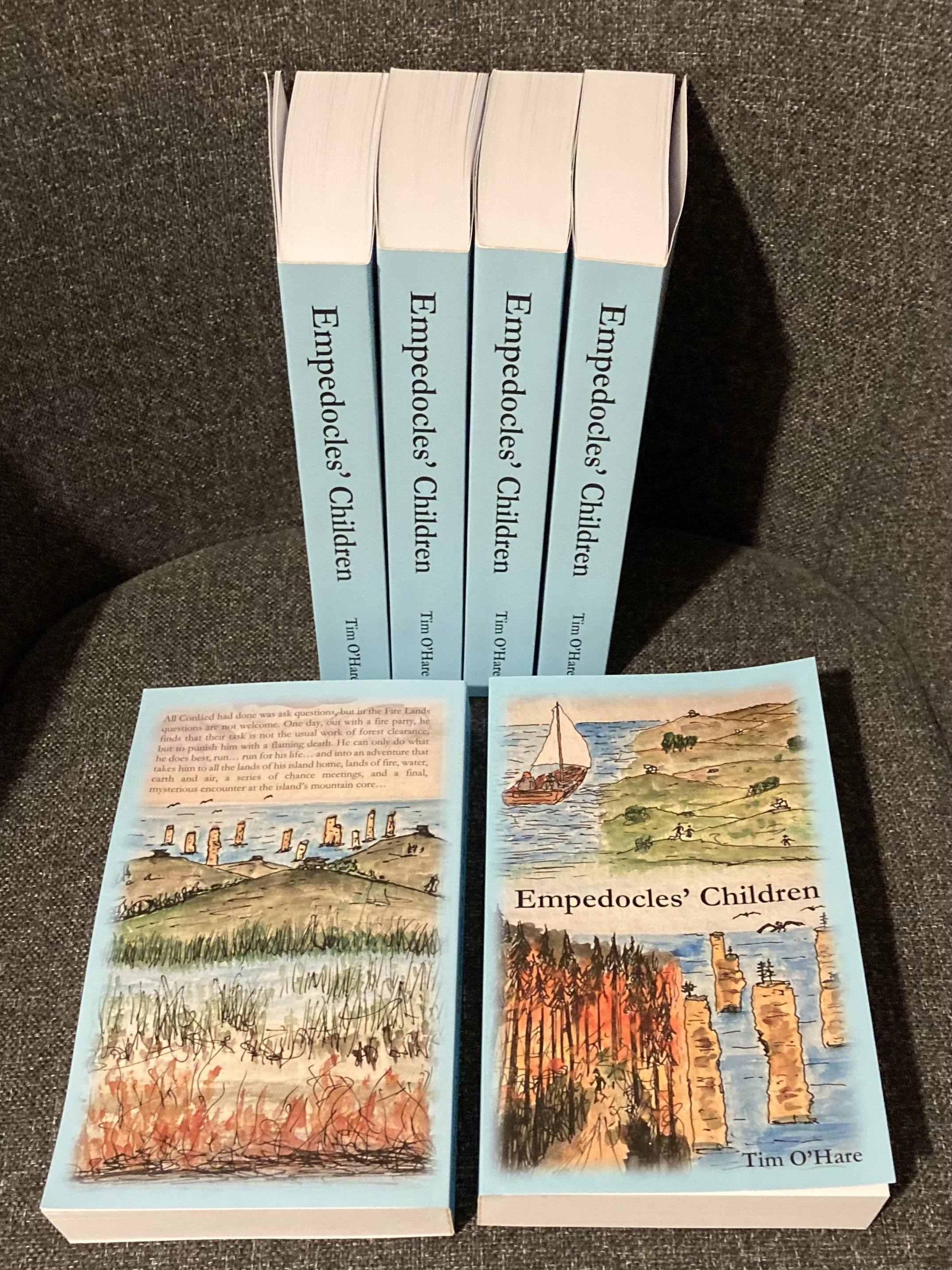
If anyone reading this thinks that they’d like to be a test reader then please do get in touch. The story follows a group of children who are brought together as they travel through a disintegrating island realm, facing all kinds of natural challenges – fire, floods, earthquakes, volcanic eruptions and landslides – as they are gradually drawn towards the mountain that sits at the island’s core and, unknowingly to a meeting with a strange philosopher-hermit who must share the wisdom that will allow the fractured peoples of the island to come together to re-build their world. I think that the book would probably be put into the ‘middle grade’ of perhaps ‘9-12 age group’ categories but honestly, it’s a fun adventure with lots of twists and turns that adults should enjoy too – I certainly did!
 Tim O'Hare