Swallows and Amazons – Arthur Ransome #reading

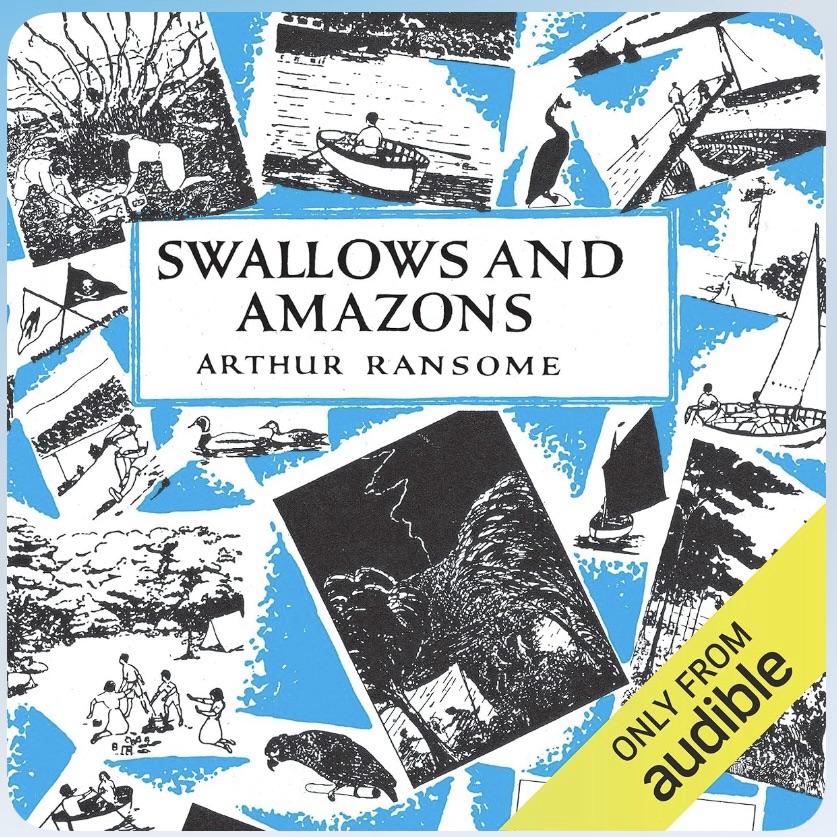
I listened to the audiobook of Swallows and Amazons, Arthur Ransome’s classic novel for children during the period from late March through to early June this year. It was a fairly long process, almost 9 hours of listening, accomplished mostly on my walks to and from work. There were two reasons for my choice of listening, the first linking to my desire to read explore more novels for children as I tried to find stories that were in any way comparable to my own attempt at a children’s adventure story (something that I have written about in my post on Cornelia Funke’s book The Thief Lord), and the second being that Swallows and Amazons was a suitable ‘R’ pick as I worked my way, for the second time, through an alphabet of author surnames in James Mustich’s wonderful book ‘1000 Books To Read Before You Die’.

Swallows and Amazons is, of course, a very well known title, and for many people it is a much-loved one. But despite its name being very familiar to me, I had never previously read a single word of it. I had a vague idea of what it was about – a bunch of kids having adventures on a boat – but for some reason I thought it was set in the Norfolk Broads rather than the Lake District.

The story revolves around the adventures of four siblings, conveniently, to give a nice balance, two boys and two girls – John, Susan, Titty and Roger – as they spend a summer holiday camping on an island in the middle of a lake and sailing their boat, Swallow, around and about each day. Published in 1930, the children unsurprisingly fall into neatly gender-stereotyped and age-constrained roles, John is very much the responsible old-head, and, naturally, captain of the Swallow. Susan, next oldest, and mate of the Swallow fulfills the ‘mother’ role, taking great care and pride in keeping their camp tidy, preparing meals and keeping the younger children in order. Titty, the younger sister, is the Able Seaman and, it turns out, a little bit of a rebel (the privilege of youth!). Finally, Roger, the baby of the family and ship’s boy, is very much treated as the youngest – being taught how to swim, sometimes being allowed to stay up late or accompany the others as a special treat, and frequently falling asleep.

The main action in the story involves the Swallows interactions with two local children, Nancy and Peggy Blackett, captain and mate of their own boat Amazon, and very much portrayed as rather unsophisticated and down-to-earth locals, in comparison to the rather ‘smart’ Walker children. Initially, the relationship between the Swallows and the Amazons is somewhat hostile but, as you might expect, they end up joining forces, first against the Blackett’s uncle James, who lives in a houseboat on the lake and seems to be inexplicably grumpy and awkward, and then against some rather unsavoury characters who they become embroiled with. Throughout the story it is very much John and Nancy who are held up as the masters of the craft of sailing their boats and leading the adventures, but in the end it is young Titty who turns out to be the real star.

Listening to the audiobook of the story was quite an odd experience. The attitudes and happenings of the story are very dated, and I will admit that the constant references to Titty took some getting used to. The story is absolutely chock full of nautical references to the extent that practically everything the children do is rendered in nautical-speak – for example, everyone else is a pirate or a landlubber, they are constantly jibing or backing the mainsail or trimming the freeboard, and everything they drink becomes grog. All of these things – the datedness, the setting, the obscure language – left me wondering how it could be that, more than 90 years after its publication, Swallows and Amazons is still often lauded and recommended as a story for modern children. Perhaps there is some innate craving for a return to the semi-wild that a child can connect with, even if they (probably) haven’t got a clue about one end of a boat from another, and almost certainly have no idea whatsoever what ‘pemmican’ is!

So did I enjoy Swallows and Amazons? Would I recommend it?

Well, let’s be honest, Swallows and Amazons wasn’t written to entertain an almost 60 year old man with limited interest and experience in sailing, reading it 95 years after it was set and published. It’s probably not surprising then, that I would have to say that I was left underwhelmed… But maybe if I was 12 years old with my thoughts turning to imagined adventures and challenges, and yearning to escape from the constraining influence of the adults in my world I might have felt differently. Then perhaps, I would have leapt onboard at the chance to join John, Susan, Titty, Roger, Nancy and Peggy as they hoist their flags, cast off and allowed the wind to fill their sails and send them racing across the lake in pursuit of their next adventure!
The Thief Lord – Cornelia Funke #reading

Since I finished writing my children’s adventure story, Empedocles’ Children, earlier this year, I have been exploring the various avenues through which I might eventually get it published. By far the most likely is that I will end up self-publishing Empedocles’ Children as an eBook and print-on-demand paperback, largely because to get a book out into the world via a traditional publishing route you have to first be successful in gaining the interest of a Literary Agent and, by all accounts, the chances of that happening are pretty minimal… As a result, I am adopting the working assumption that the doors to traditional publishers will remain firmly closed to me, but that doesn’t mean that I am not going to give that route to publication a try, in fact I have already started, having worked my way through an online course from Jericho Writers called ‘How To Get A Literary Agent’. About a month ago, following the approach suggested in that course, I sent off ‘query letters’, accompanied by a one-page synopsis and whatever portion of the manuscript the agent requested querying authors to send (usually the first three chapters), to eight Literary Agents. My plan is to send off a further set of query letters to another group of eight agents sometime in September, and then complete a final set of eight submissions in November(ish). The logic of this staged approach to submissions is that it provides the opportunity to modify the submission made to the later groups of agents on the basis of any responses (or lack of responses) received from the earlier one.

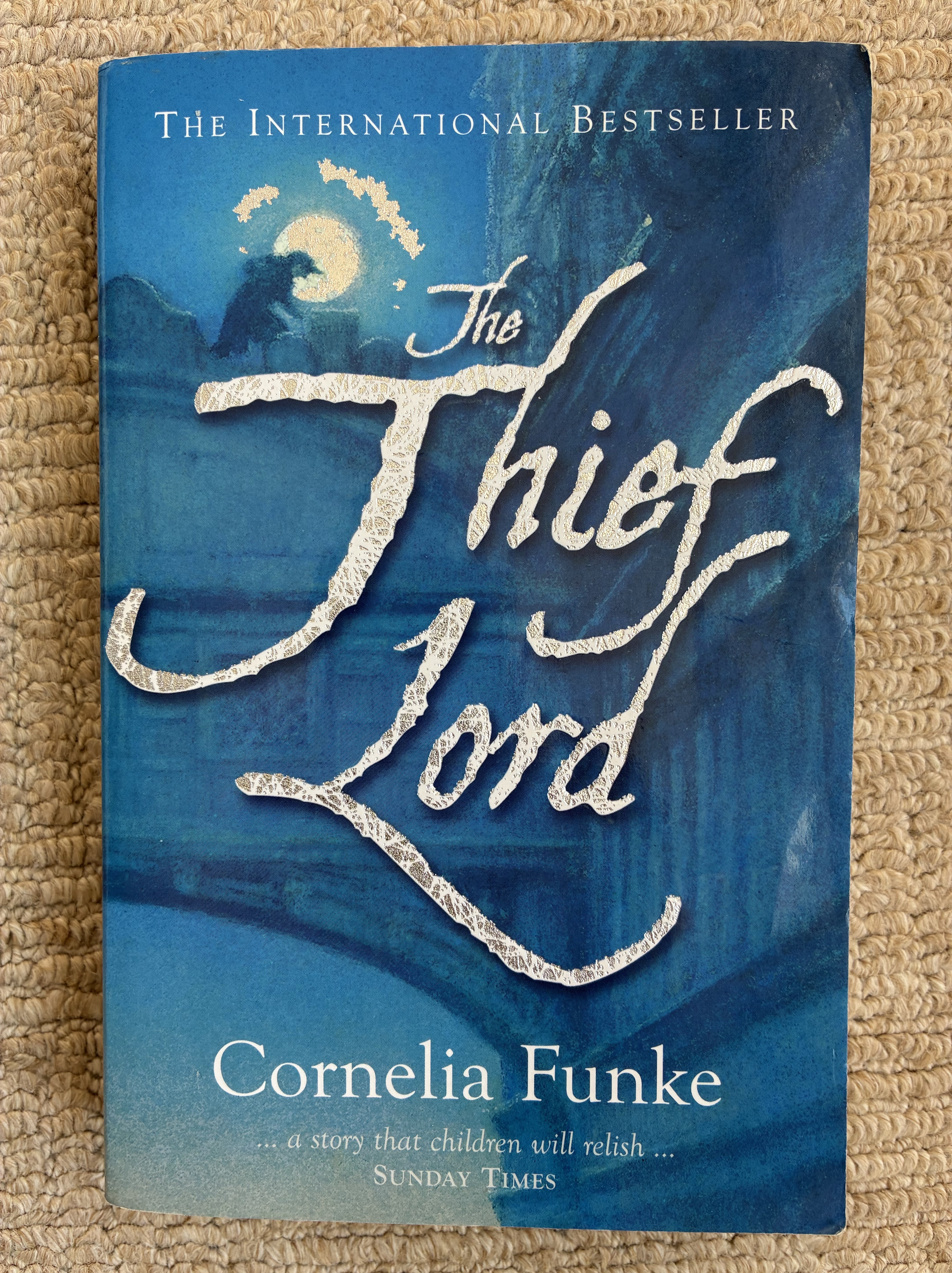
But what has any of this got to do with Cornelia Funke’s children’s novel The Thief Lord? The answer is that one of the things Literary Agents generally ask is that authors liken their work to what are termed ‘comparative titles’ (or ‘comps’). This is supposed to be a good way of the author showing where their book fits into the market (and that they know where their book fits into the market), and so help the agent decide whether or not it might be the kind of book that they want to represent and think they can sell to a publisher. With this in mind, before I could finalize my submission package I had to try to come up with a few such comps. Since I don’t routinely read children’s fiction, I spent a long time perusing the shelves of the local bookstore, but this didn’t really help me much because it seems to me that almost all new children’s books now feature magic, witches and wizards, dragons and suchlike. I also decided that I should try to get into the habit of reading some children’s fiction, and so when I stumbled upon a copy of The Thief Lord in a charity shop, I grabbed the opportunity to read a title by one of the most successful writers for children of recent decades.

The story of The Thief Lord is set, rather randomly, in Venice, and follows two orphaned boys, Prosper and his younger brother Boniface who have travelled from Germany after escaping from the clutches of their rather severe aunt who only wants to adopt the younger Boniface. In Venice, the two boys fall in with a group of street children led by the super confident, and extremely talented ‘Thief Lord’, Scipio. The first half of the book sees Prosper and Boniface become steadily more drawn into the group and their schemes to steal items to sell on, often to a corrupt antique dealer Barbarossa. The story hangs together pretty well and I found it a fairly enjoyable read…

…but then in the second half of the story, everything turns a bit weird. The group of children, rather improbably end up being befriended by a woman, Ida Spavento, whose house they were trying to rob, and then the plot suddenly takes Prosper and Scipio to an island where they find a merry-go-round that magically changes the age of those who ride it. I won’t spoil the story by saying who rides it and the extent to which they become younger or older, suffice to say that two of the main characters undergo contrasting permanent transformations after the merry-go-round breaks, trapping them at their new ages. I found the whole of this section of the book to be rather random – as if Funke knew that she wanted (or needed) to put a surprise twist into the book but hadn’t really worked out how to embed it into the story that she was in the process of writing. However, I’m an almost-60-year-old adult and The Thief Lord clearly wasn’t written for someone like me. Perhaps younger readers like (or liked, The Thief Lord was published in 2002) stories that change tack quite radically partway through. Who knows?

Overall, I quite enjoyed reading The Thief Lord, but I didn’t find it particularly satisfying. Interestingly, according to the Wikipedia entry for the book, a review in Publishers Weekly ‘found fault with the pacing’, a comment which matches up well with my own feelings about the story. In the end, I wasn’t left much the wiser in terms of finding a comp for my own book, although there is some similarity in the way that our stories unfold as they go along rather than following some obvious up-front structure or plot. I think there is also some similarity in the way that the stories bring together a group of children with different backgrounds and attributes. But in most respects the two books are very different, not least because Funke’s book has been published, translated into different languages, turned into a film (albeit apparently not a good one) and sold many thousands of copies, whereas my book hasn’t been published, hasn’t been translated, hasn’t been turned into the film and hasn’t sold a single copy…

…yet!

The Time Crackers – progress update #writing

Some time ago (by which I mean years, not weeks or even months), well before I had finished writing the final draft of my children’s adventure story Empedocles’ Children, I had the idea for another children’s book – The Time Crackers. Empedocles’ Children ended up as a fairly weighty tome, coming in at around 110,000 words and (probably) best suiting readers towards the upper end of what is termed ‘middle grade’ (ages 8-12). I hadn’t particularly aimed it at that reading level, it just turned out that way, but for The Time Crackers, I felt that the story would connect best with slightly younger children, and decided that I would make a conscious effort to keep the chapters short and ensure that the story was snappy and moved along at a good pace.

Without giving too much away, the basic premise of The Time Crackers centres around two children who discover a portal through which they shift to the same location but at a specific time at which an important (real) historical event takes place there. They are able to move back and forth between the historic and modern time periods (as long as they keep hold of the ‘key’ of course, which is tricky when they don’t even know that one exists…). Then, while they are in the historical setting, they get caught up in an adventure that requires them to solve a coded puzzle which then leads them to take action to ensure that the history unfolds as it should do.

At the outset I had the basic premise of the story, the location and its associated historical setting and event, and an idea for the initial incident that brings the two children to discover the time-crossing portal (the setting is Plymouth and the historical setting is the late 16th century so you can probably guess the historical event!). I also had the idea for a second location, and an association with a completely different historical period, and so I can quite imagine that by the time I have finished it, The Time Crackers will have become The Time Crackers 1:….., the first story in The Time Crackers series.

I started writing the first chapter of The Time Crackers (‘Flashback’) at least a year ago (probably more) and managed to add two more chapters (‘The New Girl’ and ‘Target Practice’), reaching the point in the story where the two children, Jim and Mols, have been introduced (to the reader and to each other), we have got to know a little bit about Jim, his character and his home set-up, and things were nicely set up ready for the trigger incident that leads Jim and Mols to discover the time portal. But then, as is often the way with me, things ground to a halt as I got busy, diverted my attention towards other creative projects (such as my discovery of painting 14 months ago), or just succumbed to the chronic procrastination that is the bane of my life. Whatever the reason, the ability to sit down and write new words eluded me…

… until yesterday, when, without too much effort, I finally opened and re-read Chapter 3, decided that it was essentially complete and then found that sentences were emerging in my brain and flowing smoothly to my fingers and then onwards onto the screen as I launched myself into Chapter 4 (‘Noises In The Dark’). The result was that after about 30-40 minutes I had harvested the next 800 or so words of the story, and in the process, advanced the story almost to its pivotal moment, the accidental discovery of the time portal. That moment deserves to be the focus of Chapter 5, but before I can find out exactly how events unfold, I need to go back into Chapter 4 and flesh it out with another an additional few hundred words so that it balances the length of the previous chapters a bit better. I had been hoping to do that today, but alas, I managed to divert my attention into other projects instead. I am not sure whether this was a piece of deliberate self-sabotage, my brain opting not to even try to write just in case the well had run dry, or whether it was just the way of things. What I do know is that I really would like to press on with writing this story, because I am excited to see how it unfolds and to discover what thrills and scrapes Jim and Mols get themselves into as they try to solve The Mystery of Drake’s Drum.

Empedocles’ Children – progress update #writing

Some time ago, something like 10 years ago to be more precise, the basic idea for a children’s adventure story popped into my head. It was really just the bare bones of a story – a title (Empedocles’ Children), an underlying basis for the story, a vague idea of the way that it would conclude, and a fairly detailed visual image of the event that would launch the reader into the action. At some point, fairly early on, I wrote out a version of the first chapter, but once those words were out of me, I didn’t do much to make further progress. In the meantime, fragments and ideas for the story would pop into my head at random moments, often resulting in me excitedly exclaiming to whoever was in the vicinity that: “I have just had a great idea for my book when I write it”. I think this must have happened quite a lot and over an extended period (years) because eventually, after one such utterance, my younger daughter (who would have been in her late teens at the time) responded with the rather cutting, but entirely fair, response: “Well that will never happen.”

But, eventually, I did begin to make progress, producing several more chapters in 2021 and then, in a series of bursts of creativity that became gradually longer, more frequent and more reliable, I found myself approaching the end of the story. Along the way I found the process of writing the story an absolutely fascinating one. Whether it is the ‘right’ or ‘best’ way to approach things or not (and it is probably not), I wrote the story without any kind of outline or plan, other than knowing a little about where the main characters in the story (four children called Conlaed, Yara, Tal and Karin) had to end up, and a final climax to the story that became gradually sharper in my mind as it approached. Instead, I simply sat myself down and let the story emerge. When I talk to people about this process I usually use one of two analogies – that story writing is like find a seam of precious ore and then chipping away to follow it through the surrounding rock, or that it is like gently pulling on a thread to tease it from a knotty bundle. I also tended towards thinking that even though I didn’t know how the story would unfold, I could trust my characters to show me. In that sense, I was simply following them on their journey, and describing the events that befell them as I did so. At times, it was hard to escape the feeling that the story (stories in general) are already ‘out there’ and that the task of a writer is to find (not create) one and then reveal it to others.

A couple of months ago I reached the point where I had a full draft of the story, and I then spent some time reading it through to check for errors, omissions and inconsistencies and to make any corrections and revisions that were necessary. I spent quite a lot of time going and back and forth with the dialogue, struggling a bit to work out the best way to format this (which I found difficult because there does not seem to be a standard method for presenting dialogue, something that surprised me a lot). Then, with a final draft version completed I was left wondering what, exactly, I should do next with all of those words. And there were a lot of them, a whopping 110,000 or so in fact, because the final version came at with 48 chapters (plus a prologue, interlude and epilogue).

I’m still not quite sure what I will do next with my manuscript. I know that I can go down a self-publishing route fairly quickly and easily – I have already got the text in a ‘flowable’ format suitable for e-readers. I also know that to try to get a book published by a traditional publisher first requires gaining the interest of a Literary Agent, something that seems to be incredibly difficult – so I know that that route is both difficult and unlikely to be successful. My instinct is that I want to at least try to go down the traditional publishing route and see what happens, and so at the moment I am working my way through various materials that should help me engage with that process. At some point, I might actually get to the stage of having written a synopsis, a query letter, identified comparative titles (‘comps’), drawn-up a long-list of suitable agents to query, and a short list for a first batch of submissions. Then all it will take is a bit of bravery and a willingness to suffer rejection…

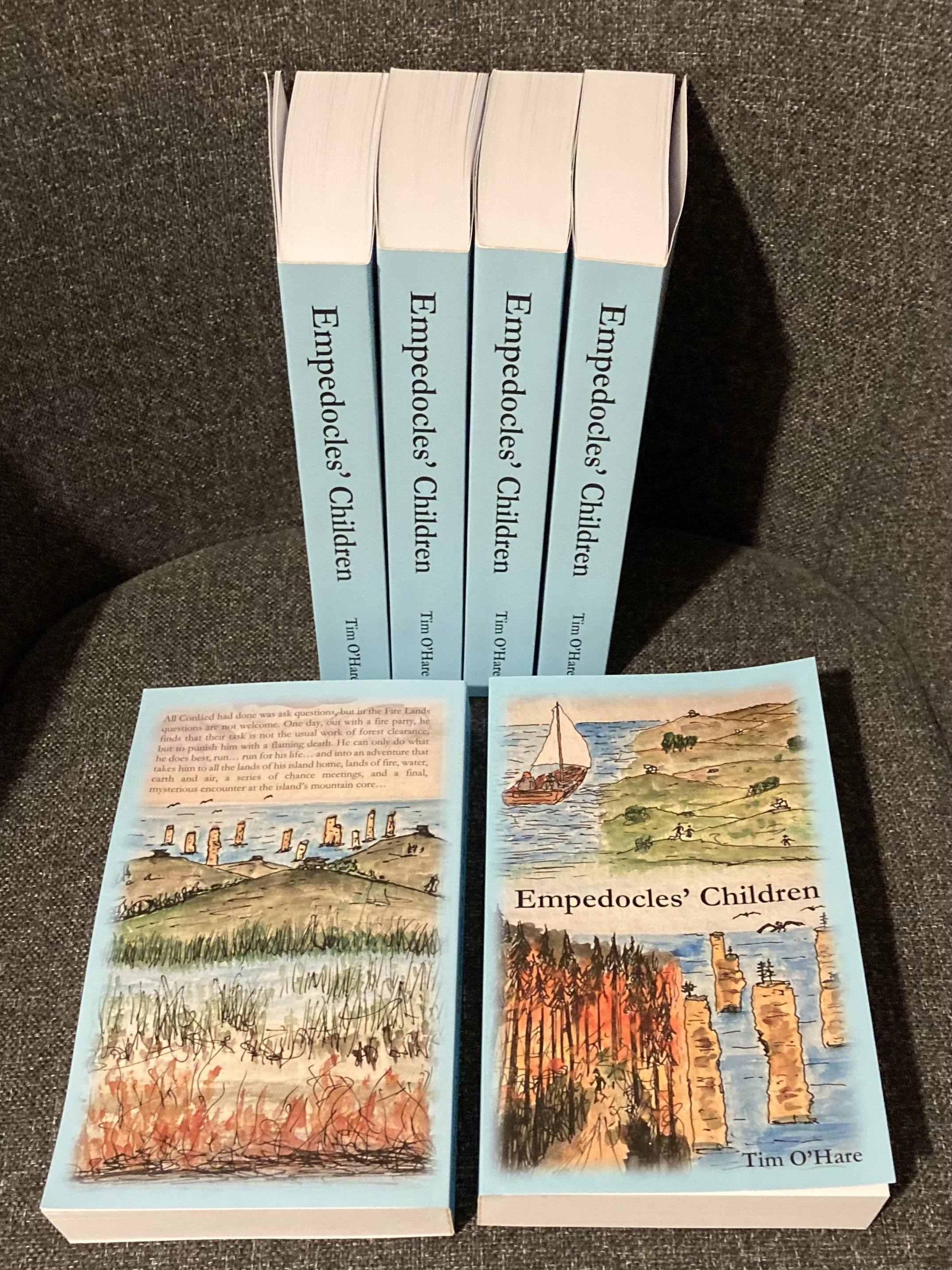
In the meantime, I decided that one of the issues with writing (certainly these days when writing on a computer) is that once you have finished your story you have nothing physical to show for your efforts. With this in mind, I spent a week or two putting my text into an attractive, ‘proper’ book format, painted some pictures to use as cover art, and then I sent it off to a printing company to get a few copies of it as a properly printed paperback book. Now, even if I make no further progress towards publishing it at all, I can, at least, glance at my bookshelf and see a nice fat paperback sitting there that I produced. Just that thought is rather satisfying and it allows me to inwardly respond to my daughter’s statement, “that will never happen”, with the words “but look, it did!”

If anyone reading this thinks that they’d like to be a test reader then please do get in touch. The story follows a group of children who are brought together as they travel through a disintegrating island realm, facing all kinds of natural challenges – fire, floods, earthquakes, volcanic eruptions and landslides – as they are gradually drawn towards the mountain that sits at the island’s core and, unknowingly to a meeting with a strange philosopher-hermit who must share the wisdom that will allow the fractured peoples of the island to come together to re-build their world. I think that the book would probably be put into the ‘middle grade’ of perhaps ‘9-12 age group’ categories but honestly, it’s a fun adventure with lots of twists and turns that adults should enjoy too – I certainly did!