
At work, I am part of the supervisory team for a part-time PhD student who is trying to explain the relatively recent (2001) appearance of a tree bumblebee Bombus hypnorum in the U.K. My involvement in the project arose because one possibility for explaining how these bees made the hop across the English Channel from mainland Europe is that they might have been carried over be easterly or southeasterly winds. As the only person who teaches some meteorology in my department I was drawn into discussions at the outset of the project about 5 years ago, and my involvement has continued ever since.
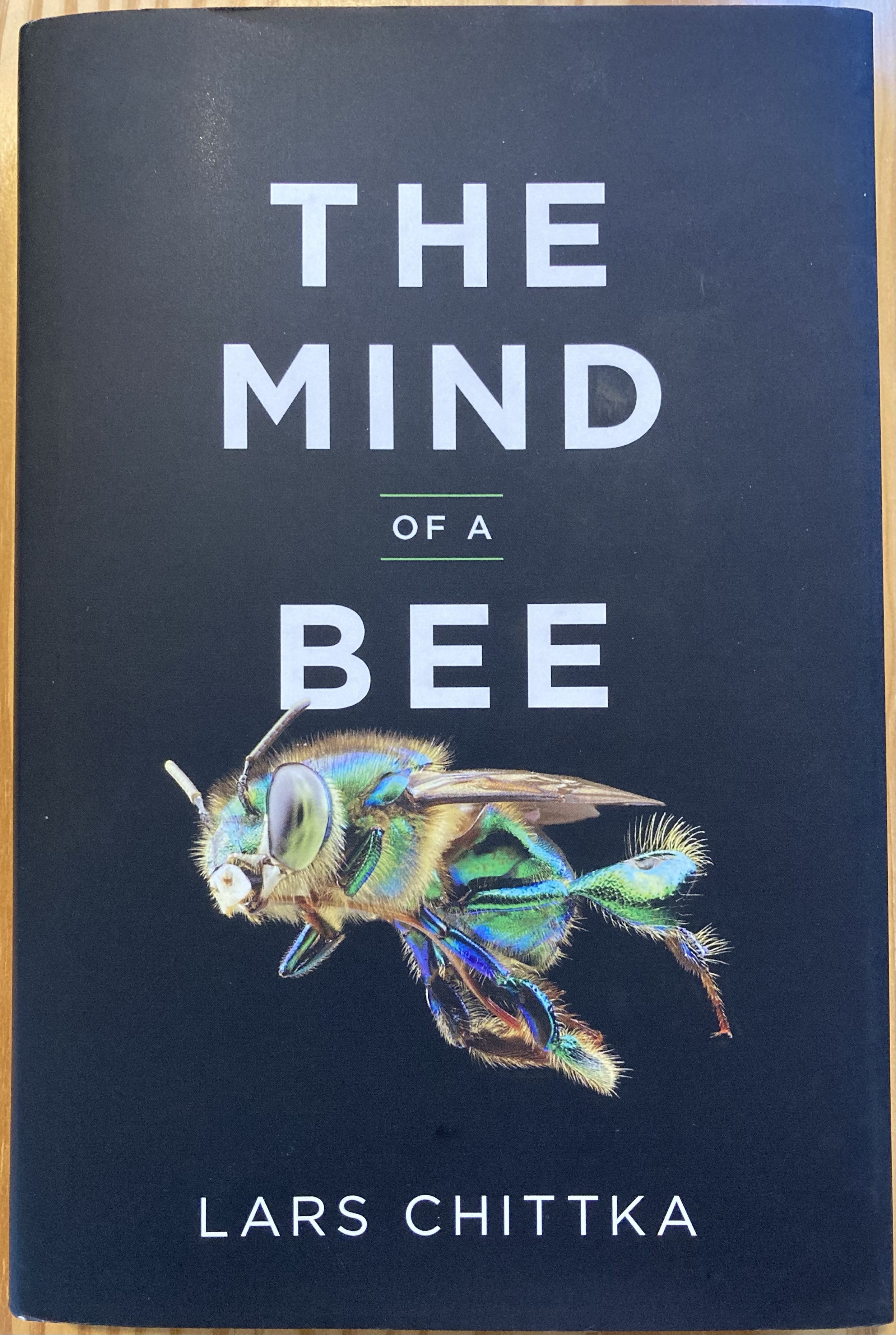
What do I know about bees? Almost nothing… I completed an ‘O’ Level in Biology back in 1981 but I don’t recall bees ever being a topic that we learned about. Since then, although I have a general interest in natural history, I can’t say that I have thought about bees very much. But sometime around 2017 or 2018, the bird box in our garden was taken over by bees, I mentioned this to my the Head of School (who does know about bees), learned that most bumblebees nest in holes in the ground but that some, like my ones, were tree bumblebees, and from there I gradually became enmeshed in the ongoing attempt to explain why one type of these tree bumblebees had suddenly appeared in the U.K. Eventually, I decided I really should get to know a bit about more about bumblebees and that led me first to read Dave Goulson’s book ‘A Sting In The Tale’ (in June 2022) and then at the start of this year, Lars Chittka’s book ‘The Mind of a Bee’.
‘The Mind of A Bee’ was a fascinating book, covering bees’ sensory capabilities, instinctual behaviours, intelligence, communication systems, spatial memory and navigational capabilities, learning, brain structure, personality and consciousness. Packed with easily understandable summaries of a huge of scientific experiments and interesting background information about the scientists that conducted them, ‘The Mind of a Bee’ leaves no room for doubt that despite their small size, bees brains are capable of many astounding feats and that the bees themselves are highly complex animals with many sophisticated behaviours and skills.
The part of the book that interested and intrigued me most was the section early on about sensory capability and, in particular, bee vision. Bee vision is shifted to shorter wavelengths than human vision which means that bees can ‘see’ in the ultra-violet part of the electromagnetic spectrum and are effectively red-blind (which explains why red flowers are relatively rare in European fauna [research has also shown that flower colours have adapted to match insect vision and not the other way around as would perhaps seem more intuitive]). Bee vision is also trichromatic (UV, blue, green) and bee brains mix these three colours in the same way that human brains mix red, green and blue, ending up with a mixed colour that is indistinguishable from pure light at the relevant frequency. Apparently, this is unusual… and it is also very different from the way that we perceive sound, where we can perceive many frequencies at the same time so that we hear chords, harmony and dissonance. This difference arises because we have thousands of auditory receptors responding to different frequencies. I found it fascinating to think about what sound would be like if we could only sense three frequencies and mixed them to make a single note and what vision would be like if we saw objects as chords of different coloured lights. To be honest, my mind was a bit blown by thinking about all of this!
Reading ‘The Mind of a Bee’ certainly gave me a lot of insight into the brains, behaviours and learning capabilities of bees. It’s certainly a book that opens up the mind of the human that reads it and makes that mind think about just how different the game of life can be for different animals.
 Tim O'Hare