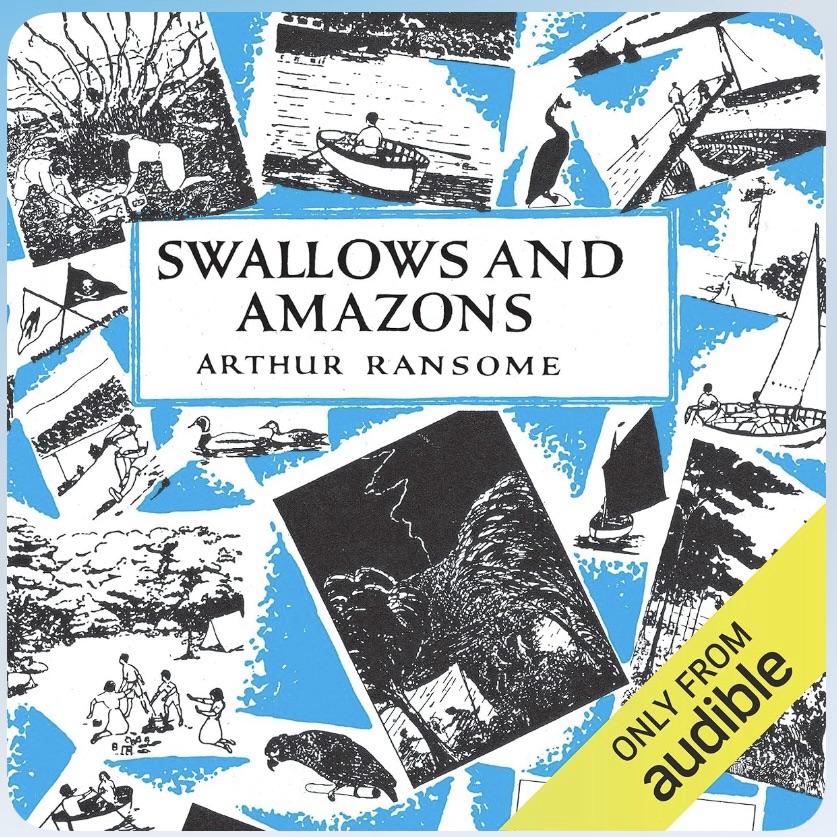
I listened to the audiobook of Swallows and Amazons, Arthur Ransome’s classic novel for children during the period from late March through to early June this year. It was a fairly long process, almost 9 hours of listening, accomplished mostly on my walks to and from work. There were two reasons for my choice of listening, the first linking to my desire to read explore more novels for children as I tried to find stories that were in any way comparable to my own attempt at a children’s adventure story (something that I have written about in my post on Cornelia Funke’s book The Thief Lord), and the second being that Swallows and Amazons was a suitable ‘R’ pick as I worked my way, for the second time, through an alphabet of author surnames in James Mustich’s wonderful book ‘1000 Books To Read Before You Die’.
Swallows and Amazons is, of course, a very well known title, and for many people it is a much-loved one. But despite its name being very familiar to me, I had never previously read a single word of it. I had a vague idea of what it was about – a bunch of kids having adventures on a boat – but for some reason I thought it was set in the Norfolk Broads rather than the Lake District.
The story revolves around the adventures of four siblings, conveniently, to give a nice balance, two boys and two girls – John, Susan, Titty and Roger – as they spend a summer holiday camping on an island in the middle of a lake and sailing their boat, Swallow, around and about each day. Published in 1930, the children unsurprisingly fall into neatly gender-stereotyped and age-constrained roles, John is very much the responsible old-head, and, naturally, captain of the Swallow. Susan, next oldest, and mate of the Swallow fulfills the ‘mother’ role, taking great care and pride in keeping their camp tidy, preparing meals and keeping the younger children in order. Titty, the younger sister, is the Able Seaman and, it turns out, a little bit of a rebel (the privilege of youth!). Finally, Roger, the baby of the family and ship’s boy, is very much treated as the youngest – being taught how to swim, sometimes being allowed to stay up late or accompany the others as a special treat, and frequently falling asleep.
The main action in the story involves the Swallows interactions with two local children, Nancy and Peggy Blackett, captain and mate of their own boat Amazon, and very much portrayed as rather unsophisticated and down-to-earth locals, in comparison to the rather ‘smart’ Walker children. Initially, the relationship between the Swallows and the Amazons is somewhat hostile but, as you might expect, they end up joining forces, first against the Blackett’s uncle James, who lives in a houseboat on the lake and seems to be inexplicably grumpy and awkward, and then against some rather unsavoury characters who they become embroiled with. Throughout the story it is very much John and Nancy who are held up as the masters of the craft of sailing their boats and leading the adventures, but in the end it is young Titty who turns out to be the real star.
Listening to the audiobook of the story was quite an odd experience. The attitudes and happenings of the story are very dated, and I will admit that the constant references to Titty took some getting used to. The story is absolutely chock full of nautical references to the extent that practically everything the children do is rendered in nautical-speak – for example, everyone else is a pirate or a landlubber, they are constantly jibing or backing the mainsail or trimming the freeboard, and everything they drink becomes grog. All of these things – the datedness, the setting, the obscure language – left me wondering how it could be that, more than 90 years after its publication, Swallows and Amazons is still often lauded and recommended as a story for modern children. Perhaps there is some innate craving for a return to the semi-wild that a child can connect with, even if they (probably) haven’t got a clue about one end of a boat from another, and almost certainly have no idea whatsoever what ‘pemmican’ is!
So did I enjoy Swallows and Amazons? Would I recommend it?
Well, let’s be honest, Swallows and Amazons wasn’t written to entertain an almost 60 year old man with limited interest and experience in sailing, reading it 95 years after it was set and published. It’s probably not surprising then, that I would have to say that I was left underwhelmed… But maybe if I was 12 years old with my thoughts turning to imagined adventures and challenges, and yearning to escape from the constraining influence of the adults in my world I might have felt differently. Then perhaps, I would have leapt onboard at the chance to join John, Susan, Titty, Roger, Nancy and Peggy as they hoist their flags, cast off and allowed the wind to fill their sails and send them racing across the lake in pursuit of their next adventure!
I wrote this piece back in 2021 – one of three that I wrote under the working title: ‘Glances and Glimpses’. Each of the pieces captures some thoughts on an activity or incident that connects different periods of my life and/or opens a window on some aspect of my character, thereby providing a glance or a glimpse inside my head and into my life. I used to think, rather grandly I suppose, that I might write enough of these to produce a full-blown autobiography/memoir of sorts, and who knows, that may still be the case. For now I will be content to post this one here, with the others to follow. Perhaps doing this will spur me on to have go at writing some more ‘Glances and Glimpses’ to join them in the not too distant future.
+++++
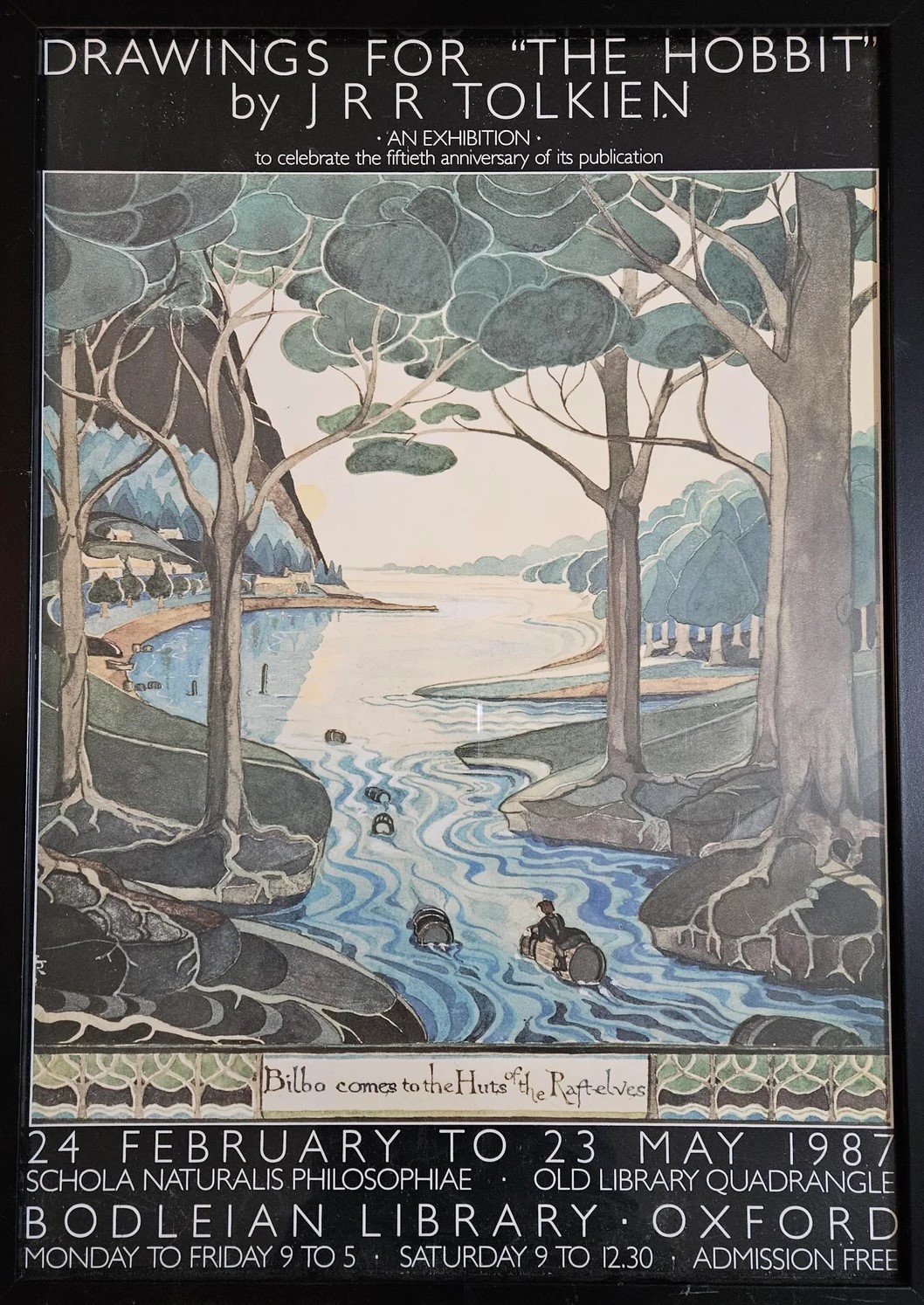
In the downstairs toilet of our house, which is just a small room off the hallway tucked underneath the stairs, hangs a poster. It’s mounted in a simple clip-frame. Every time I go into that space I look at that poster. Every time I see that poster I smile inwardly, and rapidly tell myself the story of when I first saw it, how I first obtained it, how I lost it, and how I got it back again. Ultimately, it’s a story of a thoughtful act of kindness, a simple act of love, a gift-giving from someone who deeply cares about me. It’s also a story that serves as a bridge to my past, and to many moments of happiness some years before the gift-giver even came into my life. There’s more. The theme of the poster is one of adventure and bravery, fear and danger, and leaping (plunging might be better) into the unknown. Those words – adventure, bravery – are not really me. Plunging into the unknown is NOT what I do. Fear stalks me constantly. So the poster is a reminder that it is okay to be brave, to be adventurous, to take risks and to plunge into the unknown, regardless of your fears, and without clear sight of the dangers. In fact, it’s more than okay, it’s a positively good idea!
The poster at the heart of this story advertised an exhibition of drawings that the author J.R.R. Tolkien made to accompany his book ‘The Hobbit’. The exhibition took place at the Bodleian Library, Oxford, between 24th February and 23rd May 1987 and was a celebration of the fiftieth anniversary of the publication of the book in 1937. It is a beautiful poster, mostly because apart from a title and the vital information about the exhibition in white letters on a black background at the top and bottom, it is almost entirely made up of one of Tolkien’s best works of art. The picture is titled ‘Bilbo comes to the Huts of the Raft-Elves’ and captures the moment in the story when, having strayed into the territory of the Wood-Elves and been imprisoned in their dungeons, the hobbit Bilbo manages to obtain a set of keys, free his band of dwarf companions and escape by floating them all off down the river in empty wine barrels. The picture shows the river after it has leveled out through rapids and waterfalls, meandering onward towards a small settlement through woods that come right down to the water’s edge, all gnarly roots and hummocky promontories. In the distance there are buildings – the huts of the Raft-Elves – alongside a small beach-like area on a broad right-sweeping bend in the river. In the mid-ground, in the centre of the channel, are a number of barrels floating smoothly down towards the beach, and bringing up the rear is one barrel with the small figure of Bilbo clinging tightly to the top of it as it floats along, since, having himself sealed the last dwarf-laden barrel, there was no-one left to seal in Bilbo… The lighting of the picture is beautiful, rays of sunlight stretching down through the canopy of trees, illuminating the middle distance, drawing the eye ever onward. The colours are soft greens, soft blues, greys and browns. It is a delicious palette that perfectly captures the deep woods, the swirling waters and the hope that lies ahead. The poster was designed by Trilokesh Mukherjee and whilst it is the picture that is the real thing of beauty, credit must be given for a design that blends the outer information and the inner artwork to such wonderful effect. Trilokesh Mukherjee will probably never know just how much pleasure his piece of design work has given me over the last 34 years.
As you will gather, I love this poster. I loved it from the moment I first saw it pinned to a noticeboard in the long corridor of Lady Margaret Hall, Oxford, that I wandered down several times each day to get from my room in college to the dining hall and food. I loved it so much that one day, on my way back from dinner, I stopped at the poster, pulled out the drawing pins that held it fast to the wall, and grabbed it. From that moment, that poster was mine. I could place it on my own wall and gaze at it whenever I wanted to, as much as I wanted to. My precious!
Looking back, it is hugely ironic that whilst I gained possession of the poster, I did not set foot in the exhibition. It was open for 8 hours every weekday and 3.5 hours every Saturday during the entire period of the exhibition. It was perhaps a 15 minute walk from my room and in a building that I frequently passed. There was no admission fee. Yet still I did not go to see the actual work of art itself. At that time in my life, going to an art exhibition just wasn’t really the kind of thing I did. Tragic really.
I had, of course, read The Hobbit – just once at that time, perhaps 10 years previously. I remember the circumstances fairly well. I was off school with a cold – the sort of 3 day ‘snuffler’ that was bad enough to lay a child low but not bad enough to prevent all kinds of activity… So, I could read. Over those few days I took the small hardback copy of The Hobbit down from our family bookshelves – I remember there was no dust jacket, just the soft, almost olive green board covers – and I followed Bilbo and his companions as they made their way from The Shire to The Lonely Mountain, defeated the dragon Smaug and gathered up the golden treasure hoard. Along the way of course, Bilbo gains The Ring, that bringer of so much trouble and strife, that metaphor for the weight that we all carry with us through life. But that is another tale. The one abiding memory that I have from my first reading of The Hobbit was from towards the end of the story when one of Bilbo’s dwarf companions, I think I was the effervescent Killi, dies of wounds received in a fight. I think perhaps he was protecting Bilbo at the time. I remember how I cried; oh how I cried.
1987 was the year that I finished my time studying in Oxford, and so that summer the poster was rolled up and carried away from its spiritual home. Bilbo had come to the huts of the Raft-Elves, now he was coming with me… and he stayed with me for some years, probably stuck to a wall on display at times, perhaps not at others. I know that he was still with me some years later – certainly four or five years later – because after I had met my wife Karen we must have had the poster on display at home. During that time I must have spoken fondly of the poster, so strongly in fact, that my words burned an impression in her memory. Dragon fire words!
The problem with posters of course is that they are not made to last. My poster had a job to do for perhaps a few months at most. So, as the years passed and the poster was moved here and moved there, pinned and unpinned, rolled and unrolled, blutacked and unblutacked, its edges died a slow death, its corners fractured, its heart creased. At some point, probably at one of our early house moves, the decision must have been made that my precious poster should end its journey; and so it was lost and essentially forgotten about, by me at least.
We come forward many years – around 30 years from when I first saw the poster on the noticeboard in Oxford and perhaps 20 from when it slipped away from me. My elder daughter was at university in Reading and with my younger daughter in tow I took myself off to Oxford to watch Plymouth Argyle play Oxford United down towards the south-eastern fringe of the city. My wife came along too to share a little time with our elder daughter who had popped up on the train for the afternoon. I can’t be sure of the score of the match, but it might have been 0-0 for there has certainly been one such goalless draw between those two teams at that location that I have seen, the most mind-numbingly dull 0-0 draw that you could possibly imagine, bereft of goals, bereft of excitement, bereft of anything remotely resembling entertainment.
We drove home to Plymouth immediately after the game. I was probably tired and almost certainly not in a good mood. Travelling halfway across the country for that sort of game is not the best way to spend a Saturday. I am sure that doom and gloom would have been the order of things, for me at least. And then:
“Guess what I’ve got you?”
There it was. My poster. Well, not exactly my poster but a flat, undamaged, shiny copy of the exact same poster – not a reproduction, not a different poster of the same picture… the same poster – ‘designed by Trilokesh Mukerjee’. Perfection.
It turned out that wife and daughter had been browsing in Blackwell’s – the famous Oxford bookshop – and there, nestled hidden in a rack was the ‘Drawings for “The Hobbit” by J.R.R. Tolkien’ exhibition poster – just one copy, presumably sitting there for 30 or so years, costing just a few pounds, waiting for its moment.
That poster, my second copy, did not get pinned, rolled or blutacked, it got loved. As soon as possible it went straight into a frame and onto the wall, the wall where it has remained ever since, and where I now see it several times most days. It reminds me of happy times in Oxford – friends, places, events. It makes me laugh that I didn’t even make it to the exhibition. It causes me to retell its story in my mind. And it reminds me how things that are lost can be found. Most importantly, every day it reminds me that someone listens, someone watches, someone remembers and someone loves.
A couple of years later, I noticed that there was an exhibition of artwork and artefacts of Tolkien in the Bodleian Library, Oxford. It was the only such public exhibition of these items for many years and it included the small number of paintings that Tolkien painted for The Hobbit. Of course we went. The pictures, the maps, the draft chapters were all wonderful. The picture was wonderful. But my poster is better.
Bilbo and the dwarves escape from the dungeons of the Wood-Elves and down the river in the only way that is possible. It is an uncomfortable mode of transport, it is an uncertain path to take – being caught whilst loading the barrels, drowning, suffocating, being dashed against rocks are all possible outcomes – but they take it nonetheless. Quite literally, they throw themselves into life and life carries them forward. That is a lesson that I need to be reminded of every single day. The road goes ever on, but it requires bravery to keep moving forwards.
(c) Tim O’Hare, March 2025 (originally written in 2021)

 Tim O'Hare