I’ve just read Martin Lindstrom’s book on branding “Buy-ology”. I had picked is up in the local Oxfam shop and thought it looked like it might be interesting (along the lines of Freakonomics) and the title triggered a vague memory that I had read a good review of it somewhere. Anyway, I have to say that I found it to be poorly structured and not particularly interesting. Lindstrom claims to have applied science to marketing/branding and cites various studies which have used various brain scanning and imaging techniques to show which parts of the brain light up when we are exposed to different kinds of marketing images, sounds and smells. It claims to reveal fresh secrets about how we are persuaded to part with our money but pretty much everything that he said seemed like common sense to me, even the revelations about how things like Nokia’s ring-tone actually damage the Nokia brand. So, all in all, this was a bit of an irritating book – you can get an idea of this irritation from Martin Lindstrom‘s website – fire it up and then wait for the annoying little videos of Lindstrom dispensing branding advice to pop-up…
2000 up!
Well it took just over 8 months to reach 1000 hits on this site but only another 4 months (almost) to get the next 1000. The site has now gone through the 2000 hit barrier. Thanks and keep coming back!
The Circumnavigators
I just finished reading another of my bargain basement charity shop book purchases – A Brief History of The Circumnavigators by Derek Wilson. As the name suggests, the book tells the tale of the various mariners who led the most historically important ocean voyages around the globe (plus a few other less important but dor other reasons distinctive voyages). It begins with Magellan, or more correctly Sebastian D’El Cano because Magellan died part way round so contrary to popular opinion he was most certainly not the first person to circumnavigate the globe. Other notable mariners covered include Drake, Bouganville, Cavendish, Cook and, more recently, Chichester.
I’m not really sure why, but I have always enjoyed reading about marine history and the great voyages of exploration. My interest probably comes from my father who, if he had had more time would certainly have been quite obsessed by them, but I’m not aware of any reason why he had such an interest. Perhaps some research on his family tree might discovery an interesting maritime link.
Anyway, I enjoyed the book more than I thought I would – I had put off starting it a few times because the text looked perhaps a little dense, but it was actually an easy read packed full of quirky incident and interesting personalities.
On Giants’ Shoulders
I’ve mentioned before in previous book-related posts how I quite often find my reading material in the charity shops of Mutley Plain (Plymouth). Well one such book that I bought some time ago but have only just got round to reading was Melvyn Bragg’s “On Giants’ Shoulders: Great Scientists and their Discoveries. From Archimedes to DNA”. This book was produced to accompany a Radio 4 series in which Bragg (a non-scientist) talked to various scientists about the lives of a selection of famous scientific figures from history (including Archimedes, Galileo, Newton, Laviosier, Darwin, Poincare, Freud, Curie, Einstein, Crick and Watson) about the nature of their work and about the nature of scientific genius.
I found this book a really interesting read and also quite inspiring (it made me want to be a better scientist). It made me think quite deeply about what it means to be a scientist and to contribute to scientific knowledge. Good stuff.
The ups and downs of my meters
I love figures and I love playing around with them…
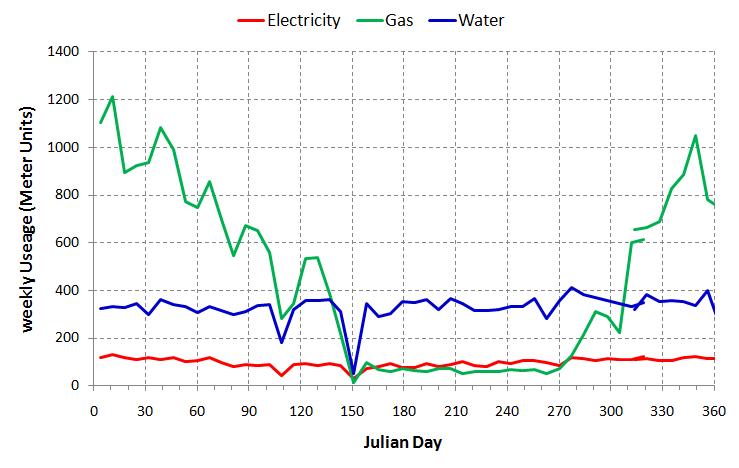
Over the last year, I have taken a meter reading for each of my household utilities every weekend. I started just after we had a water meter installed and I wanted to make sure I was checking regularly for leaks. The data is displayed graphically below. Some points of interest are:
1. The drop in water useage around Day 105 and 150 are when I went on holiday (4 days at Easter, 7 days in May).
2. Gas useage seems to show an apparent roughly monthly variation (in the winter) which is a bit odd (The graph below below is now a couple of weeks old – intriguingly the same pattern of roughly monthly variation in gas useage is starting to show up this winter too – have I discovered a signal of some previously unknown meteorological cycle?)
3. During the summer the electricity and gas show a small out of phase variation (gas goes up when electricity goes down and vice versa). I think this relates to the food we were eating – i.e. when we cooked something in the oven (electricity) we weren’t using the hob (gas).
Homo Britannicus
I just finished reading “Homo Brittanicus: The Incredible Story of Human Life in Britain” by Chris Stringer. This was a book that I decided to read after hearing Chris Stringer interviewed on the Scientific American podcast a few weeks ago. He came across as a really enthusiastic, knowledgeable and skilled story teller and so I thought his book would probably be an interesting read. The book tells the story of a recent research project called the Ancient Human Occupation of Britain (AHOB) that set out to bring together a whole range of experts from different fields to integrate, extend and better understand the evidence for early human occupation of the British Isles. It takes the reader into the worlds of Neanderthals, early Homo variants, archaeology, anthropology, paleaoclimates and paleaontology and explores what the evidence can tell us and what it can’t tell us.
I did enjoy the book but not as much as I had expected to from listening to the podcast. It’s a little heavy going in places and I got a bit lost sometimes working out which inter-glacial period or ice age was being referred to because the overall time-line of the story isn’t that strongly put across. Still, the book took me into a world that I don’t normally encounter or think about thich is always a good thing I think. One of the key elements of the events surrounding early human occupation of Britain was the dramatic changes in sea level that accompanied changes in ice volume associated with ice ages, and there’s a lot of emphasis placed on the fact that the British Isles used to be much more connected to (what is now) mainland Europe across the North Sea. An important region of this land bridge is called Doggerland (now submerged). So, it was interesting to pick up this week’s New Scientist, Issue 2735 [21 November 2009] and read an article all about how archaeologists are turning to evidence from the seafloor (from places like Doggerland) to unlock further secrets of early human history in Europe.
100 greatest albums
Following up on the recent “100 Greatest Films and Books of the Decade” features in The Times newspaper, last Saturday’s edition included the “100 Greatest Albums”. I didn’t expect to do too well with this list (i.e. I didn’t expect to have too many of them in my CD collection) but I thought I’d take a look anyway. So, here goes my list from the 100 Greatest Albums:
02: Back to Black [Amy Winehouse]
03: In Rainbows [Radiohead]
10: The Seldom Seen Kid [Elbow]
17: Viva la Vida or Death and All His Friends [Coldplay]
59: Beautiful World [Take That]
65: Scissor Sisters [Scissor Sisters]
71: A Rush of Blood To The Head [Coldplay]
Not so good really and I’ve even had to cheat a little by including the Take That and Scissor Sisters albums which, although located in my CD shelves, are not exactly mine…
I only narrowly missed out on having the top 3 though. No.1 in the list was Kid A [Radiohead] – I have four Radiohead albums but not that one.
So that’s 11 of the top hundred – a better return than I managed for the top 100 films (see previous blog post).
The World According to Bertie
I recently finished reading “The World According To Bertie”, the fourth book in Alexander McCall Smith’s “44 Scotland Street” series. These books are interesting for the way that they are constructed – McCall Smith wrote the first one (I’m not sure about the subsequent ones) as a serial in The Scotsman newspaper, with each short chapter appearing in print on successive days. So, the books are made up a lots of short chapters about four pages at a time which build through the book to tell the stories of a whole series of individual characters who sometimes interact but are often only loosely inter-related. Bertie, of this book’s title is a highly intelligent six year old boy with an insufferable “new age” mother and a put-upon father but although the book carries his name he features no more than the other half dozen or so characters that McCall Smith has introduced through the series.
I enjoyed this book less than the others in the series – perhaps the format and the character is getting a little tired – but I do think it is a clever way of putting together a book that has wide appeal. It’s inevitable that each reader will have one or two characters who they are more interested in and with a wide range of characters its hard not to be drawn to someone in the story. I think that in this particular case one or two of the less interesting and more irritating (to me) characters get more “page-time” which is probably why I didn’t enjoy it so much. It’ll be interesting to see whether McCall Smith does a fifth one in the series or whether he too is getting tired of the format – some of the plot twists and resolutions did seem a bit forced as if this might be the last one.
It means something to me

This picture will mean nothing to anyone else (well, almost anyone else) but it means something important to me.
100 greatest books
Over the last couple of weekends The Times newspaper (which I buy on Saturdays only) has run articles on the “100 Greatest Films/Books of the Decade” (the decade in question being 2000-2009). I thought it would be interesting to see which of these films/books I have watched/read – perhaps this is a measure of how “current” or media-savvy I am. So, here goes my list from the 100 Greatest Books:
10: The Da Vinci Code (Dan Brown)
17: Harry Potter and The Deathly Hallows (J.K. Rowling)
18: Bad Science (Ben Goldacre)
22: The Amber Spyglass (Philip Pullman)
25: The Curioius Incident of the Dog in the Night-time (Mark Haddon)
44: Freakonomics: A Rogue Economist Explores the Hidden Side of Everything (Steven Levitt and Stephen Dubner)
48: A Short History of Nearly Everything (Bill Bryson)
54: Eats, Shoots and Leaves: The Zero Tolerance Approach to Punctuation (Lynne Truss)
60: Collapse: How Societies Choose to Fail or Survive (Jared Diamond)
75: The Damned United (David Peace)
91: My Father and Other Working-Class Football Heroes (Gary Imlach)
So that’s 11 of the top hundred – a better return than I managed for the top 100 films (see previous blog post).
There are a couple of others in the list that I’m definitely going to read at some point including:
06: The Tipping Point: How Little Things Can Make A Big Difference (Malcolm Gladwell)
57: Fleshmarket Close (Ian Rankin)
and a few titles that sound like my kind of book so there’s a little scope for my total to go up.
It’s rather alarming to note that my “top book” in this list is Dan Brown’s “The Da Vinci Code” but I should also point out that this was also listed as the No. 1 “worst book of the decade” in the same report. Fortunately, I have definitely not read, and never ever will read, the No. 3 “worst book” – “Being Jordan” by Katie Price.

