Simplify

I was musing this morning…

[aside: Is ‘musing’ a verb? Is it actually possible ‘to muse’? I probably mean that I was thinking this morning but ‘thinking’ doesn’t really capture the somewhat day-dreamy type of thinking where I let my thoughts ramble playfully wherever they choose, settling occasionally for a few moments before setting off again like a butterfly flittering between flowers. So, regardless of whether ‘to muse’ is a valid verb in this context, that is what I was doing.]
… Anyway, I was musing this morning and settled on the word ‘Simplify’. I think it absolutely captures the essence of what I need to do as much as I possibly can. I suspect that pretty much every thing that I am involved with, every system or process I use, every group of possessions I own, every place I utilise could benefit from being simplified. I do try to keep things simple. I like to think of myself as a tidy and uncluttered person (or at least a person who would like to be tidy and uncluttered). But I am very conscious that there is so much stuff – stuff I own, stuff I interact with, stuff I have to do, stuff I want to do, stuff I think I should do, stuff I might do if I ever get round to it. Stuff, stuff, stuff. It all needs a good prune. Hack it down, thin it out, clear the decks, get rid. Simplify.

“I am a Crazy, Stupid Person”

On my walk into work this morning, as I passed a mum and her young son (presumably) coming the other way, I heard the lad, who must have been about 5 years old, proudly and loudly say: “I am a crazy, stupid person”. To my ears, he didn’t say this in a negative way implying that being crazy was bad or that he was stupid in the sense of being ‘thick’ but, rather, he seemed to say it in an excited and celebratory way. The message I heard was more like “I’m a bit bonkers and isn’t that fun?!”.

Now isn’t “I’m a bit bonkers and isn’t that fun?!” a great philosophy of life for a 5 year old? In fact, isn’t it a great philosophy of life for all of us? Go forth and be crazy, stupid, bonkers or a little mad at times. I think the world will be a better place for it…

Essentialism and the 7 Habits of Highly Effective People

This morning, on my walk into work, I listened to an episode of the Art of Manliness podcast called ‘The Difference Between Essentialists and Non-Essentialists‘. It was an interview with Geoff McKeown, author of a book called ‘Essentialism’ that was published about three years ago. In very basic terms, Essentialism is a mindset which involves identifying areas of activity in life that have the most meaning/value when viewed from a long-term perspective and then using these as a filter to help manage decisions on activity and effort on an ongoing basis. Rather than mindlessly saying yes to things or simply committing yourself to try to do everything as best as you can, an Essentialist would know the key goal that they are trying to achieve in life (potentially taking a 100+ year timeframe as a means for deciding this) and then focus attention on actions that contribute to achieving this overarching goal. The idea is not new, but I felt that McKeown had an exceptionally clear way of expressing it, to the point that I am certainly going to read or listen to the book sometime soon. In the interview, reference was made to the famous quote from author Steven Covey’s that “the main thing is to keep the main thing the main thing” which obviously captures the same idea in a nutshell. Listening to this section of the podcast I was reminded of Covey’s classic book ‘The 7 Habits of Highly Effective People’. I read this way back in early 2001 and so it would have been one of the first books on productivity, self-management that I ever read. I recall that it contained much of value. At that time I was also experimenting with mind-mapping and produced a mind-map summary of the complete book. Amazingly, I have just managed to find a rather fuzzy scanned image of it..
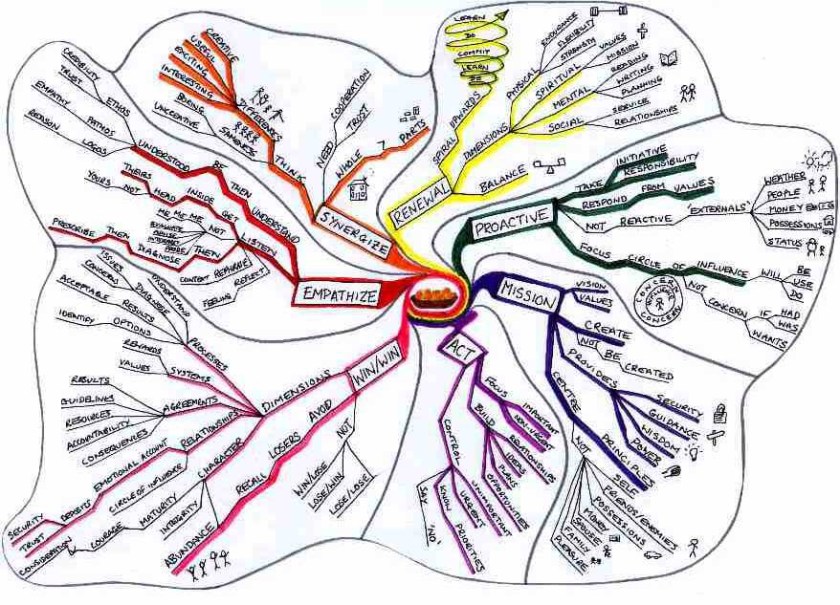

Apart from anything else, I rather like this mind-map as a piece of ‘art’.

One of the things I recall from my reading of ‘The 7 Habits’ was the development of a personal ‘mission statement’ based around the different roles that one plays in life (for me it was things like, father, husband, teacher, manager, researcher etc.) and the same idea is picked up by McKeown through the idea of an ‘Intention’ (The Main Thing). It seems to me that Covey probably has the edge here because I don’t think I could have a single Intention in life but I certainly could have a single Intention for each of my main roles. I think this is certainly something that I will give some further thought to.

Anyway, from that podcast I now have a mind that is filled with curiosity to pursue the idea of Essentialism further, both through McKeown’s book but also by going back to Covey. Annoyingly, I gave my copy of ‘The 7 Habits’ to a charity shop years ago and even bought a second-hand copy more recently but gave that one away too. So, one of my first tasks here is going to be to hunt down another copy of it.

Watch this space for further thoughts on Essentialism then, as and when I have followed up on these sources.
The Obstacle is the Way (Ryan Holiday)

I just finished listening to the audiobook version of Ryan Holiday’s book ‘The Obstacle is the Way’. This is one of his earlier books I think and serves as an introduction to Stoic philosophy. I have come across the ideas the book contained before, through other reading such as William B. Irvine’s excellent book ‘A Guide to the Good Life: The Ancient Art of Stoic Joy’ and various podcasts including interviews with Holiday himself, but it was good to have another pass through the principles underlying Stoicism. The specific focus of the book is the idea that obstacles should be viewed as opportunities to develop, grow and find alternative solutions rather than as insurmountable blocks to progress. Overall, I felt that the book went on a bit and that the third section on ‘Will’ has weaker than the preceding ones on ‘Perception’ and ‘Action’,  but overall it was an interesting listen and it held my attention through to the end.

It certainly seems that I am increasingly settling into a Stoic philosophy towards life. Key elements to this are always remembering that there are alternative viewpoints to any situation and that the way that we perceive things occurring around us or to happening to us is to some extent a matter of choice. I think that I am now much more aware of this and much better at catching myself before I react and asking whether there are other ways of perceiving a situation that might illicit different reactions. I am definitely trying to be less attached to thinking and more driven towards action. Perhaps most importantly, I am fully embracing the idea that you should only concern yourself with things over which you have an element of control.

I think that I am probably quite close to the point where I would regard myself as a Stoic (in fact I said as much in a talk I gave yesterday). Coupled to this, I suspect that fairly soon I will start to annoy people around me (or maybe just my family) by trotting out a phrase which seems to have become my new mantra, “there’s ALWAYS a silver lining”, when something doesn’t seem to be going so favourably.

From now on I am going to try to dip into two of the major bases of early Stoic writing – Marcus Aurelius’s ‘Meditations’ and Seneca’s ‘Letters From A Stoic’. I think it is also time for me to revisit William Irvine’s book on the subject.

My Intentions Manifesto

Over the last few years I have been absorbing content from various books and podcasts which has gradually been re-shaping the way that I try to live my life. Amongst this reading and listening has been quite a lot on aspects of productivity, Stoic and eastern philosophy, mindfulness and creativity (to list just the broad topics that come to mind immediately). Recently, I took the step of trying to boil this down to a series of short, simple principles that provide a kind of manifesto for my life. I can’t say that I necessarily always manage to live by these principles, but I have them written down and have them easily accessible so that I can glance through them and remind myself how I want to be. Initially, they changed quite a bit as I iterated them towards a state that I was happy with but the list seemed to settle down at 9 items which I think capture everything I want captured for now. I thought I would share them here. They are expressed not as instructions to myself but as intentions and so I am calling this list my Intentions Manifesto. It goes like this:

I intend to…

… be PRESENT

… be DELIBERATE [1]

… be PLAYFUL [2]

… focus on SINGLE STEPS

… take ACTION

… take the STAIRS [3]

… act with KINDNESS

… keep moving FORWARDS [4]

… leave things BETTER [5]

Notes:
[1] I often come back to the idea that whatever you do you should do it deliberately rather than accidentally.
[2] I loved Mark Rowlands exposition of the importance of play and being playful in his book ‘Running with the Pack’. He (sort of) defined play as being when you deliberately choose to do a task in a manner that makes it harder than it needs to be for no reason other than because you can. I liked that idea.
[3] This comes from Rory Vaden’s book ‘Take the Stairs’ and captures the/his idea that if you tackle the hard stuff now, what follows becomes easier but if you take the easy route now what follows is harder (‘Short-term easy = long-term difficult, short-term difficult = long-term easy’)
[4] I mean keep things/stuff moving forwards at all times not keep physically moving forwards although the latter is also good advice when running a long way!
[5] This comes from a podcast (it might have been The Unmistakable Creative interview with Jim Bunch but I can’t be sure without going back and listening again). Anyway, expressed in a slightly fuller form I mean that it is a good idea to always leave environments in a better state than you find them in. An environment could be the world around me generally but it might also be something small like the bathroom, my office or even my bag.

The Philospher and the Wolf (Mark Rowlands)

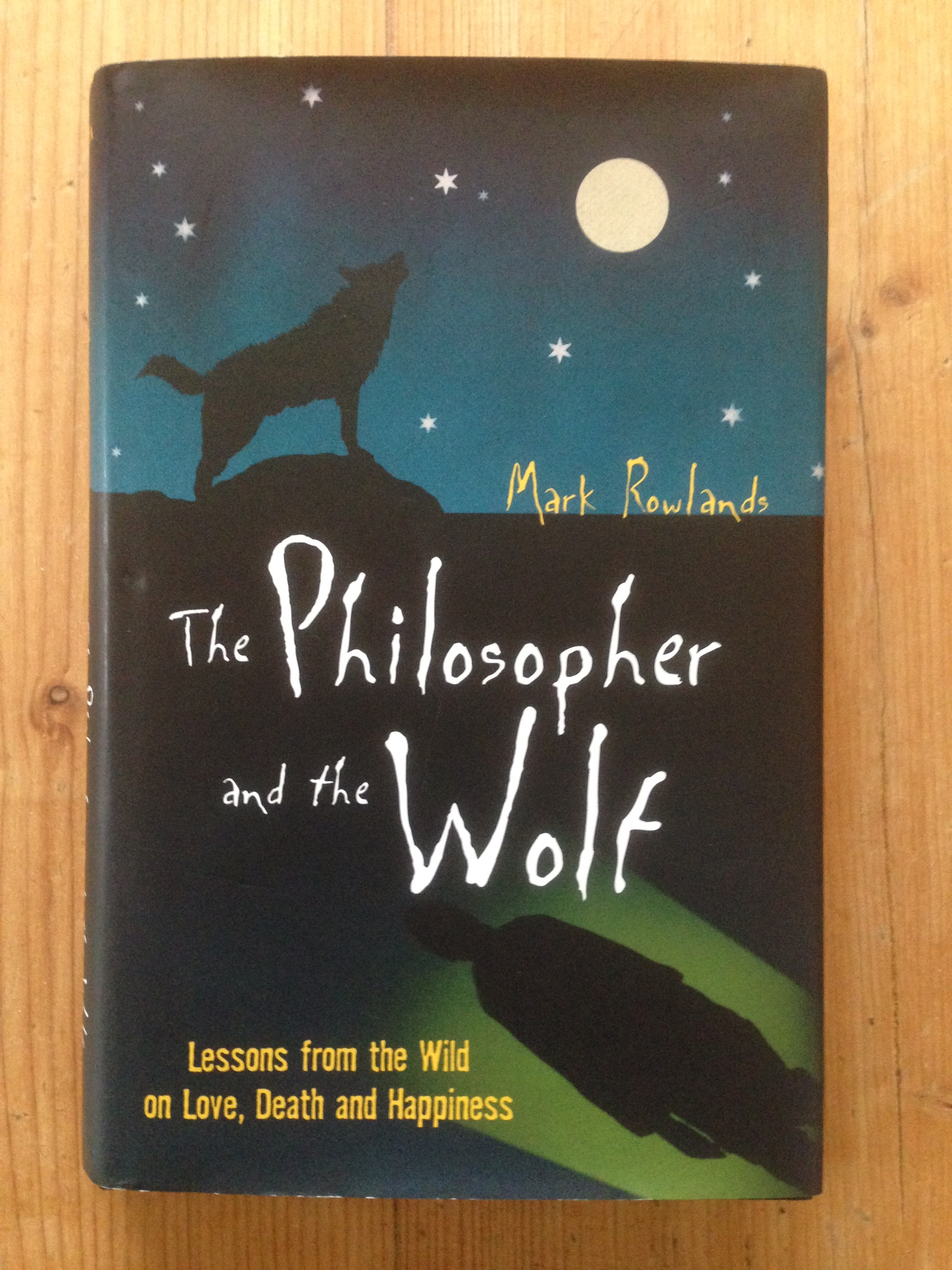
This morning I finished reading Mark Rowland’s book ‘The Philosopher and the Wolf’:

I came to this title having last year read his book ‘Running with the Pack’ which blended his experiences running, and especially running with his wolf and dogs, and his work as a philosopher/academic. In that book, a section describing the states of mind that can occur when running long distances in terms of various classic philosophical ideas particularly struck me and it was largely because of that section that I identified TPatW as a future title to read.

I am really not a dog person. In fact I am not much of an animals person. I am certainly not be the sort of person who might think that it would be good, fun, sensible, practical or reasonable to have a wolf around the house. But I certainly AM interested in philosophy, at least I increasingly find myself thinking that it is a subject that I really would like to pursue in more depth. Consequently, I came to TPatW in search of more of Rowlands’s wonderful exposition of philosophical ideas and not out of an interest in the wolf!

Anyway, once again I really enjoyed Rowlands’s writing – the mix of cautious autobiography, education and philosophical musing – and am more convinced than ever that I need to try to find some kind of structured introduction to philosophy to work through. Rowlands uses his observations of the wolf (Brenin) and the intertwining of their lives and actions to draw out some profound messages about what it is to be a human (and a wolf) and ends up arguing that the meaning of life is not to be found in possession or in purpose but in the ‘higher moments’ (moments where we dig in and carry on regardless of the adversity that we face [my definition]) that lie scattered along the timeline of life. Rowlands describes these moments as ones where we shout “F**k You” to the Gods and it is clear that by choosing to melt part of his existence with the life of Brenin, he was doing just that.

Captain Ultra and the See-Saw of Vulnerability

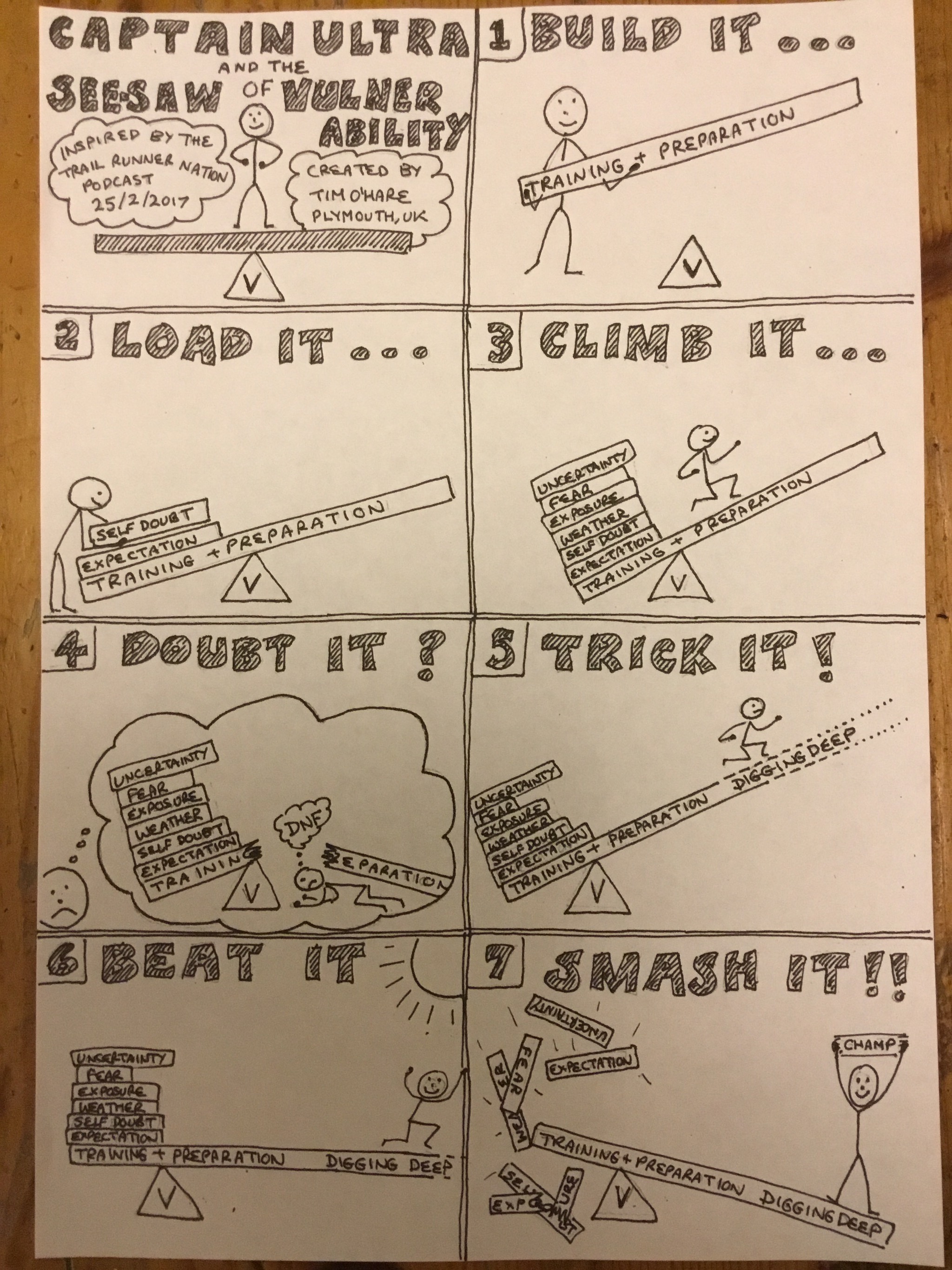
I mentioned in my entry yesterday that I am running the New Forest Marathon on Sunday and with that in mind this seemed like a good time to post a short cartoon strip that I wrote a few months ago, prior to tackling my first 50 mile ultramarathon. The cartoon was inspired by an episode of the Train Runner Nation podcast which discussed how prior to a big event it can seem that you are loading up more and more issues and stresses relating to the run which weigh you down and can make a successful outcome seem impossible. When running the event, if self-doubt creeps in, you may never reach the point where you can overcome this adverse load and a DNF (Did Not Finish) may result. The knack is to keep believing and digging into your inner strength beyond the point that you thought possible until a pivot point is reached when the balance tips and the adverse load smashes down and the race is beaten. As I listened to the podcast on my way home from work, I really liked the visual analogy that was developed, and so I drew out my cartoon almost as soon as I arrived home – it was great fun to produce, and, from my limited experience, does capture the reality of preparing for and completing an endurance event pretty well.

Incremental Progress

In the last few days I have been exploring the power of making incremental progress. Last week, I identified several long-term projects or areas of activity that I wanted to complete and, since then, I have set about making one small piece of progress on each one every day. The projects include writing an entry on this blog each work day (6 in a row not including this one), progressively sorting out my office at work and completing a short set of core exercises each work day (7 in a row). Obviously I need to keep things going for longer before I can make a proper judgement about this activity and rate my success but I feel that the early signs are promising. I feel that I have already been working on these tasks long enough to begin to feel and see progress and can catch a glimpse of how things will be when I have extended my runs up into the 10s of days.

There is really something quite alluring about the idea that if I do something for, say, just 10 minutes every weekday for a year then I will have accomplished over 40 hours of activity in a year. If I consider what I could achieve if I sat down and wrote for 40+ hours or did 40+ hours of exercise or spent 40+ hours sorting out my office (of course I don’t think I will need quite that long…) then the possibilities are enormous. Obviously, there is a limit to the type of activities that can usefully be performed in this manner – if I want to write a novel then I probably need to lengthen the time spent on writing each day (but perhaps not). Nevertheless, there seems to me to be a lot to say for the idea of making slow, steady, incremental, progress. I liken it to being the tortoise racing the hare, and idea that often pops into my head when I am out on a long run. If I remember the fable correctly, in the end the tortoise wins the race…

Watching the waters go by

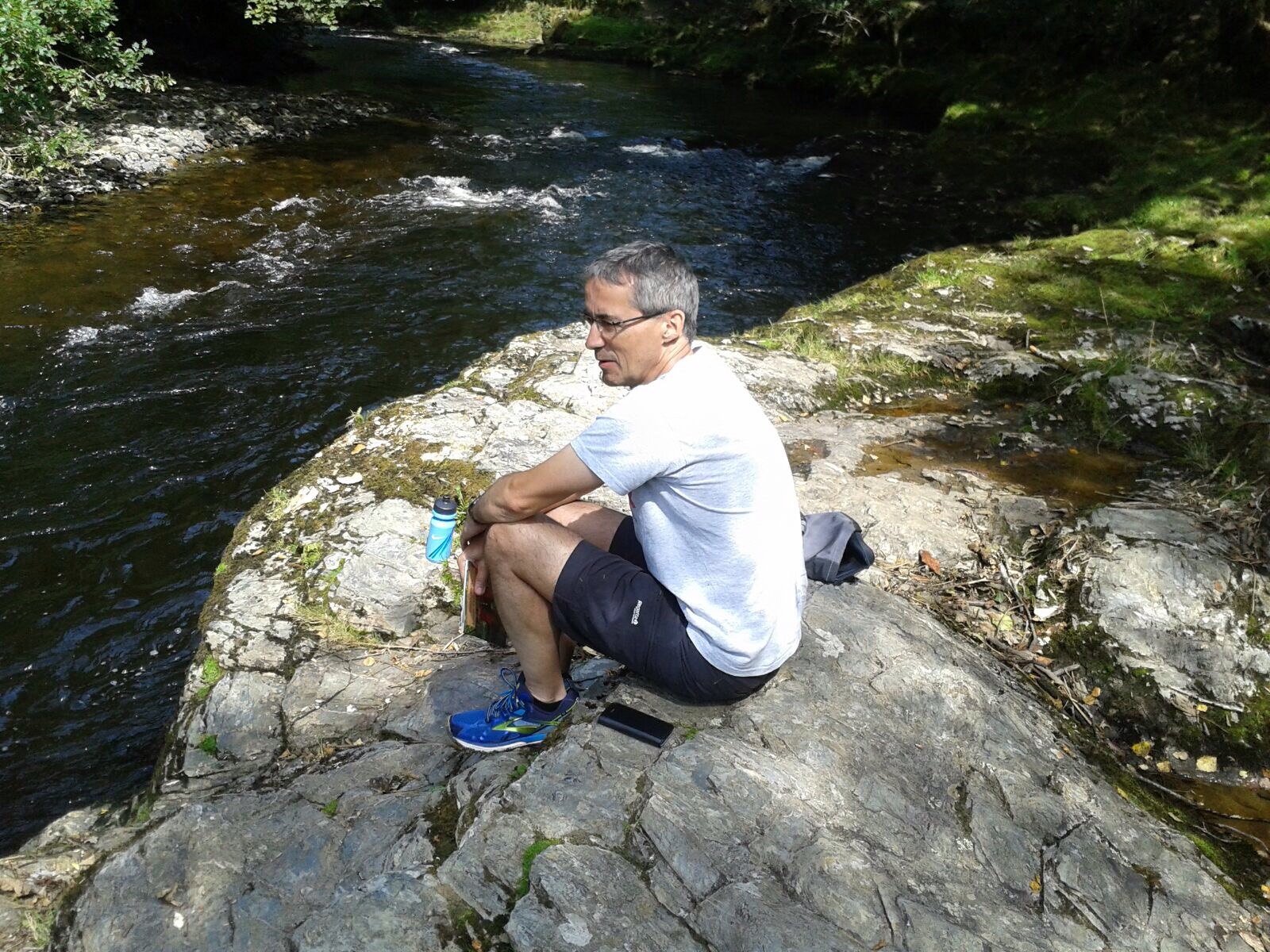
On Sunday we took a walk from Long Ash near Horrabridge down to Double Waters – the aptly named confluence of the Rivers Walkham and Tavy and then back via Grenofen Bridge. At Double Waters we stopped for a while and ate a picnic lunch sitting on a rock next to the river Walkham. It was a marvelous place to watch the waters go by and to contemplate. The waters flowed rapidly past shedding eddies, creating waves in the surface and carrying a constant stream of leaves, sometimes floating sometimes submerged, but always flashing past in an instant never to be seen again – a perfect reminder of the transient nature of existence.

IMG_2990