Mistakes Are Not Always Bad #wisdom

A couple of weeks ago we paid a visit to Make Southwest, an exhibition space for contemporary craft and design and a leading charity for craft education located in the small town of Bovey Tracey on the southern edge of Dartmoor, about 25 miles from our home in Plymouth. It’s a venue that we have visited a few times before – there is always some kind of special exhibition (this time it was a exhibition of contemporary bells called Sound and Silence) and an interesting array of local artwork, books and assorted items to look at in the shop. On this occasion, the reason for our trip was to see a smaller exhibition of wood engraved prints and, in particular, the printmaker Molly Lemon, who had travelled down from her base in Gloucestershire to demonstrate her work. We have encountered Molly at several Craft/Art Events in the last couple of years and always enjoyed viewing, and chatting to her, about her work. We also enjoyed seeing her compete in, and reach the semi-finals of, the Sky Arts TV Series Landscape Artist of the Year a few weeks ago.

Since I started painting about a year ago, whenever I go to any kind of art gallery or art/craft event I particularly enjoy scavenging the work that is on display or sale for ideas that I can try out for myself. Looking at the various pieces of artwork for sale in the shop at Make Southwest, I was particularly enamoured by some tiny pieces of work created by the printmaker Mike Tingle (also here). These were very small (just a few centimetre) square prints on slightly larger squares of rough-edged paper, with a title and the artist’s name written in pencil around the picture (there is an example of a similar kind of picture just below the centre in this piece of work: Dartmoor Box No 1). I really liked the miniature size and somewhat ‘rough’ nature of the pieces and I immediately thought that it would be fun to try to produce something similar using one of my own small Dartmoor Scenes watercolour paintings.

After returning home, I set about seeing what I could produce. First, I selected one of my pictures, opting for this one of a tree growing out of a typical Dartmoor dry-stone wall:
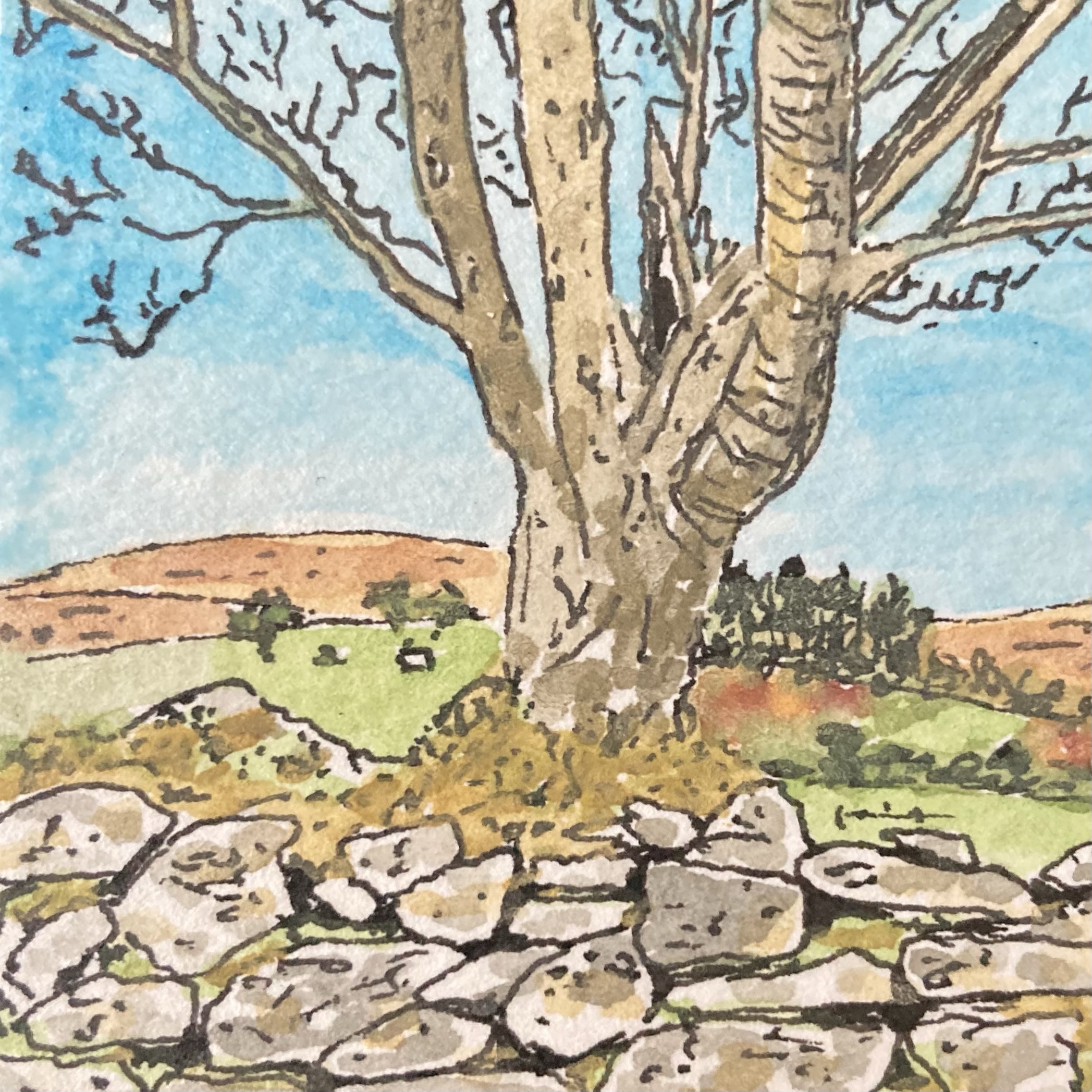
The original picture is a 4.5 cm square ink and watercolour sketch, and my intention was to use our home inkjet printer to make the best quality colour photocopy of it that I could, printing onto a sheet of watercolour paper so that the texture of the original was preserved. I’d already played around with making copies of some of my paintings in this way and so I knew that although the copied versions weren’t quite the same as the originals, with the paler colours tending to wash-out a bit, the process worked pretty well. So far so good.

This is the point at which I made my mistake. In the process of making the copy I somehow selected black-and-white printing, and so when I saw what the printer had spat out into the print tray I was instantly annoyed and frustrated. To make matters worse, because the original picture was on a small square of fairly thick paper, as the scanning light moved below the copier glass a dark shadow line was cast on one side of the copied picture. Not only did I only have a black-and-white copy, but I had a black-and-white copy that had a dark line along one of its edges. What a waste of a sheet of paper and ink…

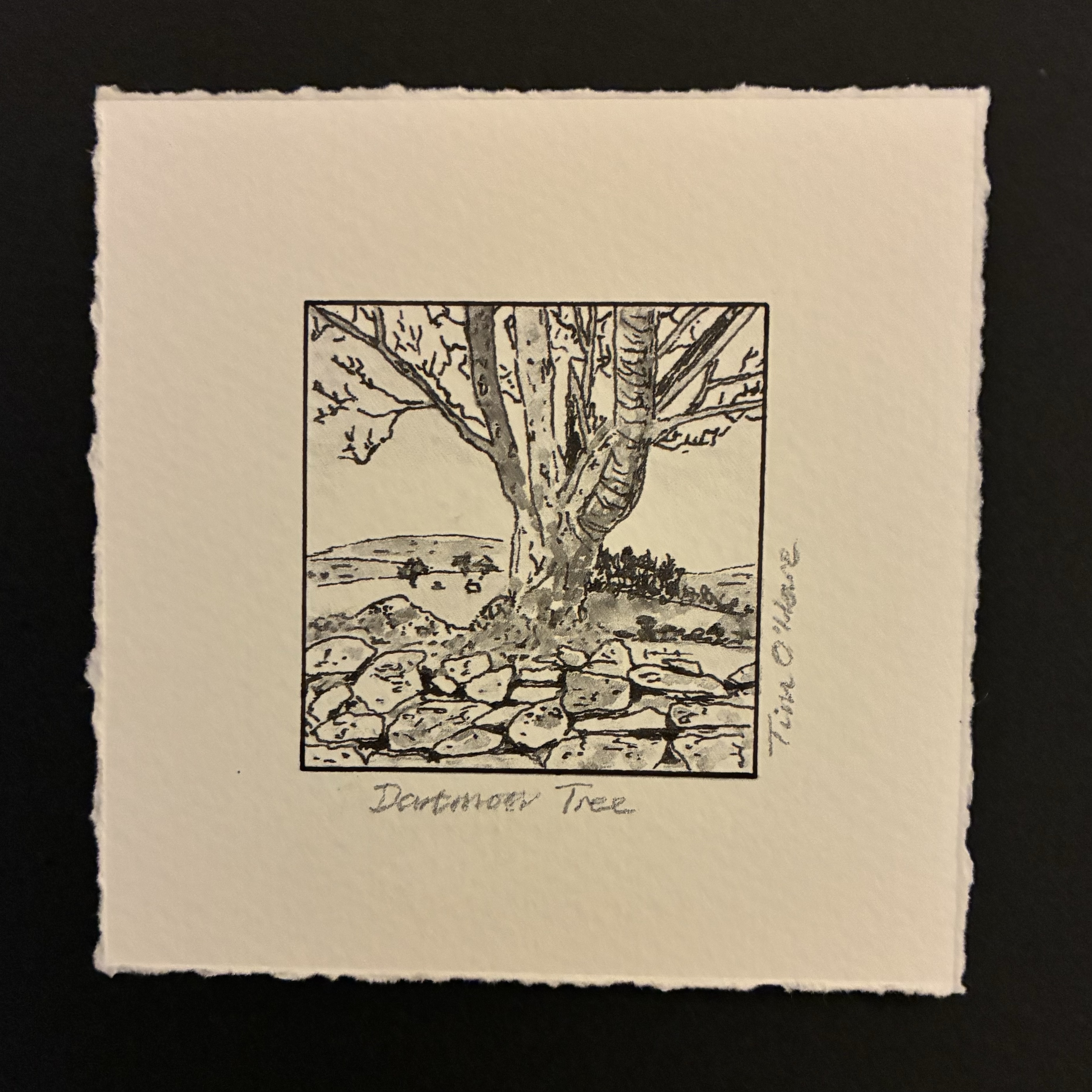
However, once I had overcome my initial disappointment and self-censure, I decided to press on with the rest of my production process and see what the end result looked like. I had intended that there would be no border between the picture and the surrounding area of paper, but now there was that dark line along one side spoiling that design idea. What could I do? Well, go with the mistake of course. I took my drawing pen and with the aid of a straight edge and a lot of care, I inked in a similar line on the other three sides. Hmmm… it didn’t look as I had planned but I liked the result. Then I measured out a wider border, and again aided by a straight edge, I tore the paper down to size. This part of the process is something that I have found takes a lot of care… if the tear is too sharp you don’t get the nice rough edge I was after, but if you are at all rushed and loose you end up with something that looks clumsy and careless. Fortunately, I managed to do a good job. Finally, I grabbed a soft pencil and quickly wrote a title below the bottom edge and my name on the right-hand side…

The result of this endeavour was the small picture shown at the top of this post and, despite my black-and-white and shadow mistakes in the copying process, I’m really pleased with the end result, so much so, in fact, that I intend to take the rest of my Dartmoor Scenes pictures and treat them in the same fashion. Even better, not only did I end up with a new picture that I really liked and the discovery of a new way to transform existing pictures into a different, somewhat distinctive, form, but I also gave myself a great reminder that making mistakes in life is not always a bad thing. In fact, sometimes, as in this case, a mistake can open up a different path from the one that was intended that leads you towards an unexpected but interesting, exciting or enjoyable destination!
WARNING Stop Look & Listen Before Crossing The Line. #wisdom

Sometimes little pieces of wisdom appear in front of you out of nowhere. You see or hear something that makes you stop and think, and you then find yourself carrying it with you as time passes.

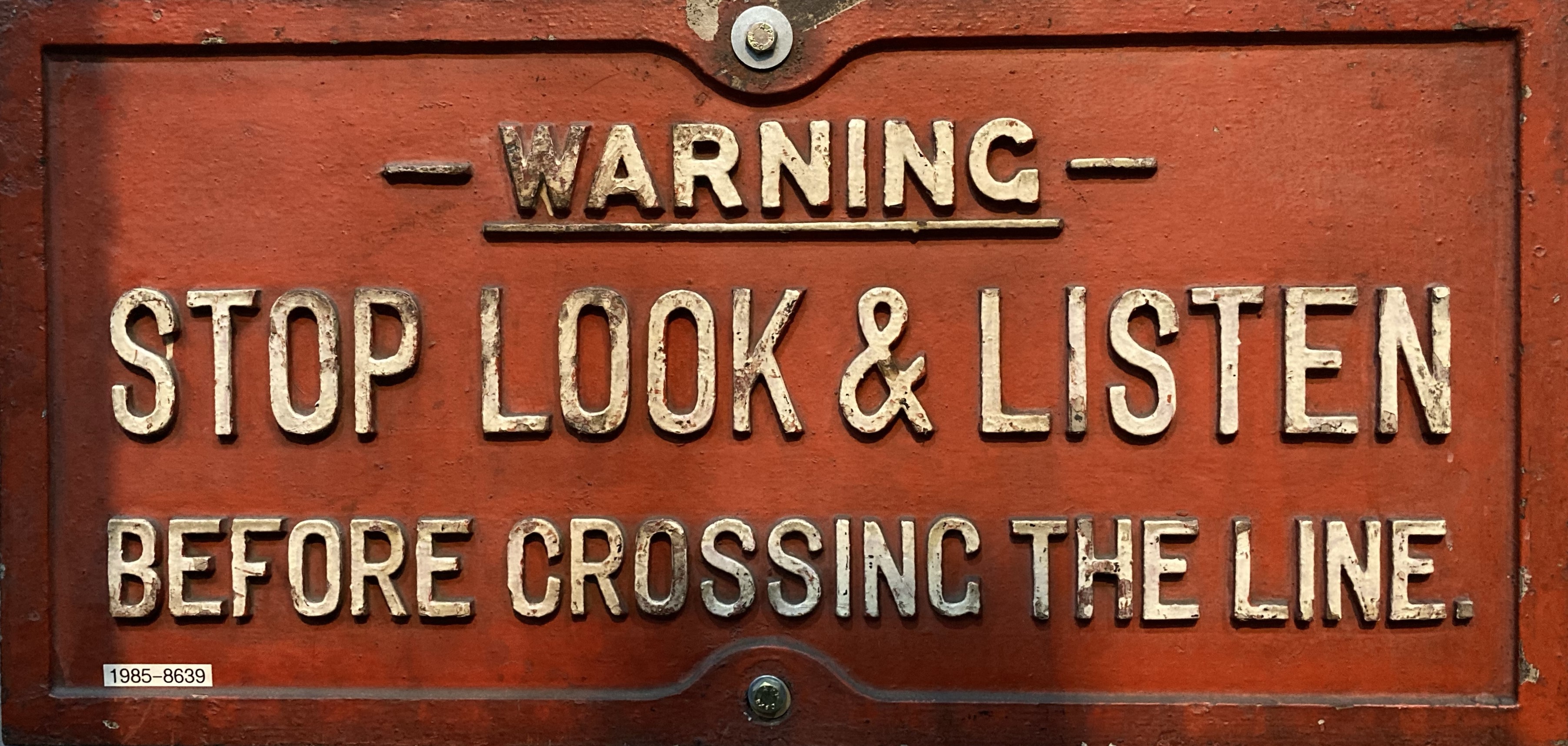
A couple of years ago we paid a visit to the National Railway Museum in York. In addition to some rather impression locomotives and rolling stock of various vintages, the museum is home to a vast range of smaller items associated with rail transport through the ages. Whilst wandering through the exhibits, I was much taken with a simple cast iron sign that was bolted to the wall (shown in the photograph above). Painted a rather satisfying and suitably alert-inducing red, its white embossed letters spell out the message: ‘WARNING – STOP LOOK & LISTEN BEFORE CROSSING THE LINE.’

There are a few things that I particularly like about this sign – its colour, the neat, bold use of capital letters, the way that the words are perfectly balanced and centralized, and the inclusion of the final full stop. Somehow, that last grammatical detail adds to the feeling that this is a sign that was serious about doing its job…

…which was obviously to warn people to take care crossing an unguarded railway line.

I guess that most people visiting the museum walk past that sign without taking much notice of it. In fact, many probably don’t even register that it is there. But as soon as I saw it, I knew that it was a sign and the message that it conveys, were something that I wanted to capture for posterity:

-WARNING-
STOP LOOK & LISTEN
BEFORE CROSSING THE LINE.

Isn’t that great advice, not simply in relation to navigating the obviously dangerous act of crossing a railway line, but for life in general?

A genius would make the history of his parish more interesting than another’s history of the world – Henry David Thoreau #wisdom

By Benjamin D. Maxham active 1848 – 1858 – National Portrait Gallery, Public Domain, https://commons.wikimedia.org/w/index.php?curid=24948639

For some years I have been reading my way through the Journal of Henry David Thoreau. Initially, I would just read a few entries at a time, but at some point in 2020 I hit upon the idea of reading entries on the day and month that they were written. At that time I was quite a good way through the book, and so my ‘on-this-date’ reading began with the entries that Thoreau wrote in 1856. Now, 5 years later, in my 2025 it is Thoreau’s 1861, and so the entries I am reading come from the penultimate year of his life (Thoreau died aged 44 in May 1862). When I started this project I was reading a journal entry on most days, but in the last few months, as Thoreau’s health has declined, the frequency of entries has reduced drastically such that I am only sporadically opening my copy of the Journal to discover that there is something there for me to read.

Thoreau’s Journal is packed with detailed observations of the land, wildlife and people around Concord, Massachussetts, and while many of the entries are quite dry and descriptive, with Thoreau you never know when a wonderful nugget of wisdom or a special turn of phrase will crop up. One such occasion happened last May, a couple of weeks before my elder daughter’s wedding, when a perfectly phrased gem popped up that I was able to integrate beautifully well into my ‘father-of-the-bride’ wedding speech!

Earlier this week (on 18th March to be exact) I read a passage of the Journal that I greatly enjoyed and which made me think, and so I thought I would use this post to highlight it to the world (as if… a better wording might be ‘to share it with the one or two people who might randomly stumble upon these words’). In the passage, Thoreau reflects on how the interest one might show in any given piece of history depends on more than just the subject of that history and that… No, I must let Thoreau take up the story…

You can’t read any genuine history – as that of Herodotus or the Venerable Bede – without perceiving that our interest depends not on the subject but on the man*, – on the manner in which he treats the subject and the importance he gives it. A feeble writer and without genius must have what he thinks a great theme, which we are already interested in through the accounts of others, but a genius – a Shakespeare, for instance – would make the history of his parish more interesting than another’s history of the world.’

It’s that last line that is the sparkle within the diamond: ‘a genius would make the history of his parish more interesting than another’s history of the world.’.

In my opinion, Thoreau has it spot on – everything is interesting and anything can be interesting if its story is well told. So, when we think about what to read, what to listen to, what to absorb from the world around us, the secret is to recognize and pay attention to those who are masters of the story-telling craft.**

* or woman obviously, but Thoreau was writing in 1861
** like Thoreau (obviously)

The Secret to Success

A few weeks ago, while reading Theodore Zeldin’s great book ‘The Hidden Pleasures of Life’ I came across a quote which resonated with me at the time and has stuck with me ever since. It comes from a 1967 New York Daily News interview with Bob Dylan in which he was asked about the delay in him producing a new recording and media reports that he had been offered a huge sum of money to switch record labels. His response was:

“What’s money? A man is a success if he gets up in the mornin’ and gets to bed at night and in between he does what he wants to. What I want to do is make music.”

I’ve picked out the middle sentence in bold because that’s the part that I read in Zeldin’s book and the part that is relevant here.

It’s possible to read this sentence as a simple instruction to do whatever you want to do, perhaps being selfish in the process. But that’s not how I read the quote or all that I take from it. For me, there are three elements to the quote, three ‘secrets to success’ – things that could be considered as markers of a successful life. One might also see them as essential ingredients or instructions…

1) Get up in the morning
It sounds simple but there’s quite a lot in this. First, if you get up in the morning then that implies you have made it through another night; you have survived to live another day – that’s Success Number One. Secondly, if you ‘get up’ then you have gone into active mode; you are engaged with life, doing something (anything) – and that’s Success Number Two.

2) Get to bed at night
Similar to ‘Get up in the morning’ there are two parts to this. First, if you ‘get to bed’ then you’ve clearly got a bed of some sort and that implies a least some degree of safety and security which has to be a good thing – Success Number Three. Secondly, the phrase implies that you have made it through another day and, no matter how easy or difficult that has been, I would count that as Success Number 4.

3) Do what you want to do in between
I guess this is obvious – a day spent doing things that you don’t want to do could still be regarded as a success in some ways (see above) but I think it is self-evident that a day spent doing what you want to do, whether that is one thing, a calling such as ‘Dylan’s “make music'”, or a multitude of things big and small, is going to be a better (more successful) day than one where much of your time is given over to activity that is misaligned with your personal values and interests. That’s Success Number 5.

I think it’s obvious that Success Number 5 is THE BIG ONE but I’d also argue that a single day of Success Number 5 would not really make for a successful life – that would only come when it is coupled with Successes Numbers 1-4 over and over again. I would just add here that what is good for one is surely also good for everyone else and so an interpretation of ‘do what you want to do’ that is generous to others and does not work against their own success will most likely lead to the greatest success in life overall. I certainly don’t take this phrase as an excuse for selfishness.

So, that’s the goal: get up in the morning – do what you want to do – go to bed at night; the secret to success in a nutshell.

Benjamin Franklin’s 13 Virtues

I am quite taken by the idea of Benjamin Franklin’s 13 Virtues and, in particular, his really neat method for reminding himself of them and reviewing the extent to which he was complying with his intentions each day. I came across the idea when this article popped up in the automated feed of my Pocket app (which I use to capture interesting odds and ends from the internet).

Franklin’s 13 Virtues were: temperance, silence, order, resolution, frugality, industry, sincerity, justice, moderation, cleanliness, tranquillity, chastity and humility.

It would be hard to argue that adhering to these virtues would not be a good thing (okay, absolute chastity may not be a necessity but excessive pursuit of, or thoughts about, opportunities not to be chaste would probably be unhelpful). Understandably, the list does have something of an 18th century feel to it, but my instinct is that these things are pretty much timeless, at least up to a point.

The really neat part is how Franklin reminded himself of these virtues and kept track of his behaviour. He did this by having 13 cards, each one bearing a grid with the 13 virtues as rows and the days of the weeks as columns. Each card also had one of the virtues as its heading. He carried one card with him each week, rotating through the pack of 13 over the period of one quarter year. So each week he had a single virtue which acted as his primary focus (the one that headed the card he carried) and a simple, reminder of the whole set of 13. He reviewed the card he carried regularly and, at the end of the day, marked off in the relevant row/column his adherence to that virtue on that day. At the end of a week he had a simple visual record of how well he had lived his life in accordance with the virtues and then at the end of each quarter year he could take a longer timescale look at things.

I’d like to spend a little time mulling over the 13 virtues to decide whether any of them could be usefully replaced with other virtues, and then it would be really quite cool to print up a set of cards. I am imagining a playing or credit card size with the grid of virtues and days on one side and the single key virtue stated on the reverse, perhaps with a suitably evocative picture. Alternatively, I can imagine this as a small pdf document that is designed to be viewed on a smartphone screen (actually, it would work really nicely as an app – if only I knew how to make one!). If I had such a set of cards (or similar) I don’t know whether I would find the time to complete the review each day. I already complete a mini-journal to remind myself what I did each day (now into my fourth year) and have recently started completing a short end-of-day review pro-forma on my iPad, so having ANOTHER type of review going on is probably excessive (‘probably’? – I must surely mean ‘obviously’). But, I do like Franklin’s idea a lot – beautiful simplicity and clarity.

Edited to add that I have just discovered a series of articles about Franklin’s virtues on the Art of Manliness website. These date back to 2008 which perhaps explains why I haven’t noticed them before despite regularly visiting AoM and listening to the AoM podcast!

Like A Dog Leashed To A Cart

I really love the Stoic analogy that describes a human life, and its relationship to ‘fate’, as being like the life of a dog leashed to a cart as it trundles its way along. The idea is that the dog has a certain amount of freedom to move around, explore and control what it does but this activity occurs within the constraints of the length of the dog’s leash and the relentless movement and path taken by the cart, which the dog has no control over whatsoever. Similarly, we have a certain amount of freedom to go about our business but this is all within the context and constraints of wherever fate leads us. We can never know whether the cart will turn onto a different path, enter difficult terrain, slow down or speed up or even tumble headlong over a cliff edge.

I was thinking about this analogy a lot on a long run yesterday morning. In particular, I was thinking about what we can do to increase our freedom – to increase the scope of our control over life. By definition, within this analogy, we have no control over the cart. It is tempting to think that we might be able to influence the route it takes or the speed it travels at but the whole point is that we are not driving and nothing we do has any influence on the driver. Accepting this leaves two areas for consideration. First, there is the ease and guile with which we move over the terrain around the cart. Secondly, there is the length of the leash (or its flexibility). However, on reflection, I think we have to regard the leash as being ‘owned’ by the cart and so not under our control. Thus, leading a successful life is really all about maximising your ability to move around the terrain that is within the reach of your leash, bearing in mind that all the time you are being shifted along by the cart. We have to become more agile, more skillful, more resilient, faster and have more stamina.

I also got to thinking about how the people that we share our life with are also on their own leashes, attached to their own carts. This means that we cannot assume that their carts and our cart will stay on the same path. For a time the carts may share a road, and for that period we may be able to run around on our leash with them exploring the terrain we encounter, but clearly we cannot assume that it will always be so. We may decide to trot along together and do everything that we can to maintain our connectedness but ultimately one cart may veer off the shared path and the tug of our leashes may not allow us to stay together.

It’s also interesting to think about what it means to build something over time. Within this analogy we could only build something substantial in our life if we can engineer things so that we can spend a significant amount of time in the same space. This means that we need to be fast enough to run ahead of the cart to start the building process and can keep building for as long as the cart doesn’t catch up and pull so far ahead that we are dragged away from our construction. So to build something significant we need to be able to move quickly relative to the cart (to get ahead of it) and to move around fast enough to be able to draw together the resources that we need in the limited time available to us. I guess we could also carry whatever it is that we are building with us along the journey. In that instance I think that what we would actually be doing is building ourselves or something within us (skills, attributes) that we can deploy wherever we happen to be and with or for whoever we happen to be there with.

One way or another then, this analogy points to the need for agility (which to me combines speed, skill and guile) and stamina. I think agility comes in different flavours – physical and mental. We can hone both our agility and our stamina through exercise, developing our skill and technique and becoming more aware and knowledgeable about both ourselves and of the terrain around us. Finally, we also need resilience because it is inevitable that our cart will take us away from where we think we want to be at times and if we react negatively when this happens then we will waste time and energy on regret and despondency when we feel the leash tighten and tug on us as, inevitably, we will. Far better to accept that the leash is pulling us in some direction and focus on how to make that work than to strain painfully at the leash and be dragged to that other place anyway.

[Before writing this entry I tried to look up this dog and cart analogy so that I could give it its proper attribution but it seems as though it is something that multiple Stoic philosophers wrote about. If I had looked a bit harder and a bit deeper I might have found the original source, but I could sense my leash beginning to tighten and I had to move on!]

Just get the job done

Spoiler Alert – If you haven’t watched Series 4 of Game of Thrones yet and think that your might want to, don’t read the rest of this post… [I’m not sure who I am addressing with that comment – almost no-one will ever read this anyway!]

Towards the end of the Series 4 of Game of Thrones (TV series), episode 8 to be exact, there is a classic piece of single-handed combat that nicely captures a really important lesson in life. The fight is a ‘Trial by Combat’ in which the flashy Prince Oberyn of Dorn elects to fight the ruling family’s representative, the huge, heavily armed and aptly named knight ‘The Mountain’. Oberyn has chosen to fight on behalf of the person on trial because he seeks revenge/justice against The Mountain who, previously, had raped and killed Oberyn’s sister. So, essentially, the battle is one of speed, agility and showmanship (Oberyn) versus cumbersome bulk and extreme brute force (The Mountain). Everyone watching expects The Mountain to win easily because that is what he always does, such is his size and power, but Oberyn fancies his chances because he is quick and skillful.

The battle starts and the lightly-armoured Oberyn spins and dances his way around The Mountain wielding only a long spear. It’s very flashy and showy stuff. The spear whirls and twirls through the air as Oberyn leaps under, over and around The Mountain but no particular damage is done. I can’t remember the exact sequence, but The Mountain does take the ascendancy at some point, smashing Oberyn’s spear after, I think, the latter slips or is tripped, but a replacement is immediately thrust into Oberyn’s hand. Oberyn then lands a telling blow, and another and another until The Mountain is put onto the floor, apparently in a near-death state with mortal wounds… This is where Oberyn gets things wrong. He is so bent on seeking vengeance on behalf of his sister that it isn’t enough for him to win the battle and kill her abuser, he feels the need to insist on a confession from his nearly dead adversary. He stands over him yelling at him to confess – to confess for the rape, to confess for the murder, to name the person who gave him orders to do this crimes etc. Over and over he dances over The Mountain’s prone body, screaming for him to own up to his crimes. And then [of course], suddenly, The Mountain grips Oberyn’s leg, twists him round (brute strength comes in handy even when you are practically dead) and lays him on his back. The Mountain rights himself, crouches over Oberyn and thrusts his hands into his head/eyes pushing down with the enormous force that his massive frame gives him. [At this point I began to stop paying much attention to what was happening on the screen – I am a pretty squeamish person and I could tell it wasn’t going to be pretty. Unfortunately, not only was the resulting scene visually one of the most gross things I have witnessed but, also, the popping sound as Oberyn’s skull bursts open was also pretty horrendous (shudder)]. So, despite being taken to the brink of death by Oberyn, The Mountain wins the fight.

But the thing is, Oberyn COULD have won. In fact, Oberyn SHOULD have won. All he needed to do was to take his spear and finish The Mountain off. He had the time and he had the opportunity. But oh no, these flashy types simply cannot resist the temptation to make a point, to play to the crowd or to try to finish things in style. You would think they would learn.

So the lesson here is that when you are given the opportunity to get the job done, don’t lark about, don’t show off, don’t try to make a point or get extra value/credit or anything similar, learn a lesson from Oberyn’s mistake and just get the job done.

Action, Knowledge and Devotion

I am currently listening to a series of lectures titled ‘The Meaning of Life: Perspectives from the World’s Great Intellectual Traditions’ given by Professor Jay Garfield from The Great Courses. I am only a little way in but already I am struck by his introduction to the ancient Indian/Hindu text The Bhagavad Gita. In this, he introduces the three disciplines on ‘yoga’ of Action, Knowledge and Devotion.

As I understand things, and my understanding is certainly not pure and un-mangled by my own thoughts, the idea of the Action Discipline is that one should maintain a commitment to action for its own sake and not as a means to an end. The idea is to disassociate the desire to take action from the possible outcome/reward and focus on simply taking action because this is the right way to live. In addition, it is essential to realise that to choose not to take action is actually a false choice since inaction is really an action not to do something and both the action and the inaction have consequences. So inaction is actually action and should be acknowledged as such. The example that comes to my mind here is that when I do exercises in the morning I should try to simply do exercises in the morning and not be particularly concerned about the longer-term impact these might have on my physique/well-being etc. In other words, I do exercises in the morning because that’s what I do.

The Knowledge Discipline refers to the need to understand the context in which actions are taken and to grasp their consequences. Actions should be taken from a basis of sound knowledge and knowledge should be expanded through action. An important aspect of this is reflection. Contemplation was a word that cropped up.

The Devotion Discipline is the one that, at this time, interested me the most (I have already THOUGHT about action a lot and have no difficulty with a commitment to seeking and using knowledge). The main idea behind Devotion seems to be that actions should be directed towards the greater whole (i.e. towards the cosmic or eternal scale) and not on the self. One should always consider whether an action is being taken with one’s own interests at heart or whether it is for the greater good. This can be applied at a more local level, for example, I might choose to teach a class in a particular way because it is easy for me to do so but I SHOULD be looking to teach it in a way that produces the maximum benefit for the students involved. This may sound obvious but I think it poses an interesting challenge as to always complete actions with this level of devotion to the greater whole would surely make them more difficult, time-consuming etc. I can see that to follow the Devotion Discipline may require a shift in mindset and a fair amount of work but I can also see that it is really the right thing to do.

Action, Knowledge, Devotion – it does seem like a powerful triad.

Days Lost versus Days Gained

The days seem to be rushing past at a rate that far exceeds anything I can remember. Each morning the alarm goes off at 6:55, I wake up thinking ‘here we go again’ and it seems like only moments ago that I last did the same. I’m quite familiar with the feeling that time seems to pass more quickly as I get older, something which I always put down to any given time period, such as one hour, being an ever-reducing proportion of my whole life. I am pretty sure that we perceive the passing of time, at least in large part, as being relative to our lifespan to date. But this new sensation of the days tumbling one after the other with such apparently rapid rapidity feels new, or at least more severe.

I expect that time seems to be passing particularly quickly at the moment because I am busy at work. This is my busiest time of year as far as teaching sessions are concerned and most days have multiple fixed appointments such that there is rather limited freedom to shape the progress of each day. Add to this the fact that I have begun to pack some of my early mornings with exercise and it is easy to see how each day has really become a procession of scheduled activities through which I am passing, one after the other with somewhat monotonous regularity. When I think about all of this I am torn between thinking that the solution is to do less and open up more free space in my schedule or to do even more in an attempt to shift myself into a mindset of constant activity. My instinct is that whilst it always seems tempting to do less and to try to relax, it is probably better to stick with things and/or do more. Like many machines, we seem to be able to keep going better and be more effective if we are constantly in use (accepting that sleep is an essential activity that helps to maintain the machinery).

As I write this another thought comes to mind. I think I have a tendency to wake up and think ‘here we go again’ in a somewhat negative, or regretful, manner. Perhaps I am viewing each rapidly passing day as something that has been lost whereas I could view the arrival of each new day as a cause for celebration. Each day that passes is one less day that I have to live but each morning that I awaken is one more day in which to live. Is the glass becoming increasingly empty or is the glass being refilled on a daily basis? It is all a matter of perspective and I think the trick I need to try to employ is to switch my morning mindset to one of excitement at having successfully awoken to a new day and the opportunities it brings. This post started out being titled as ‘Time is rushing past’ but I think the new title ‘Days Lost versus Days Gained’ is a far better way of capturing what has been in my mind as I have written it. The author and Stoic Ryan Holiday suggests that we should carry with us a constant reminder of our mortality to help steer us towards a ‘seize the day’ mental attitude. I am not sure that I really want to constantly remind myself that this day might be my last but I can see some sense and value in this idea. In a similar vein, artist and author Austin Kleon recommends reading the obituary column of a newspaper each day to provide this kind of reminder and also to draw inspiration about what it is possible to achieve with a human life.

Carpe Diem.

Here, Now

Last night and this morning on way way home from and to work I listened to an episode of the Tim Ferris podcast by ex-US Navy SEAL and now leadership consultant Jocko Willink. I first came across Willink a year or two back through his book ‘Extreme Ownership’ in which he draws out leadership lessons from his time as a SEAL commander in Iraq (in particular). The basic idea of Extreme Ownership is that when you have a problem to solve you have to completely own it and focus your attention solely on what you can do to resolve it rather than looking to blame others or the circumstances or to look for solutions from others. It’s an idea I like and one that is very much in tune with the Stoic philosophy of focusing only on things that are in your control (or which you have some influence over) and not wasting time and effort worrying about things which you cannot influence. Stephen Covey calls this your ‘Circle of Influence’ as opposed to your ‘Circle of Concern’.

Anyway, in the podcast Willink introduces some of the material in his new book on ‘Discipline’. Much of the podcast involve Willink talking about his training regimes and about martial arts. Whilst there was some content of interest here I found this to be not especially interesting or useful because it is very obvious that what he regards as being beginner level is WAY above the level that a mere mortal could manage (e.g. An exercise routine that involves doing 100 of any kind of exercise such as pull-ups in one go is well beyond most people, let alone when that is only small piece of an overall routine!). But there were some elements that I found more applicable. Willink talks about the importance of getting up early and gives a blue print for how to achieve this – basically 1) go to bed earlier and 2) work hard during the day so that you get really tired and have no trouble going to be early! This might sound like trite advice, but really, when it comes down to it, there is obvious truth in what he suggests and any attempt to make things more complicated is probably just an attempt to get out of rising early in the first place.

In a similar fashion, Willink has some extremely simple advice about making a change in life or getting started on something. Listening to him speak it is pretty obvious that he is not the sort of person who you would suffer procrastination as an excuse for not achieving something. He cautions against over-thinking things, doing too much research, reading about what you want to do etc. and again, in a definite nod to the Stoic approach, urges ACTION. He answers two questions ‘where should I start?’ and  ‘when should I start?’ both of which can easily derail someone who proscrastinates in the simplest possioble manner…

Where should I start?

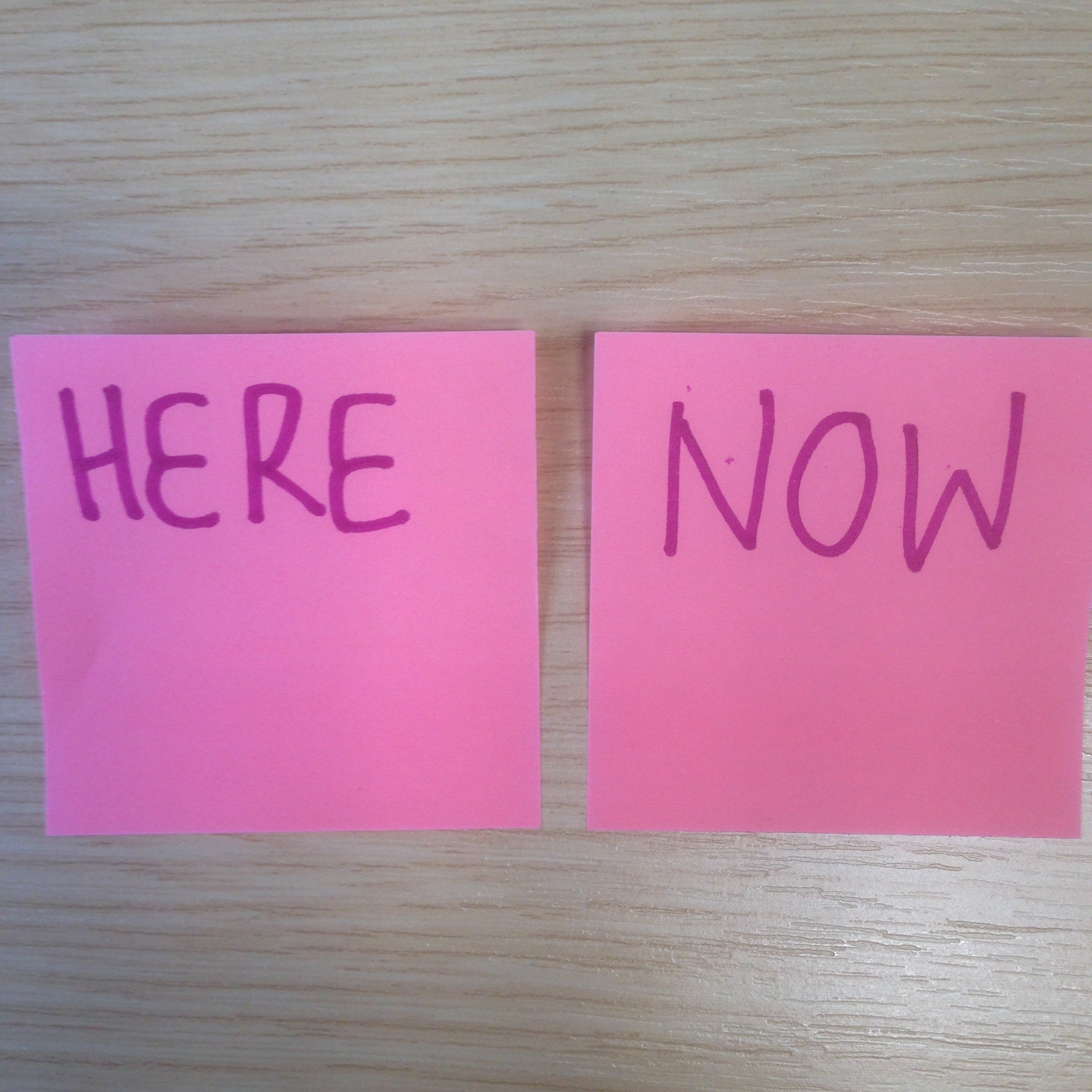
HERE

When should I start?

NOW

I have copied these words onto post-it notes which are now stuck on the top of my computer monitor to provide a continual kick up the backside from Jocko:

That’s it for today – I’ve got work to get on with!