Blue #poem

What is blue
and is whatever it is the same for me as it is for you?
A scientist might state that blue describes:

colours perceived by humans observing light with a dominant wavelength between approximately four-hundred-and-fifty and four-hundred-and-ninety-five nanometres‘,

which may well tell us how blue can arise –
in the human mind,
when a certain type of electromagnetic radiation enters the eyes.
But this does not, I think, tell us what blue really is.
For how can we be sure
that the imagined colour that my mind selects,
in its constant rush to paint upon its ever-changing canvas,
comes from the same small pan
into which you dipped your brush?

You can say that blue is the colour of the sky
(by day at least),
or of the vast expanse of open sea
(mostly),
or the shirt worn by the best team
(certainly not).
But what if you see all of those as I see green?
(Well then we would agree – those shirts belong to by far the greatest team the world has ever seen).

So what is blue
to me, or to you?

To complicate matters further…
‘blue’ could refer not to colour but, rather,
to the tone of my thoughts.
But if I tell you that just now the thoughts inside my head are blue,
how do you know
whether I am simply feeling a little down on my luck,
or whether my mind, unleashed,
is filled with images of a naked couple…?
Again, we come unstuck.

We must agree then, I think, to put aside all ambiguities,
and to take the definition, with all of its nanometres, at face value.
Then we can label the sky as blue and the sea as blue,
we can assume my mood is melancholy
even if it is really full of sauce,
and we can move on
(although, we will never agree about those shirts of course).

(c) Tim O’Hare, September 2023


BLUE: I’m not entirely sure where the idea for this poem came from but I guess I just liked playing with the words and the rhymes and bringing together some threads from different aspects of my life – science, perception, atmosphere, ocean, sports.


A revised version of this poem was published in Issue 16 (March 2024, ‘Colour’) of Consilience – an online Science Communication/Poetry journal. I’ve repeated it below for completeness…


What is blue
and is whatever it is the same for me as it is for you?

A scientist might state that blue describes:
‘colours perceived by a human when observing light having a primary wavelength in the range four-hundred-and-fifty to four-hundred-and-ninety-five nanometres’,
which may well tell us how blue can arise –
in the human mind,
when a certain type of electromagnetic radiation enters the eyes –
but does not, I think, tell us what blue really is.
For how can we be sure
that the imagined colour that my mind selects in its constant rush
to paint upon its ever-changing canvas
comes from the same small pan into which you dipped your own brush?

You can say that blue is the colour of the sky (by day at least)
or of the vast expanse of open sea (mostly)
or the shirt worn by the best team (certainly not).
But what if you see all of those as I see green?
(And then we agree those shirts belong to by far the greatest team the world has ever seen).

So what is blue
to me or to you?

To complicate matters further…
Blue could refer not to the colour of a sight but, rather,
to the tone of my thoughts.
But if I tell you that, just now, the thoughts inside my head are blue,
how do you know whether I am simply feeling a little down on my luck
or whether my mind, unleashed, is filled with a tumble of racy thoughts?
Again, we come unstuck.

We must agree then, I think, to put aside the ambiguities
and to take the scientist’s definition, with all of its nanometres, at face value.
Then we can label the sky as blue and the sea as blue;
we can assume my mood is melancholy even it is really full of sauce;
and we can move on
(although, we will never agree about those shirts of course).

(c) Tim O’Hare, March 2024
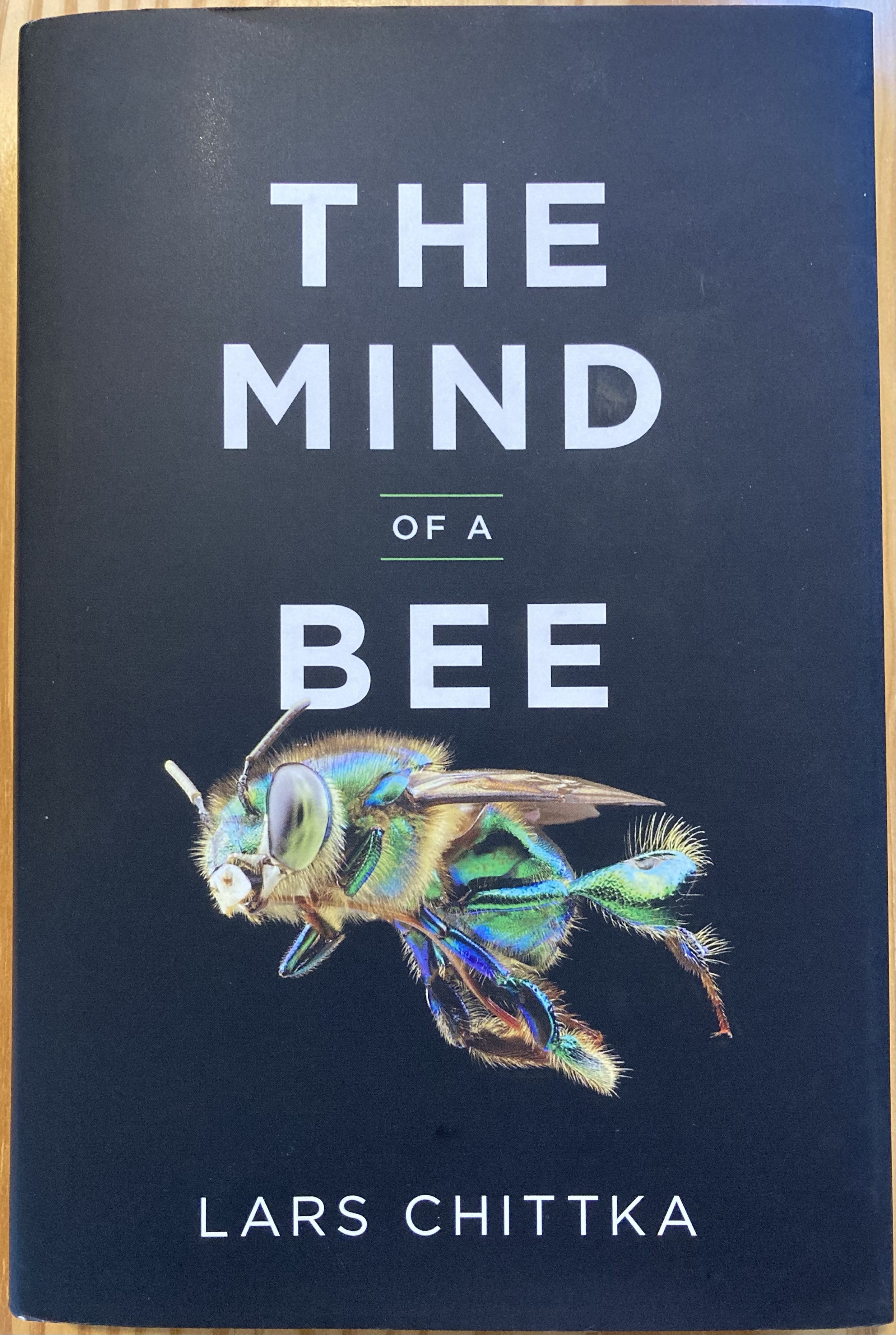
The Mind of a Bee – Lars Chittka #reading

At work, I am part of the supervisory team for a part-time PhD student who is trying to explain the relatively recent (2001) appearance of a tree bumblebee Bombus hypnorum in the U.K. My involvement in the project arose because one possibility for explaining how these bees made the hop across the English Channel from mainland Europe is that they might have been carried over be easterly or southeasterly winds. As the only person who teaches some meteorology in my department I was drawn into discussions at the outset of the project about 5 years ago, and my involvement has continued ever since.

What do I know about bees? Almost nothing… I completed an ‘O’ Level in Biology back in 1981 but I don’t recall bees ever being a topic that we learned about. Since then, although I have a general interest in natural history, I can’t say that I have thought about bees very much. But sometime around 2017 or 2018, the bird box in our garden was taken over by bees, I mentioned this to my the Head of School (who does know about bees), learned that most bumblebees nest in holes in the ground but that some, like my ones, were tree bumblebees, and from there I gradually became enmeshed in the ongoing attempt to explain why one type of these tree bumblebees had suddenly appeared in the U.K. Eventually, I decided I really should get to know a bit about more about bumblebees and that led me first to read Dave Goulson’s book ‘A Sting In The Tale’ (in June 2022) and then at the start of this year, Lars Chittka’s book ‘The Mind of a Bee’.

‘The Mind of A Bee’ was a fascinating book, covering bees’ sensory capabilities, instinctual behaviours, intelligence, communication systems, spatial memory and navigational capabilities, learning, brain structure, personality and consciousness. Packed with easily understandable summaries of a huge of scientific experiments and interesting background information about the scientists that conducted them, ‘The Mind of a Bee’ leaves no room for doubt that despite their small size, bees brains are capable of many astounding feats and that the bees themselves are highly complex animals with many sophisticated behaviours and skills.

The part of the book that interested and intrigued me most was the section early on about sensory capability and, in particular, bee vision. Bee vision is shifted to shorter wavelengths than human vision which means that bees can ‘see’ in the ultra-violet part of the electromagnetic spectrum and are effectively red-blind (which explains why red flowers are relatively rare in European fauna [research has also shown that flower colours have adapted to match insect vision and not the other way around as would perhaps seem more intuitive]). Bee vision is also trichromatic (UV, blue, green) and bee brains mix these three colours in the same way that human brains mix red, green and blue, ending up with a mixed colour that is indistinguishable from pure light at the relevant frequency. Apparently, this is unusual… and it is also very different from the way that we perceive sound, where we can perceive many frequencies at the same time so that we hear chords, harmony and dissonance. This difference arises because we have thousands of auditory receptors responding to different frequencies. I found it fascinating to think about what sound would be like if we could only sense three frequencies and mixed them to make a single note and what vision would be like if we saw objects as chords of different coloured lights. To be honest, my mind was a bit blown by thinking about all of this!

Reading ‘The Mind of a Bee’ certainly gave me a lot of insight into the brains, behaviours and learning capabilities of bees. It’s certainly a book that opens up the mind of the human that reads it and makes that mind think about just how different the game of life can be for different animals.

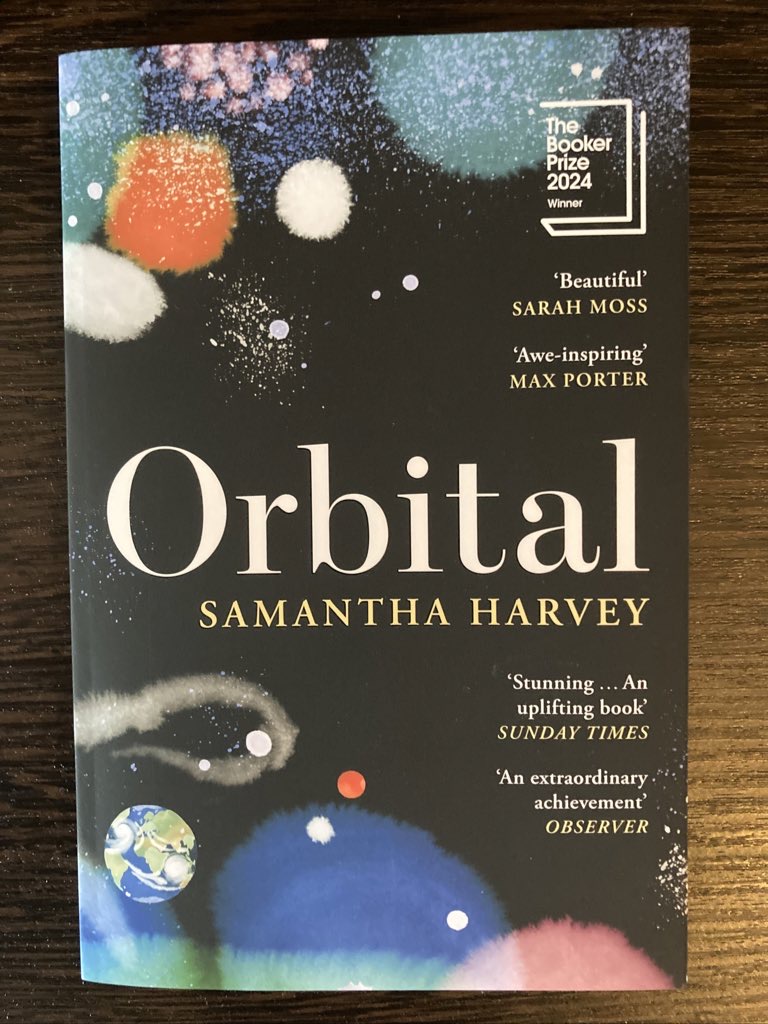
Orbital – Samantha Harvey #reading

‘Orbital’, the 2024 Booker Prize-winning novel by Samantha Harvey was the first book that I finished reading this year. I will admit that I am not usually a reader of what might be called ‘literary’ fiction but as this book was fairly short and has a science-based theme (the book recounts the thoughts of a group of astronauts on board the International Space Station (ISS) as it orbits the Earth over the period of one day), my wife thought it would probably interest me and gave it to me as a Christmas present.

I find books like this, that don’t really have a story as such, quite intriguing. It is interesting to ask the question: What it is that makes spending time with one set of fictional characters doing nothing in particular, apart from existing and thinking, interesting? (especially as it is easy to imagine many instances when it certainly wouldn’t be).

As it turned out, I did enjoy the day I spent with Harvey’s collections of imagined astronauts as they repeatedly observed their home planet (the ISS completes 16 orbits of Earth per day) and mused on their connections with the people, places and events down below. The writing challenges the reader to consider their own place in the world and the perspective from which they view both ordinary and extraordinary events. For me, the core themes that emerged from my reading of Orbital were the extent to which so much of human endeavour is bound up in the pursuit of progress, both the grand-scale technological progress shared only by a few such as the astronauts on the ISS, and the small-scale, day-to-day progress, shared by everyone of us, and the fragility of the world that all of this progress has created.

While gazing down onto the planet’s surface, one of the astronauts muses on this theme of progress in connection with his relationship with his daughter and the passage in the text that captures the stream of his thoughts as he does so was one that resonated deeply for me:

But what he meant to say to his daughter – and what he will say when he returns – is that progress is not a thing but a feeling, it’s a feeling of adventure and expansion that starts in the belly and works up to the chest (and so often ends in the head where it tends to go wrong). It’s a feeling he has almost perpetually when here, in both the biggest and smallest of moments – this belly-chest knowing of the deep beauty of things, and of some improbable grace that has shot him up here in the thick of the stars. A beauty he feels while he vacuums the control panels and air vents, as they eat their lunch separately and then dinner together as they pile their waste into a cargo module to be launched towards earth where it’ll burn up in the atmosphere and be gone, as the spectrometer surveys the planet, as the day becomes night which quickly becomes day as the stars appear and disappear, as the continents pass beneath in infinite colour as he catches a glob of toothpaste mid-air on his brush, as he combs his hair and climbs tired at the end of each day into his untethered sleeping bag and hangs neither upside down nor the right way up, because there is no right way up, a fact the brain comes to accept without argument, as he prepares to sleep two hundred and fifty miles above any ground for their falsely imposed night while outside the sun rises and sets fitfully.