I’ve just stumbled on this footage on the BBC website of a huge waterspout filmed over coastal waters in New South Wales, Australia: BBC waterspout clip. Coincidentally, at the exact moment I first saw the footage I was listening to a BBC Material World podcast feature on tornadoes.
Category: Themes
Amazing cloud film
This is an entry I’ve been meaning to write for ages. Sometime a while back I stumbled upon a website for a Science/Art project called “A History of the Sky” by a guy called Ken Murphy. This project sets out to record the history of the sky as viewed from a fixed vantage point using a time-lapse camera. The camera films the sky each day taking a picture every 10 seconds and then the film from each day is displayed side by side on a big screen producing a mosaic-like effect in which each block of the screen is a day’s worth of sky change. The aim is to put screens in public arenas and, ultimately to show the full year in one go. It’s perhaps hard to get a real grasp of what this ends up looking like but you can read more about the project at its website which also include examples of a 42 day preview movies and a 126 day version which is also available to view in better quality directly on youtube (watch in full screen mode). The 126 day version is particularly good because it is a long enough period to be able to see the seasonal change in sunrise and sunset times between the earlier and later days in the sequence. I also really like the way that you can see the pinky/purple tinge of sunset enter each image just before the end of daylight and the image dropping out to black.
Personally, I think there is only one word to describe this piece of work and that (much over-used) word is “awesome”.
Cage football
Anyone who has clicked through to look at my “Run O’Hare Run” page may have noticed that alongside my record of my running exploits I have added the comment “+ cage football on Saturday” in the entries for the last couple of weeks. I thought I would explain what this is.
Most Saturday mornings at the moment are taken up ferrying my younger daughter to her football matches for Phoenix City under-14s and then watching these games unfold. However, when there is no match, as has been the case for the last couple of weekends, some of the players in her team together with their manager/coach and a few of us old men (Dads) get together in one of those small cages that house a concrete pitch, a couple of basketball goals and a couple of open areas that serve as football goals. We then spend an hour or so running around like mad things, the girls practising their skills and the Dads trying to regain their lost youth. It’s brilliant fun – if I played football with just a bunch of men I’d be instantly mashed to pieces, but against the girls it’s possible to run around a bit, demonstrate those silky ball skills (though mine do then to occur in slow motion) and even score the odd goal or two (though my shots do have a frustrating tendency to go straight at the ‘keeper). Mind you, it’s not without no physical content – the girls are pretty good at the odd kick in the shins and it’s good to see (and experience) them beginning to get the hang of barging opposition players out of the way and trying out some of the dark arts of holding and shoving. It’s also really, really good exercise (for me). In fact two weeks ago I almost managed to reduce myself to complete physical incapacity within the space of 10 minutes – and quickly learned the lesson to pace myself better last time.
Anyway, that’s cage football.
Sun Dogs
A couple of weeks ago I was driving back from dropping my younger daughter off at her football training. It was about 6.30pm and the route took me almost due west through Plymouth. Ahead of me, in the sky, were (high) Cirrostratus clouds blocking out the Sun as it dropped down towards the western horizon. Either side of the sun were two small patches of “rainbow” – in other words not actually portions of full rainbow arcs but small patches of rainbow coloured light glinting through the clouds, horizontally one on either side of the sun. It was a beautiful site and, of course, when I got home I went scurrying to my books and discovered that what I had just seen was an excellent pair of “sun dogs”, also known as “mock suns” or “parhelia”. They are formed by the refraction of sublight through hexagonal ice crystals (hence the observation of high clouds). According to my copy of “The Cloud Collector’s Handbook” a matching pair of sun dogs earns me 35 points! (TCCH is like an I-Spy book on clouds…).
For more on this kind of atmospheric optical phenomenon this Atmospheric Optics website is really excellent and contains explanations and lots of wonderful images. The entry on sun dogs is here.
A comfortable opening day win
Just got back from watching my youngest daughter’s football team (Phoenix City under-14s) play their first league match of a new season. It was a home game against Activate and, after the upset of going a goal down eraly on (and an own goal too), Phoenix took control of the game scoring 3 in the first half and 1 more in the second half to run out 4-1 winners. She played in centre-midfield, marking Activate’s best player and providing much of the distribution that helped to unlock the Activate defence. They all played really well (tired a bit towards the end as would be expected for a first game) but it was great to get this one out of the way, some points on the board and some positivity into the goal difference column.
Fractal forecasting
There’s an interesting piece in New Scientist, No 2733 [07 November 2009] outlining some new published research which has used satellite derived rainfall data to explore how atmospheric processes show the same patterns of variation whatever scale they are examined on. Such behaviour is called multi-fractal and basically means that if you look at something on a large scale you see a certain pattern of variation but then when you look in more detail at a smaller scale the same pattern shows up (an oft-quoted example of this are coastlines which show large-scale undulations/headlands/bays but which, when viewed more closely show similar undulations at smaller scale). Fractal behaviour is starting to show up in all kinds of data and processes.
Anyway, the importance of this finding for meteorology is that currently it is verydifficult to build numerical models which accurate forecast larger scale processes because the resolution of the models prevents accurate description of processes on smaller scales (and so these have to be added into the model as special parameterisations). If atmospheric processes are really fractal (an idea that was first suggested at least 80 years ago by Lewis Fry Richardson) then it will be possible to properly (or at least better) describe the smaller scale processes in numerical weather prediction models.
I’m a believer that much of the complexity that we observe in the real world is governed by relative simple underlying principles and behaviour and this research is an example of this occuring in practice.
A new kind of cloud?
Preparing for my recent lecture on clouds I came across this set of images on the BBC website [01 June 2009] along with a brief explanation of a campaign by the Cloud Appreciation Society (yes, I am a member) for a designation for a new type of cloud – “asperatus” (meaning “roughened up” or “agitated”). Click through the images in turn and read the captions to find out more (or just enjoy the REALLY awesome photos). There’s more on the campaign for asperatus clouds at the Cloud Appreciation Society website.
Peter Shilton’s Nearly Men
As a child I was always really into football but I was brought up in a non-sporting family in the middle of a non-football county (Somerset) and so my football-related activity was limited to reading loads and loads of football magazines, covering the walls of my bedroom with pictures of footballers, obsessively keeping records of results and scorers and playing endless Subbuteo football tournaments against myself. Then, when I moved away from home to go to university I ended up in places where football wasn’t a big deal. It was only when I pitched up in Plymouth in July 1992 that I was finally in a place where there was a proper football team.
I remember that not long after we moved to Plymouth my wife and I were walking in Central Park when a bunch of guys in training kit came running towards us. Out in front of them was the manager and as they passed us my wife looked at me and said with a tone os surprise “That’s Peter Shilton” (who if you don’t know was a very famous England goalkeeper). Shilton had fairly recently taken up his first, and only, appointment as a club manager.
Anyway, after a few months I finally got myself to Home Park to see Plymouth Argyle play (they lost to Huddersfield) and from that point onwards I was hooked (I’ve hardly missed a home game since 1993 which means that I will have been to something like 300-350 games). At one time I actually used to write the match reports for the official club website and even helped out with online commentary (usually my role was to be the side-kick to the main commentator although I did also get the odd stint doing the full commentary). My first full season as an Argyle fan was 1993/94 and this was rather a momentous season for Argyle as Shilton built a team that played attractive passing football and scored absolutely shed-loads of goals. They reached the play-off semi-finals only to fall to a depressing defeat (at Home Park) in the second leg to Burnley. That season Argyle played great football but they also let in too many goals and missed out on what should have been a straightforward promotion.
The following season (1994/95) everything went badly wrong. Players got injured, the squad fractured (thanks Peter Swan) and Shilton was eventually sacked following disagreements and highly-public fallings-out with the Chairman. It was a horrible season and ended in relegation.
“Peter Shilton’s Nearly Men” is a new book written by Argyle fan Paul Roberts that describes this whole period at the club, from just before we moved to Plymouth to the relegation that followed Shilton’s departure. It’s a great read for any Argyle fan who recalls that era, being based on lots of research including extensive interviews with the players and other figures at the club at that time. It took me right back to that era – one that in some ways is still fresh in my mind but in other ways seems like ancient history. It was good to be taken back to that periods, not only to remember the football but also to recall the other memories that I have of my first couple of years in Plymouth.
Cloud cakes
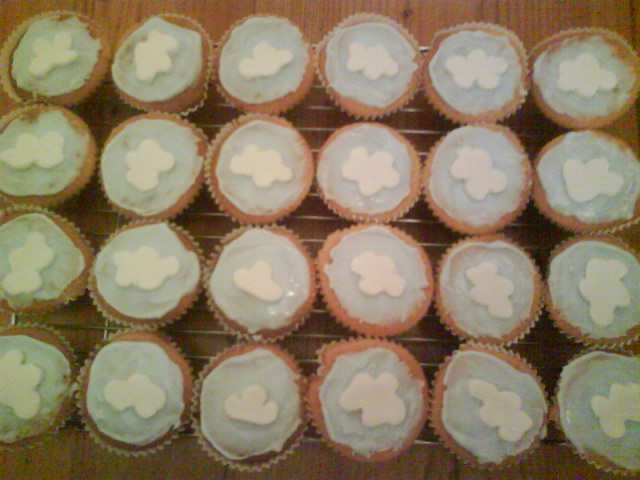
Anyone who has ever been a student on one of my courses will know that I do like to introduce the occasional gimmick or two – whether it be my use of a light sabre as a pointer in my “forces” lecture, sounding a bugle to highlight particularly important physical principles or … (further examples not disclosed so as not spoil the surprise for current students over the coming weeks!). Last week I think I surpassed myself though. At my first meteorology lecture of the year a few weeks ago one of the students came in with a plate of cakes that he was selling to raise money for a student group he is involved with. That put an idea in my head and with these particular lectures taking place late on a Friday afternoon I thought that a nice surprise for the students wouldn’t go amiss. So I spent last Thursday evening in the kitchen baking, but not just baking any old kind of cake. With last week’s lecture being all about clouds, it seemed appropriate to bake some cloud cakes. These were then taken into work and given out to the students towards the end of the lecture when I got to the section on exotic clouds.
You’re thinking I’m bluffing here don’t you? You want to see evidence don’t you?
So here you go… proof that I really am mad!
Freak waves explained?
Years ago when I was a lowly postgraduate student in North Wales there was a mysterious case of a small fishing vessel that sank in relatively calm conditions in Cardigan Bay. Concerns were expressed by some that the boat had been sunk by a navy submarine and after the relevant court cases etc. the local BBC station decided to make a short documentary about the sinking and came up to the lab I worked in to interview an expert and do some filming. I was setting up some waves in a laboratory wave channel for them to film so I got to listen in on the whole process from start to finish (I also had my index finger filmed as I used it to press the ‘on’ button for the wave tank – if ever there was an impressive claim to fame surely that has to be it!).
At the start of the filming process the interviewer briefed the expert (I’ll not name them) about the line of questioning the interview would take and absolutely promised that they would not ask the expert whether the wave that swamped the boat had been caused by a submarine. You can probably guess what happened – the interviewer proceeded to ask about each possible natural cause of sinking and each was ruled out in turn. With no natural causes left the interview then dropped in the killer question – so could the sinking have been caused by a submarine? To which the expert was left with no answer other than an open mouth and an uncomfortable pauase before a hesitant “I suppose that is possible” type of answer.
Since then I’ve come across several reports about freak waves, sinking and damaging ships and there was a BBC science documentary about freak waves a few years ago. Now, there has been some new theoretical research which suggests that certain configurations of sand banks can cause freak waves, up to three times the typical wave size, to occur much more frequently than would otherwise be expected. The authors of the work, which was reported on the BBC Website [09 August 2009] are at pains to point out that their work is theoretical, but should be possible to test their work with measurements made in particular locations. If their work turns out to be correct and to have wide applicability then the world’s shipping companies will be beating a path to their door in no time at all.
 Tim O'Hare