Deep – James Nestor #reading

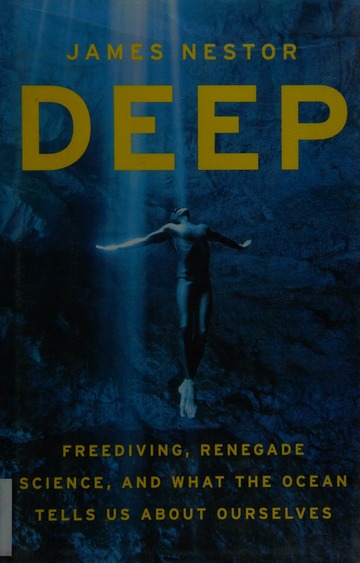
I read James Nestor’s book Deep back in February/March, but I am a bit behind with my efforts to write blog entries and so I am only just getting round to writing something about it now. You could say that I have been submerged to such an extent that I have not been able to see even a glimmer of light to guide me in the right direction to get back on track…

Deep was not a book that I had ever noticed and thought I wanted to read, but one morning, at the back-end of last year, one of the students I teach in my first-year introductory oceanography module (there are almost 300 of them, although they are rarely [never?] all to be seen in the same place) came to see me during the break in one of my lectures and passed their copy of the book to me suggesting that I might like to read it. I think that my students generally assume that I am fascinated by the subjects that I teach and will love finding out more about any topic relating to them. This is actually not the case – it was a fairly random and somewhat inexplicable sequence of events that ended with me studying for an MSc and then a PhD relating to oceanography, and from there it was just a case of me continuing to follow what seemed to be the simplest path (i.e. the one that involved me making the minimum number of decisions) into my career as a Marine Science lecturer. Inexplicable it may have been (to me at least), but it’s a path that stuck, such that here I am, some 33 years later, still following it (maybe some would call it a rut!). So, in fact, I am not that interested in the undersea world, marine life and topics such as diving, I just somehow create the impression that I am fascinated by the oceans when I am teaching students about the various processes that occur within and on them.

Nevertheless, I thanked the student for passing the book to me and set it aside to read at some point. I had previously read his later book ‘Breath: The New Science of a Lost Art’, I knew that Nestor wrote well and would almost certainly have some interesting points to make, so it wasn’t really a difficult decision.

Deep is mostly about the pursuits of the very strange (to me at least) group of humans who strive to head as far as possible downwards into the ocean depths. It is nearly structured as a series of chapters titled by a depth in feet (e.g. -650, -2500, -35,850) and containing stories of human exploration towards that depth. Initially, at shallower depths, Nestor describes the pursuits of free divers, including the absolutely insane group of people that risk death competing to dive deeper and longer than their rivals. Some of the events that Nestor recounts, in which competitors emerge from the water with blood streaming from their faces, or in a semi or fully unconscious state were pretty horrific and I find it surprising that i) the ‘sport’ is allowed to continue, ii) anyone wants to participate in it and iii) Nestor still went ahead and learned to free dive so that he could join in with various activities.

In the latter part of the book, much of the content focuses on scientists and researchers who combine diving with attempts to better understand the behaviour of marine life such as various types of sharks and whales. All of this content was quite interesting, even for someone who is not at all obsessed with sharks and whales like me! It was particularly interesting to get a glimpse of the kinds of private organisations and collections of individuals that operate in this area of scientific exploration and research – often rather cavalier and unorthodox in their approach, because, I suspect, anyone trying to do the kind of ‘animal-encounters-at-close-quarters’ research that the book describes in a traditional, more highly regulated, academic setting would probably find that their efforts were thwarted by the requirements of such niggly things as risk assessments and ethical considerations.

In the end, I enjoyed reading Deep, and found it interesting to get a glimpse of the world of underwater activity it describes. However, it did nothing to make me wish that I was able to descend below the waves myself, quite the reverse in fact. I’ve always been quite happy existing on the solid substance of the land surface, and it’s pretty obvious to me that nothing is going to change that now!

‘Our Ocean Planet’ gets underway

Today is the first day of a module that I help to teach called ‘Our Ocean Planet’. It is completely different from other modules I work on because 1) it only lasts 4 weeks and is the only thing that the students who are taking it do for those weeks and 2) it has very little technical content. The idea of the module is for small groups of students to pick an issue relating to the oceans and develop some kind of ‘product’ designed to communicate the issue to a wide audience. In the past we have had groups produce talks, books (for various age groups), websites and quite a few games. It’s quite a fun and interesting module to be involved with because no two groups are the same and at the outset there is no knowing what direction any particular group will take both in terms of the topic/issue that they cover and the vehicle through which they choose to communicate it.

This year I am involved in two ways. First I will be ‘looking after’ four of the working groups (each with four students), although this going to be a somewhat lighter touch than in the last couple of years as there is only one formal meeting with each group each week. Secondly, I volunteered to give a few lectures to provide some background information on the oceans, aimed mostly at the students on the module who are not covering any marine science in the rest of their course. On the module we have students from various marine science and marine biology degrees but also some from geography, geology and environmental science and also some from English and creative writing. I gave the first of my lectures this morning, titled ‘Geography of the Oceans’, and covered the general distribution of the oceans on the planet, the shape and form of the seabed in different domains (continental margins, deep ocean floor, ocean trenches and mid-ocean ridges) and talked a little about the dynamic nature of the seabed and the Earth’s crust more generally (plate tectonics, seafloor spreading). The session seemed to go okay and I was pleased that I got the timing about right (this is always tricky when giving a session for the first time despite years of experience – partly because the more teaching you do the more comfortable you become just talking around a topic and this can mean that you take more time on topics than planned).

This afternoon the students have been out on and around Plymouth Sound taking photographs of the water and, in particular, litter and pollution in the water, and tweeting their pictures and thoughts about what they see. Later on they will be analysing this data to get a look at the bigger picture.

The real fun starts in a couple of days time when the groups start to properly form and, panicked by the short timescale available to them (3 weeks), start to decide on their topics and how they are going to communicate them. It would be nice to see some novel topics this year and some creative approaches to the communication side of things. We shall see.

Freak waves explained?

Years ago when I was a lowly postgraduate student in North Wales there was a mysterious case of a small fishing vessel that sank in relatively calm conditions in Cardigan Bay. Concerns were expressed by some that the boat had been sunk by a navy submarine and after the relevant court cases etc. the local BBC station decided to make a short documentary about the sinking and came up to the lab I worked in to interview an expert and do some filming. I was setting up some waves in a laboratory wave channel for them to film so I got to listen in on the whole process from start to finish (I also had my index finger filmed as I used it to press the ‘on’ button for the wave tank – if ever there was an impressive claim to fame surely that has to be it!).

At the start of the filming process the interviewer briefed the expert (I’ll not name them) about the line of questioning the interview would take and absolutely promised that they would not ask the expert whether the wave that swamped the boat had been caused by a submarine. You can probably guess what happened – the interviewer proceeded to ask about each possible natural cause of sinking and each was ruled out in turn. With no natural causes left the interview then dropped in the killer question – so could the sinking have been caused by a submarine? To which the expert was left with no answer other than an open mouth and an uncomfortable pauase before a hesitant “I suppose that is possible” type of answer.

Since then I’ve come across several reports about freak waves, sinking and damaging ships and there was a BBC science documentary about freak waves a few years ago. Now, there has been some new theoretical research which suggests that certain configurations of sand banks can cause freak waves, up to three times the typical wave size, to occur much more frequently than would otherwise be expected. The authors of the work, which was reported on the BBC Website [09 August 2009] are at pains to point out that their work is theoretical, but should be possible to test their work with measurements made in particular locations. If their work turns out to be correct and to have wide applicability then the world’s shipping companies will be beating a path to their door in no time at all.

Time for Plan B – Geoengineering

There has been a huge amount of coverage of the need to cut Greenhouse Gas emissions as the primary route to slow down, halt and eventually reverse the current global warming trend and rightly so. However, in the background there have been a number of suggestions for actions that mankind could take to directly counter-act global warming. Such measures are collectively known as geoengineering and include such things as the direct removal of carbon dioxide from the atmosphere (e.g. by planting trees or fertilising the oceans) and reflecting incoming solar radiation away from the Earth (e.g. by using mirrors in space or changing the land surface to make it more reflective). These measures have not recevied much public attention, partly because they are all really, really expensive, partly because no-one knows how effective they would be and partly because by discussing the ideas in public we might distract attention from the goal of reducing Greenhouse Gas emissions.

Now, the tide has turned a little. A recent report produced by the Royal Society has highlighted the need to urgently begin considering geoengineering as a Plan B to reducing emissions. The report works through various geoengineering ideas examining their affordability and effectiveness and suggests that there should be a major shift of funding into geoengineering research. The report was widely publicised in the media at the beginning of September and the geoengineering debate is nicely summarised in New Scientist, Issue 2724 [05 September 2009].

Marine life mixes oceans

One of my colleagues carries out research examining the small scale mixing processes that go on in the oceans. He uses a complicated camera system with lasers and holograms and maps out the swirling motion of the water by tracking particles in the water [see here]. In the past he has ended up with some interesting pictures of little (microscopic) creatures in the water and he has begun to think about how these creatures stir up the oceans as they move around.

So, it was interesting when news of some research conducted in California broke recently. The work has measured the effect that jellyfish swimming in weater have on the mixing of the water water itself. Jellyfish were used because they are relatively simple and can be simulated in models quite well but the principle of ocean mixing by organisms is being considered more widely. In fact, the idea was suggested by Charles Darwin’s grandson some time ago. It turns out that the new research suggests that the mixing could be significant although the extrpolation to all ocean-going organisms, in particular the really small ones (of which there are huge numbers) is a rather uncertain process. It has been suggested that this organismal mixing could be as big as that produced by the other key mixing processes – wind and ocean tides. The result won’t change the results of ocean models because these work by adding in as much mixing as is necessary to get the “right” results but it may point a way to understanding global ocean mixing more thoroughly and it suggests that my colleague’s potential to view the water motion around smaller organisms might be a really fruitful direction to go in.

The research is reported in New Scientist, Issue 2719 [01 August 2009] and also on the BBC Website [29 July 2009].

Spare a thought for sea grass

It is common knowledge that coral reefs and coral reef ecosystems are under threat but it is less well known that sea grass meadows are also struggling. Sea grass  is found in shallow coastal waters across the whole planet and are important as a refuge for crustaceans, young fish and larger creatures such as dugongs and turtles. A recent meta-analysis (pooling data from 215 regional studies from 1879 to 2006) has revealed that the total area of seagrass meadows has declined by 29% since 1879. It is thought that much of the damage is done by sediment dumping, pollution and nutrient run-off which decrease water quality, starving the sea grass of the sunlight it needs to grow. The research is highlighted in New Scientist, Issue 2716 [11 July 2009].

Sea level rise – it just goes on and on…

New Scientist, Issue 2715 [04 July 2009] contains a substantial article on sea level rise which sets out the latest findings on rates of sea level rise and puts these into the context of past changes in sea level. It seems that a rise of 80cm by 2100 is a pretty standard projection, a rise of ~2m by 2100 is within the realms of possibility and even bigger rises cannot be discounted. An important point to bear in mind is that when projections are given for 2100 it is important not to forget that this isn’t the end of the story and that sea levels will continue to rise after this point and also that although much greater changes have occurred earlier in the Earth’s history we need to remember that humans weren’t around then…

A tale of two gases (and the Southern Ocean)

It’s reasonably well known (!) that carbon dioxide levels in the atmosphere are increasing… it’s also reasonably well known that increased carbon dioxide levels in the atmosphere are leading to increased carbon dioxide levels in the oceans (leading to ocean acidification). However, new research reported in New Scientist, Issue 2715 [04 July 2009] suggests that in the Southern Ocean, the picture isn’t quite that simple. Measurements from the Southern Ocean show that carbon dioxide levels have flattened off in recent decades (having previously increased) and a new modelling study points the finger of “blame” for this at the hole in the ozone layer in this region. Lower levels of atmospheric ozone (at high levels) and increased levels of carbon dioxide (at lower levels) have changed the energy balance in the atmosphere, generating stronger westerly winds, enhancing ocean circulation and encouraging carbon-rich water to rise up from the deep (a process known as upwelling). The result is surface water that is less able to absorb carbon dioxide from the atmosphere. This is a great example of an unexpected feedback effect of one part of the Earth-atmosphere system with another and just goes to show how complex and inter-connected all of these processes really are.

From World War II to surf forecasts

My favourite reference in my PhD thesis (1992) was to a paper from the 1940s which was titled “On determining the gradient of enemy held beaches”. I liked the way that the title gives an explicit description of what the paper is about and I also liked the way that it seemed so far removed from the time and purpose of my own study.

In reality though, a great deal of the modern-day research done on waves and beach processes has its roots in the work of scientists in the 1940s associated with predicting wave and beach conditions for Allied Forces landings in north Africa and Normandy. One such piece of work that anyone who studies waves to a reasonable level will come across is the SMB-method for predicting waves. The abbreviation SMB represents the names of the three protaganists in the development of the method – Sverdrup, Munk and Bretschneider – and the method uses a knowledge of three parameters, wind speed, duration for which the wind has been blowing and the fetch (distance) over which the waves are being built up by the wind to predict the significant wave height and peak wave period. It is based on a special diagram which cleverly combines all of the variables and presents the outputs in a graphical form called a nonogram.

So, given my own use of research originating from the World War II era, it was interesting to read an historical piece in New Scientist, No 2714 [27 June 2009] about how Walter Munk (now aged 91) became involved in wave prediction in relation to Allied Forces landings and how this work subsequently spawned the surf prediction industry. It’s a good example of how widely applicable research can be triggered by a specific requirement and how it is not always possible to spot the full value of research (Munk missed out on making money from surf prediction).

A tale of two oceans – the seas in 2050

Last weekend The Times newspaper carried various reports publicising The Times Cheltenham Science Festival. One of these focussed on the major threats to the world’s oceans including CO2 emissions, warming and acidification and carried a plea for immediate action. The report was accompanied by a nice graphic showing two versions of the seas in 2050 side-by-side. In the first of these, the major problems had been tackled and the oceans and the ecosystems they contain had “revived” and in the second, problems had not been solved and the oceans and ecosystems are “collapsed”. For each version of the oceans there are 15 or 16 points of note, either positive in the case of the “revived” seas or negative in the case of the collapsed” ones. The article is available online (The Times [06 June 2009]) and pleasingly, so is the colour graphic (either via the link in the article or directly via this link).