Stumblings #2

Here are five more random things I thought I would write about:

1) ‘Follow Your Curiosity’
There’s a slightly odd website that I browse fairly regularly called ‘The Art of Manliness‘ which describes itself as ‘a blog about growing up well, aimed at men and their unique challenges and interests’. Some of the blog posts are interesting and fun – about fitness, personal effectiveness etc. – and some are just downright odd – like one on how to survive falling through the ice (such as might happen if you are out ice fishing on a frozen lake somewhere – as you do…). I’ve started listening to the AoM podcast and in one recent episode (AoM podcast #95 ‘Follow Your Curiosity’ with Brian Koppelman) I was struck by two particular things. First, I liked the idea that in life you should not seek to follow your passion, but, rather, you should follow your curiosity. Secondly, I liked a comment that was expressed along the line of ‘Don’t be bound by the assumptions you made yesterday. You can change them’.

2) Frank Chimero and his new newsletter
I keep track of the internet writings of a few particular creative types. In each case, at some point, I have stumbled upon something they wrote that struck a chord in my head and, as a result, added them to my list of people to keep an eye on for more snippets of interest, wisdom and inspiration. On this list is a designer called Frank Chimero. I don’t remember now what it was that he wrote to catch my eye, but since then he’s posted more material that I have enjoyed and so I have continue to follow him. Somehow I have managed to get to sign up for his new weekly email newsletter ‘Frank’s Findings’ – oddly, there doesn’t seem to be a link to this on his website but you can get to see it at tinyletter.com. It has only been running for three weeks but already there has been a great mix of quirky content that I have enjoyed browsing (and if I am honest, it helped to inspire me to start these Stumblings posts on this blog).

3) Am I a scientist?
Although I work as an academic and am, nominally, some kind of marine scientist, it is fair to say that for much of my career I have focussed almost entirely on teaching, management, student recruitment and course leadership. This has meant that the extent to which I have been involved in scientific research in my field of expertise has been pretty limited at times. Sometimes this doesn’t really bother me, but at other times it leaves me with a feeling that I am not a proper academic and don’t have any very strong link to my subject area. Things have improved a bit recently, thanks largely to prompting and support from a particular colleague. A short while back I kind of sat up one day and asked myself the question ‘Am I a scientist?’. The answer was a sort of yes and a sort of no. I ought to be and, nominally, I am, but the thought struck me that if I am actually a scientist then some days I need to go to work and just be a scientist and not try to be a scientist at the same time as being all the other things my job demands me to be. The result was the idea that I would try to have ‘science days’ when I can go to work and ignore all of the other demands on me (like emails from students, requests for help from colleagues) and just be a scientist. I tried it once and it worked brilliantly. I tried it a second time and something really urgent cropped up that wrecked my plan. I suppose the jury is out on whether this little piece of sleight of mind works or not, but I suspect it might and I am going to try to keep hold of the idea.

4) Boyhood
I went to see the film Boyhood in the summer with my younger daughter and it totally blew me away. It is the best film I have ever seen and I came out of the cinema thinking I could (and wanted to) watch it again and again. I am not going to go into detail here. I just want to report that I loved this film; I loved the message, the acting, some of the music, the idea behind it, the fact that the writer/director Richard Linklatter thinks the way he does. I loved everything about it. I mention it here because it has just come out on DVD and I watched it again. It’s still brilliant. I still love everything about it. If you haven’t seen it, get hold of a copy and watch it. If, after watching it, you say something like ‘oh but nothing happened’ (as one person I know did) then all I can say is …, well, actually I don’t think I can put what I would say to you on a public forum!

5) Kurt Wallander/Henning Mankell
I like reading crime fiction but it is quite a while since I read one of Swedish author Henning Mankell’s Wallander novels. I started reading ‘The Man Who Smiled’ recently (I think this is the fourth Wallander novel) and it’s simply great. It’s so nice to slip straight back into a character and get completely hooked by a story.
Stumblings #1

This is the first of what may, or may not, become a series of posts in which I write about five things I stumbled upon in the last week or so. These ‘things’ might be anything: a book I read, a film I watched, something I created, a piece of insight gained. I have no idea whether I will be able to sustain this, what it will become in the future or whether anyone will find it interesting, but if nothing else, I intend to enjoy recognising the five things I stumble upon each week and recording them in this way. Here goes:

1) Accidental Creative Podcasts
I came across the Accidental Creative website a while back and read the first book by it’s author, Todd Henry, towards the back end of last year. Accidental Creative is aimed at ‘creatives’, taking a wide definition of this word along the lines of ‘someone whose work entails them creating value on a regular basis’. I really enjoyed the book and found a lot within it that resonated with my struggles to remain productive and creative. More recently, I started listening to the Accidental Creative Podcast and my decision to include this entry in my Stumblings is specifically inspired by a podcast on ‘Procrastinating on Purpose’ that I listened to on the way home from work one day last week. The basic idea of PoPing is that you should decide what to do at any point based not simply on whether tasks are urgent or important (classic time management approach) but also whether they are significant. Like most ideas of this type, it’s all just common sense really, in this case that it is a really good idea to deliberately spend time doing things that enable you to be more productive in the future (such as developing skills, laying foundations, scoping a project) and that to do this you have to deliberately put off until later other tasks that you could do now but don’t have to. The danger is that you simply do the tasks you can do now, create an illusion that you have been productive but then not enable yourself to work ‘better’ in the future. Anyway, I include the AC Podcasts here not for that specific episode but just as something that I think is generally seeming to have some value for me.

2) Tchaikovsky Symphonies
I grew up to classical music and always had a particular liking for Tchaikovsky. But in recent years (actually more like the last 30 years) I haven’t found time for myself to listen to classical music so much. A couple of weeks ago I went to see the film Birdman with my younger daughter and Tchaikovsky’s music features quite heavily in the soundtrack (a great choice for the film because, for me at least, T’s music is laced with strain, yearning and a feeling of desperation). Subsequently, I decided to listen to T’s later symphonies (surely his best works) and this reminded me how much I liked them and how great they are. As a child I was always most taken by the 5th Symphony, but I have to say that from this recent re-listening, the 4th Symphony is the one that did it for me this time. The music in the first movement seemed to reach right inside me, rip out my heart and then wink mockingly at me. Not everyone’s cup of tea I suppose!

3) Regular Running
This year (well since 2nd January actually) I have been running every day, if only for a mile sometimes. I suspect I will write more about this in the future but, for now, I just wanted to record that there seems to be something different that happens to both your body and your mind when you run daily rather than just running a few times each week. Physically, I can start to see my body re-shaping itself which is interesting. Mentally, I find I am far more ‘level’, quicker to focus on tasks at hand and generally more positive. It’s well known that running induces chemical changes in your body but I hadn’t expected to notice such a difference in my response between running often and running daily. Of course, it might just be me feeling something because I want to feel it. We’ll see.

4) Action v Inaction
This is a simple one. I was musing about diving in and doing something versus thinking about doing something later and the following words popped into my head: “The brief moment for action is inevitably followed by a lifetime of opportunities for inaction”.

5) Whiplash
I went to see this film with my wife and younger daughter. All I want to say is that it is brilliant. I like films that are about something rather than simply a story. Whiplash is about what is and isn’t acceptable when trying to foster genius. It almost forces you to agree with some really unacceptable behaviour on the part of a teacher/mentor. Brilliant acting, brilliant filming, brilliantly playful, brilliantly thought-provoking. Watch it.

Humans as ultra-mobile worms

Any alert readers of this site (ha, as if there are any readers…) might have noticed that I am gradually working my way thorugh some recent back issues of New Scientist highlighting a few interesting articles along the way. Something that intrigued me from New Scientist Issue 2697 (28 February 2009) was the response to a letter from a parent asking a question on behalf of their daughter (age not given). The daughter wanted to know why humans have evolved to have two systems to excrete waste products (“poo” and “wee”). I’ve never thought about this before, but the responses indicated that in fact we only have one real excretion system, “wee”, as this takes waste products from inside our bodies and ejects them to the outside. It turns out (and this is the good part) that really our bodies can be thought of as having an elongated annular shape, by which I mean that we are a chunk of connected organic matter that surrounds a long tube. We feed by drawing material in through our mouth, squashing it about a bit, squirting acid on it, sucking the good bits into our interior and leaving what is left to drop out of the end of the tube. This is certainly a very different view of things, but clearly it is not wrong. Now I keep thinking of humans as being quite like some ultra-mobile and (presumably) ultra-intelligent worms, roaming through space enveloping food, and leaving a trail of waste behind us… What a great question.

It won’t be pretty as the climate changes

Earlier this week I helped to assess some presentations given by final year Ocean Science degree students. The presentations were the endpoint of a year-long integrating case study module in which small groups of students work together to tackle a realistic consultancy-type project relating to their degree area. Several of this year’s topics related to future changes that are likely to occur in coastal regions as a result of climate change and, in particular, sea level rise (for example, there was one project on the threat to the main south-west railway line at Dawlish and another on the need to protect or re-route the coastal road at Slapton [both locations in Devon, UK]). Anyway, I don’t want to go into details about these projects but there was one thought that struck me very firmly as I reviewed the material in front of me, namely that because significant sea-level rise is going to occur and because there will be significant impacts on infrastructure such as railway lines, roads and housing, developed coastal areas ARE going to change and it’s not going to be pretty.

There was one picture of Dawlish showing the railway line, which runs along a seawall, with nice “safe” houses perched up on the hills behind the low-lying coastal strip. It is inevitable that at some point in the not too distant future the seawall will crumble, the railway line will be lost and the low-lying area will be inundated, but the houses further back an up will be okay. The thought that struck me though was that no-one will come along and landscape the eroding and flooding coastal strip; no-one will tidy up the damage, remove the old buildings, the concrete blocks and the twisted metal etc. So once we start to lose coastal infrastructure of this type (and lose it we will) there will be a region that, for want of a better description, will look like some kind of war-zone and this, in turn, will lead to abandonment of the surrounding safer/higher areas because who will want to live next to a wasteland?

But this is only looking at a local scale… Also this week I read an interesting article in New Scientist Issue 2697 (28 February 2009) on how human civilisation will have to adapt and change to live in a warmer world. While large parts of the globe may become unable to sustain existing populations, other parts (e.g. northern latitudes) may become more suitable for human habitation either as a result of changes in temperature, rainfall, soil condition etc. I’ve been comfortable with the idea that the world will change as climate changes, but it had never struck me before that along with the serious environmental consequences, it won’t be pretty.

VAT’s a mystery

If I buy a cappuccino from the canteen at work it costs me £1.09. If a student buys a cappuccino from the same canteen is costs them 95p. I believe that the difference (14p) arises because students do not have to pay Value-Added-Tax (VAT) on their food and drink purchases whereas staff do. I can understand this but what I would like to know is does it make a difference i) who drinks the cappuccino? or ii) who’s money is used to buy the cappuccino? or iii) who hands over the money that is used to buy the cappuccino? What would happen in each of the following situations:

  1. I buy a cappuccino for a student to drink
  2. A student buys a cappuccino for me to drink
  3. I use a student’s money to buy a student a cappuccino to drink
  4. I give my money to a student to buy a cappuccino for me to drink
  5. I give my money to a student to buy a cappuccino for them to drink
  6. A student gives me the money for me to buy myself a cappuccino to drink

It seems to me that in cases 1, 3 and 4 the cost of the cappuccino is £1.09 and in cases 2, 5 a 6 the cost is 95p but in cases 2, 4 and 6 I get to do the drinking and in cases 1, 3 and 5 the student does the drinking. Case 4 is the best one for me, so if any of my students are reading this and want to come to some kind of arrangement, feel free to get in touch (there’s the seed of a money-making idea in here somewhere).

Eight is not the magic number

I spend quite a lot of my time in meetings of various committees, sometimes acting as Chair. So, it is perhaps not surprising that I was interested to read a recent New Scientist article (“The curse of the committee”, Issue 2690, 10 January 2009) describing some recent work by a couple of Austrian physicists which set out to create a mathematical model of the interactions that occur in committees and organisations of various sizes. This work revisits ground covered in the 1950s by C Northcote Parkinson (who is one of those “famous” people belonging to my “I know the name but I don’t know why” category). Parkinson is best known for the so-called “Parkinson’s Law” which basically states that work expands to fill the time available for its completion (a principle that certainly seems to have a lot of truth in it). Anyway, the new research explored how the size of a committee or administrative structure influences its effectiveness.

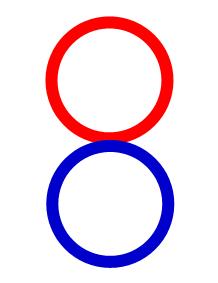
Based on knowledge of organisations throughout history, Parkinson argued that there was an upper limit on membership size beyond which an organisation becomes ineffective and will split into smaller units. The new research supports Parkinson’s hunch but more intriguingly, it was found that when the number of decision-makers involved in a group decision-making activity is eight there is a very high probability of deadlock occuring with the group splitting into two equal but opposing factions. So, the number eight is simply a bad number for committee membership etc. Thinking about this a little, it seems to me that this is an obvious result – look at the symbol for number eight: 8. It’s made up of two small loops (two groups) that touch each other but don’t overlap; two opposing factions that are unable to reach a consensus, like this:

eight

Snow? What snow?

So is the city of Plymouth sitting inside a sealed bubble, cut-off from the rest of the world, or what? Once again I have woken up to reports of huge (for the southern part of the UK) snowfalls, with the area just north and east of Plymouth being particularly badly hit. Last night, hundreds of motorists were trapped on Haldon Hill just west of Exeter and other routes across and into the south-west are also closed. Walking into work I have seen parked cars with a few centimetres of snow perched incongruously on the roof and I can go online (here for example) and see photographic proof that there really is snow and disruption out there.

But what of Plymouth? Can I see a single flake of snow in the sky? Can I see a single flake of snow on the ground? The short answer is “no”. Whilst the rest of the country has being struggling away with people grumbling about our inability to cope with the extreme weather, Plymouth has just carried on with no snow, no days off school for children,  no snowmen, no snowball fights. It’s actually hard to believe the news reports and hard not to feel that we’re living in a bubble here.