On The Road (Jack Kerouac)

I finished reading Jack Kerouac’s novel ‘On The Road’ last night. I read it because it was a that kept cropping up in podcasts that I listened to, I guess because it is very much an ‘in-the-moment’ description of a series of random incidents. The novel is written from the perspective of Sal Paradise, a youngish American man in the late 1940s/early 1950s who criss-crosses the USA, sometimes alone and sometimes with traveling companions (planned or otherwise). Basically, Sal has a series of adventures, none of which are especially dramatic or meaningful but which, nevertheless, add together into a journey of self-discovery. Sal comes across as a relatively level-headed guy which is more than can be said for his frequent companion Dean who seems to be a complete hot-head and totally out-of-control (marrying two women and having several children, leaving them multiple times, driving at incredible speeds, never sleeping, always partying etc). Dean clearly represents freedom and spontaneity and is a balance to the more measured and thoughtful Sal who is an observer of life and people (also a writer).

It’s an interesting book but also quite an odd one. I would say that I enjoyed it although I also found myself wanting to get it finished. It was almost as if I knew that being on the journey with Sal and Dean was never going to take me to an end destination and that the only way to escape was to jump off the pages.

One thing that particularly intrigues me is that my younger daughter (19) has told me that this is her favourite book, She is not a particularly avid reader and so I find it interesting that this particular title resonates with her. She has also read a few of Kerouac’s other novels (Big Sur, The Dharma Bums, The Town and The City) so there is obviously something about his style/message that catches her mind. Kerouac’s writing IS richly descriptive and somewhat hypnotic at times and ‘On The Road’ certainly captures a sense of youthful spirit and experiencing existence for it’s own sake.
On the Shortness of Life (Seneca)

On Sunday I finished reading Seneca’s ‘On the Shortness of Life’. It’s only a slim volume and I completed it in two chunks a few days apart. I have to say that I was hoping/expecting a little more from it. My disappointment could be because I read it relatively quickly and certainly not studiously but I think the rather drawn out and prosaic writing had something to do with this too, although it has to be borne in mind that it was written about 2000 years ago so perhaps that is understandable! Actually, writing the last sentence brings to mind that it really is quite remarkable that something written so long ago can still speak to a modern reader (of course the translator and editor of the edition I was reading are not quite so ancient).

Having skipped through the book I came away with three take-away messages. First, Seneca argues that life isn’t really short and that, in fact, it is plenty long enough if used correctly. Secondly, he is particularly critical of people who allow others to control their actions through their choice of work. Finally, he makes a case that the most worthy activity that you can indulge in is to learn to philosophize. Now, I may have missed the point a bit, but to my mind the last two are not especially helpful pieces of advice, which is why, overall, I ended up a little disappointed by the apparent lack of profundity from a book that I think is generally regarded as something of a classic.eneca

The Obstacle is the Way (Ryan Holiday)

I just finished listening to the audiobook version of Ryan Holiday’s book ‘The Obstacle is the Way’. This is one of his earlier books I think and serves as an introduction to Stoic philosophy. I have come across the ideas the book contained before, through other reading such as William B. Irvine’s excellent book ‘A Guide to the Good Life: The Ancient Art of Stoic Joy’ and various podcasts including interviews with Holiday himself, but it was good to have another pass through the principles underlying Stoicism. The specific focus of the book is the idea that obstacles should be viewed as opportunities to develop, grow and find alternative solutions rather than as insurmountable blocks to progress. Overall, I felt that the book went on a bit and that the third section on ‘Will’ has weaker than the preceding ones on ‘Perception’ and ‘Action’,  but overall it was an interesting listen and it held my attention through to the end.

It certainly seems that I am increasingly settling into a Stoic philosophy towards life. Key elements to this are always remembering that there are alternative viewpoints to any situation and that the way that we perceive things occurring around us or to happening to us is to some extent a matter of choice. I think that I am now much more aware of this and much better at catching myself before I react and asking whether there are other ways of perceiving a situation that might illicit different reactions. I am definitely trying to be less attached to thinking and more driven towards action. Perhaps most importantly, I am fully embracing the idea that you should only concern yourself with things over which you have an element of control.

I think that I am probably quite close to the point where I would regard myself as a Stoic (in fact I said as much in a talk I gave yesterday). Coupled to this, I suspect that fairly soon I will start to annoy people around me (or maybe just my family) by trotting out a phrase which seems to have become my new mantra, “there’s ALWAYS a silver lining”, when something doesn’t seem to be going so favourably.

From now on I am going to try to dip into two of the major bases of early Stoic writing – Marcus Aurelius’s ‘Meditations’ and Seneca’s ‘Letters From A Stoic’. I think it is also time for me to revisit William Irvine’s book on the subject.

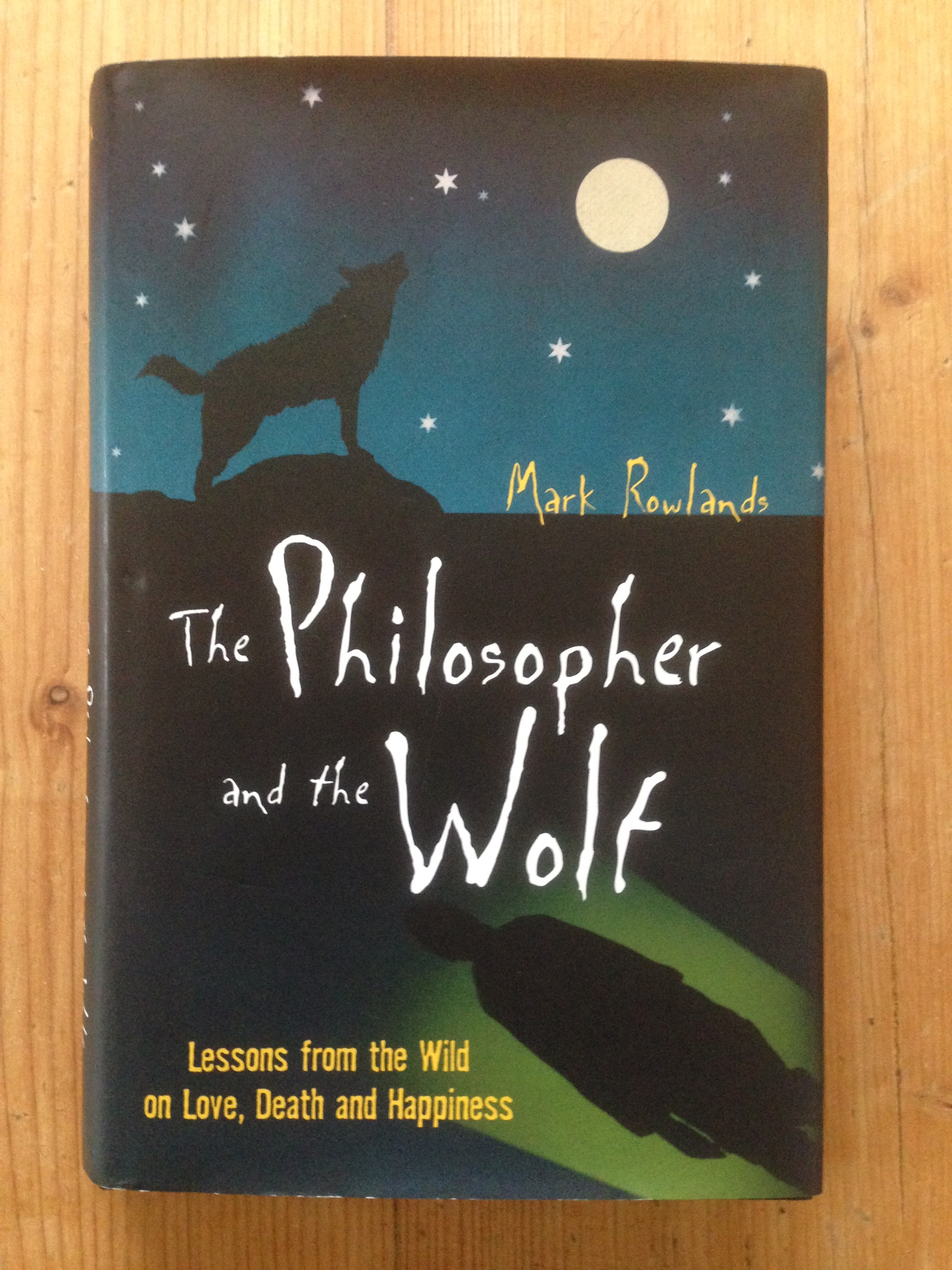
The Philospher and the Wolf (Mark Rowlands)

This morning I finished reading Mark Rowland’s book ‘The Philosopher and the Wolf’:

I came to this title having last year read his book ‘Running with the Pack’ which blended his experiences running, and especially running with his wolf and dogs, and his work as a philosopher/academic. In that book, a section describing the states of mind that can occur when running long distances in terms of various classic philosophical ideas particularly struck me and it was largely because of that section that I identified TPatW as a future title to read.

I am really not a dog person. In fact I am not much of an animals person. I am certainly not be the sort of person who might think that it would be good, fun, sensible, practical or reasonable to have a wolf around the house. But I certainly AM interested in philosophy, at least I increasingly find myself thinking that it is a subject that I really would like to pursue in more depth. Consequently, I came to TPatW in search of more of Rowlands’s wonderful exposition of philosophical ideas and not out of an interest in the wolf!

Anyway, once again I really enjoyed Rowlands’s writing – the mix of cautious autobiography, education and philosophical musing – and am more convinced than ever that I need to try to find some kind of structured introduction to philosophy to work through. Rowlands uses his observations of the wolf (Brenin) and the intertwining of their lives and actions to draw out some profound messages about what it is to be a human (and a wolf) and ends up arguing that the meaning of life is not to be found in possession or in purpose but in the ‘higher moments’ (moments where we dig in and carry on regardless of the adversity that we face [my definition]) that lie scattered along the timeline of life. Rowlands describes these moments as ones where we shout “F**k You” to the Gods and it is clear that by choosing to melt part of his existence with the life of Brenin, he was doing just that.

Deep Work

I recently finished reading Cal Newport‘s latest book ‘Deep Work: Rules for Focused Success in a Distracted World’. I had come across Newport’s work previously via various podcasts that I listen to and had read some of his blog posts covering the same content but I found the book to be a much more satisfying and useful experience.

Cal Newport is a professor in Computer Science at Georgetown University and so, in theory, his work should share many characteristics with mine. However, he is clearly driven to pursue his research much more than I have ever been and I guess this is why he has worked so much more fiercely to develop approaches to working that build and protect time for Deep Work (which he defines as ‘professional activities performed in a state of distraction-fee concentration that push your cognitive capabilities to their limit. These efforts create new value, improve your skill, and are hard to replicate’).

A central tenet of Newport’s book is that just at the time when Deep Work is becoming so necessary (and valuable) it is become increasingly rare and so those who practical the skill of Deep Work are in a fantastic position to leverage their skill to reap great rewards. Amongst the things that Newport suggests are deliberately build in time to practice Deep Work, to learn to become comfortable with boredom (and so not seek distraction so readily), to quit social media (perhaps the key source of distraction in the modern world) and to ruthlessly eliminate Shallow Work.

For me, one of the most valuable aspects of reading Newport’s book was that re-energised a desire to produce the kind of outputs that would likely come from Deep Work (not necessarily research papers but anything that requires a significant amount of creation in its generation). I think I had lost that to some extent.

Over the last couple of weeks I have been trying out some practices inspired by the book. I have been blocking out sizeable (multi-hour) chunks of time to work on the tougher kind of problems that tend to get pushed back and in these time periods I have been stealing myself against distractions as much as I can. I have generally been trying not to fill small empty spaces of time with a circuit of website or email checking. I have culled the people and accounts that I follow on Facebook and Twitter, almost to vanishing point. I have set aside regular time each day to ruthlessly attack smaller tasks, and because of this I have felt more secure at other times thatchings are not being forgotten. So far, the results have been excellent. Not only do I feel I have worked more productively and made good progress on deeper tasks, but I have also found that I have enjoyed working this way.

There are a lot of books about ‘productivity’ out there and I have read a fair few, but I sense that Newport’s Deep Work is one that will likely make a lasting impact in my life.

Tenacious

I just finished reading Tenacious, the sixth novel in Julian Stockwin’s Kydd series. In this book, Kydd finds himself a junior Lieutenant aboard the ship Tenacious as it campaigns in the Mediterranean to combat Napoleon Buonaparte’s attempts to rampage his army through Egypt to Turkey. Kydd comes into contact with Admiral Nelson and is involved in the famous Battle of the Nile and, on the back of seeing Nelson’s brilliant and decisive leadership, he sets out to take opportunities, and associated risks, to show his own potential as a leader. His first attempt at leading a small action ends in failure and he is captured by the French but is then fortunate to be part of an immediate exchange of prisoners. He then plays a vital role in the defence of Acre against the advancing French army although, in the end, it requires a huge slice of good fortune for the city to withstand the siege.

I found the previous Kydd novel a little lacking in action, but I would say that Tenacious was the best of the series so far with a good amount of uncertainty in the plot, plenty going on and not too much emphasis on Kydd’s relationship with his ‘particular friend’ Nicholas Renzi – a character who I find to be somewhat tedious and over-blown. So Kydd’s story now moves on, with him being increasingly noticed by those in the higher echelons of the Royal Navy, something which will surely lead to rapid advancement of his career.

The Fort

The Fort is an unusual, one-off, novel by Bernard Cornwell that is based on a real campaign of the American War of Independence. The really unusual part of the novel is that there is no obvious hero and it is not at all clear which side Cornwell, and thus the reader, is supposed to be on – the British Army who make and defend the fort of the novel’s title or the American forces sent to capture it and send the British packing. Bernard Cornwell’s novels usually follow a very successful formula – obvious hero (e.g. Sharpe) is involved in campaign, leads small band of forces in against-the-odds battles whilst sparring with obvious anti-hero (sometimes form the same side) and becoming involved with ravishing beauty (usually linked in some way to anti-hero). In contrast, The Fort, cuts between the two sides, describing first the British movements, then the Americans in an alternating pattern that gradually weaves the whole action together. There are potential hero figures on both sides and in the early chapters it is a little confusing if you are trying to follow this story according to the usual Cornwell formula, but after a while, it becomes clear that this story is set out differently, and then it is possible to let the plot unfold comfortably. In the end there is a (sort of) hero figure but his role is quite understated whilst there are multiple key characters on both sides who all get a good slice of the action.

This is an interesting story that promises a more exciting conclusion than the one that eventually occurs (which is, of course, constrained by the real events it follows) but after an uncertain start I found I enjoyed the way the story was delivered and the development of multiple characters.

Watchman

Watchman is an early novel by Ian Rankin, creator of Detective Rebus, set in the world of the secret service spies (Watchers) and the IRA bombing campaign in London. Following an apparent blunder on a simple mission at the start of the story, the central character of the story is an experienced Watcher who finds himself sent to Northern Ireland to carry out what purports to be a simple observing task but ends up being anything but. With his life very much under threat from unexpected areas he is forced to forge an expected alliance of sorts with an IRA terrorist and then uses this alliance to uncover the truth behind a web of corruption and betrayal within the service.

Parts of this story race along with really high intensity, particularly the section describing the immediate aftermath of the observation in Ireland, and are really gripping. But, overall, the story is perhaps a little convoluted and, at times, unbelievable. Still a good read though.

The Music Instinct

Having recently read Philip Ball’s excellent book ‘Critical Mass’ and having a deep interest of music I was quick to acquire and read his book ‘The Music Instinct’ in the hope that it might explain the mystery of why music has such an amazing impact when we listen to it. The book was interesting and informative, but I found it quite hard going in places and it really needs a sound-track so that points made in the text are instantly illustrated with examples. I discovered a lot about how music is constructed and how and why notes fit together but I don’t feel I got much closer to understanding why music has the mental and physical impacts it can sometimes generate.

Bearded Tit

A little while ago I worked my way through listening to the audio-book of Rory McGrath’s autobiography ‘Bearded Tit’. Rory McGrath is a comic who I find moderately funny some of the time and also somewhat annoying some of the time but because I have a (small) interest in birds and birds form a central part of McGrath’s story I decided to give this a listen whilst walking to and from work and I thoroughly enjoyed the story.

I particularly enjoyed the earlier parts of the story which recount McGrath’s time at Cambridge University. Here he meets and falls in love with JJ, but just when everything seems to be going so well, disaster strikes. At that point JJ completely disappears from the story, something which, as I listened, annoyed me… The later part of the story has McGrath grown-up and frequently enjoying birding trips in Easter Anglia but is is not without tragedy, before the final twist wraps things up delightfully and is a nice demonstration that, sometimes, life can be stranger than fiction!