August Heat (Andrea Camilleri)

Last night I finished reading Andrea Camilleri’s Inspector Montalbano novel ‘August Heat’. Unsurprisingly, the title alludes to the fact that the story takes place during an extremely hot August in Montalbano’s Sicily and it amused me that I was reading it at a time when we are experiencing some pretty cold weather here. The book gave me a nightly escape to warm up! As you might expect, Montalbano spends much of the book suffering in the heat, regularly changing his clothes and going for night-time swims to cool himself down and a key element of the plot is the implication that the heat rather befuddles his mind such that he behaves somewhat irrationally and allows himself to be tempted into a questionable dalliance with the twin sister of the story’s victim (a young girl whose body is found hidden in a trunk in an illegally built basement of a coastal villa).

I always enjoy Montalbano novels but I particularly liked this one as it was not too obvious how the plot would unfold but also not too convoluted. About two-thirds of the way through I thought I had been clever and identified what the main plot twist would be, but it turned out that I wasn’t right and everything unfolded in a more straightforward, but still satisfying, manner. The book ends leaving Montalbano in a rather confused state in relation to his long-term and long-distance girlfriend/partner Livia (who I have never really warmed to) and it will be interesting to see how this aspect of his life develops in the next book in the series.

Reading and Walking

Today, on my way down to the Marine Station from my office for an afternoon session on a first year module ‘Our Ocean Planet’ I found myself with a decision to make. I had not read anything scientific yet, had nothing scientific to read on me and knew I would have little time for scientific reading later on. Why was that a problem? It was a problem because my ‘scientific reading’ streak was sitting at 50 consecutive days and counting and so I was faced with a decision about whether and how to keep it going.

Without any real pre-meditation, as I walked down through the Drake Circus shopping centre I made a sudden left turn and dived into Waterstones bookshop. I had 5 minutes to spare and thought I would just have a quick look to see if there was any popular science book that leapt off the shelf at me. I thought that at least if I had something suitable to read I MIGHT be able to carve out some time to read a chapter but without a book my streak was certainly lost. After a quick perusal of the shelf I settled on ‘Seven Brief Lessons on Physics’ by Carlo Rovelli, a neat little book with seven short chapters each covering some aspect of 20th century physics (relativity, quantum mechanics, black holes etc.). The book had two great virtues that made it suitable for my purpose: 1) the chapters were really short, under 10 pages and 2) it was cheap (£6.99).

With book in pocket I continued on my way, but as I got down to the waterfront and started to skirt around the eastern side of Sutton Harbour I found myself reaching into my pocket, bringing the slim volume out and starting to read the preface. I don’t think I have ever read a book as I walked and this was a particularly risky place to start with the quayside and a drop into water on my right hand side in places and cobbles and uneven surfaces under my feet for much of the way. But having read the preface I found myself piling into Lesson 1 on Einstein’s theory of General Relativity and in a piece of sublime timing I completed the chapter just as I approached the Marine Station. The writing was absolutely perfect for my purpose – beautifully crafted for a non-scientific audience but with a scientific depth that made it a worthwhile read. I had made a good choice.

The sun was shining and the weather calm, crisp and clear so conditions were more or less perfect for my first foray into reading while walking. I did enjoy the experience and I can imagine repeating it again in similar circumstances.

Best of all, my streak remains unbroken, now up to 51 days and, what’s more, I have six more lessons to read so no excuses for not pushing on towards 60!

Atmosphere of Hope (Tim Flannery)

I have just finished reading ‘Atmosphere of Hope’ by Tim Flannery, a 2015 follow-up to his well-known book about climate change ‘The Weather Makers’. Flannery is an acknowledged global expert on climate change and, in particular, how nations and individuals are, or are not, responding to and trying to mitigate it.

Atmosphere of Hope is an interesting, albeit slightly odd, book. It is written in short chapters of 6-7 pages (which I like – I hate books with long chapters) that, at times, seem to be a bit thrown together. It is a little like he decided to rattle off a book but couldn’t quite be bothered to craft a really good one. However, he writes well and knows his stuff so despite this weakness, the book still works and is highly informative.

There is a lot of bad news in Atmosphere of Hope. Flannery spells out how, despite some progress, we are simply not doing enough to ensure that we have a better than 50% chance of 2 degrees Celsius warming. But, as the title of the book suggests, he also offers some hope, in particular highlighting advances in third-way technologies – ones designed to actively remove carbon from the atmosphere – and the huge potential for renewable energy sources (primarily solar and wind) coupled with electric vehicles to form a major part of a climate change mitigation solution. Overall, I was left reasonably optimistic – the advances in technology are massive and the rate at which use of renewables is advancing whilst economies are still growing offers considerable hope. I was most interested, and surprised, to read about how electric vehicles could act as the battery storage mechanism to even out the unsteady supply of energy associated with most renewable sources. I had never really thought about this idea before and how excess energy generated at times of high supply could be stored in millions of small vehicle batteries which could then feed energy back into the grid at other times.

One issue with the book, which is not the fault of the book itself but rather with the time that I read it, is that it was written before the Paris climate conference in 2017 and, perhaps even more importantly, in the pre-Trump era. It would be interesting to read Flannery’s thoughts taking into account these developments – I ought to have a look online sometime to see what I can find. Or I could just wait a few years for his next book!

The Naming of the Dead (Ian Rankin)

Last night, finally, after rather too long a time, I finished reading the 16th (I think) novel in Ian Rankin’s Rebus series: The Naming of the Dead. Unsurprisingly, the book was classic Rankin/Rebus – Edinburgh crime, social commentary, Rebus breaking rules – but in some ways this story was a little different from others in the series in that in the final analysis the secrets to the crimes were more stumbled upon than solved through clever detective work. I enjoyed the book – like anything by another of my much-read authors Bernard Cornwell, Rankin’s Rebus novels are in the ‘never fail to deliver category’, but for some reason, or reasons, I rather struggled to get through it, taking over a month, a decidedly sluggish rate of progress through a book for me.

I think that to some extent I have slipped out of the habit of reading in the evening before I sleep. For example, today I have already lost 25 minutes of my pre-sleep reading time to doing the washing up and now to writing this blog entry. The real killer is making the mistake of ‘just watching’ the 10pm News headlines on the TV, something that can easily extend to watching the whole news programme, and the local news and weather and then the national weather that follows it – that can blow 40 minutes in one go (and results in exposure to a huge amount of incredibly depressing information). So, as much as possible, I try to avoid the news. And from now on I am going to really try to get reading as soon after 10pm as I can. To help with this, and as a counterpoint to the wet, windy and cold weather we are experiencing at the moment, my next book is taking me to Sicily for another slice of Inspector Montalbano. In Montalbano’s world of crime the sun is always shining, the weather is always warm and, most importantly, there is a vast amount of sumptuous Sicilian food to read about. It’s going to be delicious.

Northern Lights (Philip Pullman)

Years and years ago I read Philip Pullman’s trilogy ‘His Dark Materials’ and thought it was wonderful. I particularly liked the concept of daemons, the plain-dwelling animals that use tree nuts as wheels and the description of death which comes, I think, in the third book. I have always wanted to re-read the books but with so many other works to get through it seems like a missed opportunity to use reading time for a repeat reading rather than of something new. I have also listened to audiobook versions of at least some of the books (I can’t remember whether I got all the way through) but lost those versions. So, recently, I decided to try the audiobooks again and bought the first volume, Northern Lights, via the Audible platform.

It has taken me a while, listening as I walk to and from work most days, but today I completed Northern Lights. I have to say that whilst I think the story is tremendous, I think I would prefer to have read the book myself. I liked the general narration by Philip Pullman himself but I found some of the character voices, particularly those of the children and Lyra, to be rather annoying. However, I know that listening to these books is probably the only way that I can get through them in a reasonable timespan so this minor annoyance is just something I will have to put up with. I can’t decide whether to crack straight on with the second book, The Subtle Knife, or to give myself a break. It probably makes sense to go straight on with the series to get continuity in the story. I can sort of remember what happens next but I found many elements of Northern Lights that I had forgotten about so hopefully things will continue in that vein. One thing I felt from this listening was that I was surprised how much the finer points of the story are explained as it goes along. My recollection of reading the books was that a lot of things remain a bit puzzling, but that didn’t seem to be the case although my recollection may relate more to the final parts of the final book which I remember being all a bit complex and difficult to fully grasp. It will be interesting to see if that remains the case.

Lucky Les – The Best Book Ever? – Reader, You Decide…

By far the best, most inspirational, book I had as a kid was ‘Lucky Les’ by E.W. Hildick:

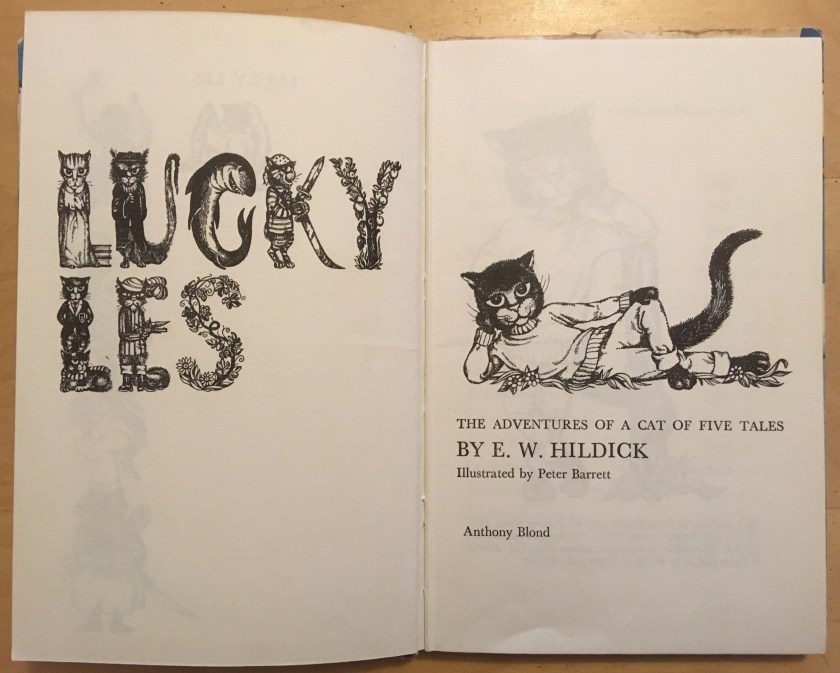
The hero of this book is Les, the youngest member of a family of anthropomorphised cats who, being black, is naturally the luckiest of all his brothers and sisters. In fact, Les is so lucky that he is probably the luckiest cat alive. He always gets the cream on the top of the milk and ALWAYS got the black one in a packet of fruit pastilles (a part of the story that has always lived with me). He was that lucky.

The book is beautifully illustrated with pen drawings like these on the title page:

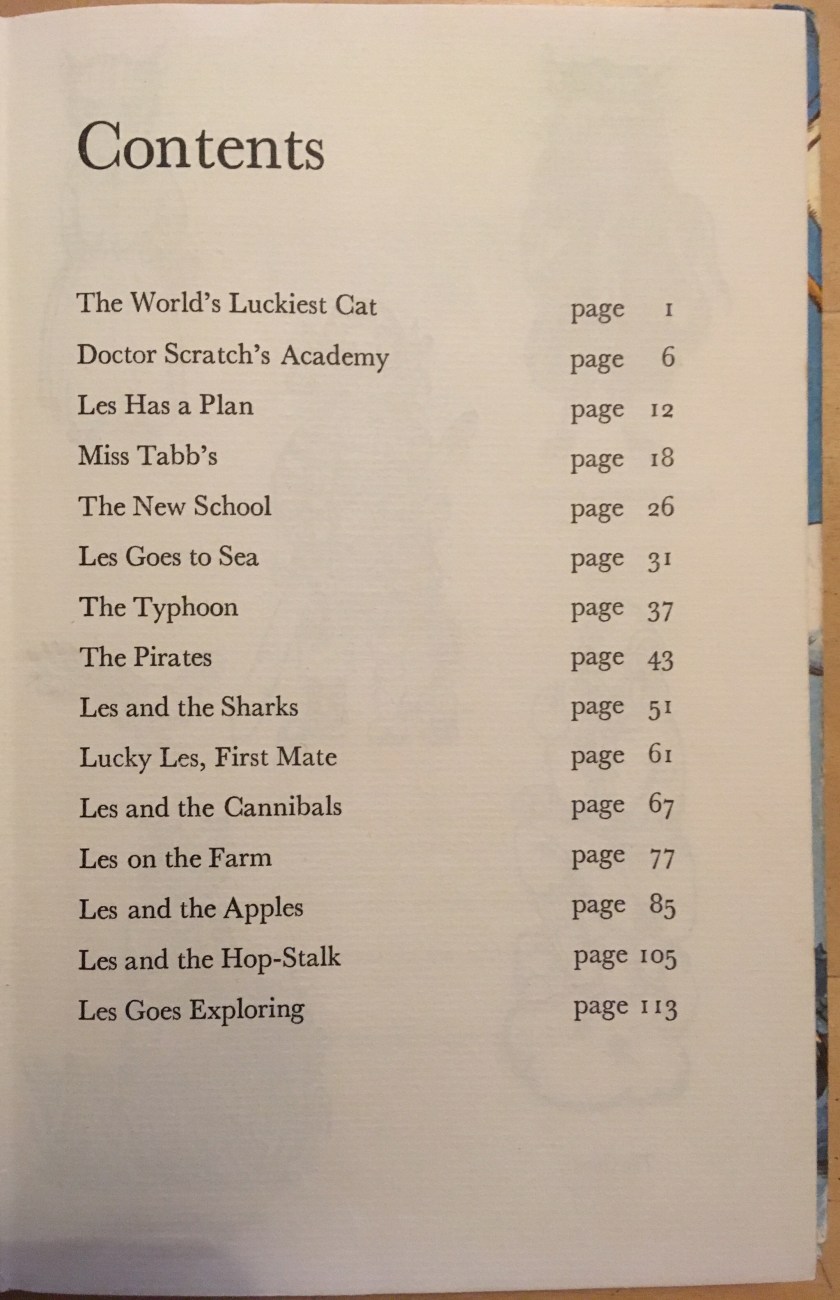
But the main reason that Lucky Les is such a great book is that it is cleverly arranged to provide multiple possible stories. At the end of most chapters the reader can decide what will happen next to Les (one of two choices each time pointing to specific later chapters) such that he can go to one of two schools (Dr Scratch’s Academy or Miss Tabb’s [Dr Scratch is essentially a pirate masquerading as a headteacher whereas Miss Tabb is so soft and caring as to be completely ineffectual at running a school – and guess what, if you put the two of them together you get the perfect school]) and then follow one of two primary career paths (going to sea or becoming a farmer) each of which then leads to various other branches (as a farmer he can grow apples or hops, a choice which ultimately leads him in two different directions). As such, Lucky Les perhaps represents the first piece of career guidance literature that I ever read (and at that time I certainly wanted to be a farmer so it is ironic that I ended up not going to sea but studying it!). There are five possible endings to the book but a couple of parallel branches along the way so in total I think there are about nine permutations – which seems to me like a great way of keeping a young reader interested in a book for an extended period.

I really loved reading Lucky Les as a child (in the early/mid 1970s I guess) and am so pleased that I still have my original hardback copy. I must read one or two of the permutations again soon.

I have often thought that it is surprising that there are not more branching books of this kind and wondered whether I might one day have a go at writing one. Perhaps there is scope for a follow up, something along the lines of ‘What Lucky Les Did Next’ or, if I allow myself to be really cynical for a moment: ‘Unlucky Les: What Happened When The Luckiest Cat In The World Grew Up’.

If This Is A Man (Primo Levi)

A short while ago I stumbled on a recommendation for Primo Levi’s autobiographical works ‘If This Is A Man’ and ‘The Truce’. Sadly, I cannot remember where this recommendation arose but it was clearly sufficiently attention grabbing that I ordered a copy. Last night I finished reading the first part – ‘If This Is A Man’.

Primo Levi was a (Jewish) Italian chemist who was swept up by German occupying forces towards the end of the Second World War and sent to a work/concentration camp linked to Auschwitz. He is one of the few who survived this experience and one of the very few who wrote about the experience. His reason for doing so was to try to ensure that what happened in the camps would never be forgotten or taken for granted by future generations.

Quite obviously, Levi’s account of life in the camp makes for harrowing reading, but he has a way of just describing the way it was without over-analysing that makes the account highly readable and interesting but never allows the reader to escape the fact that he is not writing a story. Over time the men in the camp had almost every aspect of their humanity stripped away from them, always with the ongoing threat of the ‘Selections’ which sent so many to the gas chambers. Levi’s story is one of ingenuity – the ingenuity of taking actions and controlling thought processes to survive from day to day for no reason other than to survive (the pursuit of freedom was never a viable objective).

At school I stopped studying history at the age of about 13-14 and so I missed out on the commonly taught ‘modern European history’ element that covers this ground. Obviously I was aware of the holocaust, some of the camps and the general topic but this was pretty much the first time I have properly exposed myself to thinking about what went on. I found it fascinating and challenging and this WAS a book that I would recommend as one that people OUGHT to read.

There were a few passages that particularly struck me, one of which contained the following quote, words written by a friend of Levi tat continued to run through his mind:

“…Until one day
There will be no more sense in saying” tomorrow”

Flashman on the March (George MacDonald Fraser)

A couple of nights back I finished reading George McDonald Fraser’s 12th and last written novel in the Flashman series – Flashman and the March. This one covers the period 1867-68 and finds Flashman embroiled in the rescue of British hostages from the mad King Theodore in Abyssinia. In typical Flashman style the plot involves him in a series of scrapes out of which he always comes up smelling of roses having apparently put the needs of Queen and country before his own safety and completed various heroic deeds. The truth is, of course, that Flashman is a bit of a coward who always looks to save his own skin but somehow manages to bring about circumstances where others believe he has been selfless and heroic. Along the way Flashman always has at least one encounter with a powerful female character who, how can I put this, falls victim to his physical charms and this book is no exception.

I found Flashman on the March to be one of the weakest of the Flashman series. There simply isn’t enough action or complexity to the plot. Flashman goes on a long journey, meets woman companion (etc.), escapes from danger, falls into danger again, escapes, falls into more danger etc. etc. until eventually in the final battle everything resolves itself in the way that you know it always will and Flashman’s reputation is enhanced even further. Overall, this adventure is just a bit boring.

I now have only one more Flashman novel to read to complete the entire series, which spans his adventures from 1839 through to 1894. This is Flashman and the Tiger (the 11th title written) and is split into three parts including a final part, the actual Flashman and the Tiger story itself, which brings in Sherlock Holmes as a character which sounds like an interesting twist. Judging by the rate I have been getting through this series, alternating titles with all the other random books and fictional series that I am working through, I should be reading that one in perhaps 18-24 months time.

‘Less but Better’ – Essentialism (Greg McKeown)

After listening to an Art of Manliness podcast interview with Greg McKeown last week I went straight ahead and listened to the audiobook version of his work ‘Essentialism’. The basic idea of Essentialism is that it is a mindset in which you seek extreme clarity on where/how you can make your best contribution in life and then focus ruthlessly on paring back activity that does not align with this goal. The underlying principle is one of ‘less but better’. McKeown argues that there is an increasing tendency for people to adopt a non-essentialist mindset by default and that it is necessary to actively combat this by shifting toward Essentialism as a way of life.

There were two particular elements of Essentialism that struck a chord with me. First, there was the ‘less is better’ principle. I think it is hard to argue against this but very easy to slip into a mode of working which runs counter to it. ‘Less is better’ works for me because it is expressed so simply but captures a lot (so it is, itself, a great example of less is better!). Secondly, I liked the idea that you should look for your ‘essential intention’ and see this as one decision made now that saves you from one thousand future decisions. However, I do struggle to come up with one essential intention that covers every aspect of my work/life and think it would probably work better or be more useful to find several complementary essential intentions for the various roles that I have (bear in mind that my work is very much multi-faceted – a kind of portfolio job within a job). Overall, I found that Essentialism matched a lot of principles that I have been trying to adopt – doing things deliberately rather than accidentally, simplifying things as much as possible, trying to mono-task and remain in the moment as much as possible etc.

Whilst I enjoyed the book, I did feel that it became a bit confused as it went along. There were quite a few chapters that were not so much about Essentialism but, rather, seemed more like general productivity, self-management advice and I got the impression that McKeown was really just writing a general book about improving personal productivity but used the neat idea of Essentialism to hang things off even when the fit was not so good. I suppose the difficulty was that a book that explains ‘less is better’ really only needs to be very short and, so, would be unlikely to be very sellable.

Essentialism and the 7 Habits of Highly Effective People

This morning, on my walk into work, I listened to an episode of the Art of Manliness podcast called ‘The Difference Between Essentialists and Non-Essentialists‘. It was an interview with Geoff McKeown, author of a book called ‘Essentialism’ that was published about three years ago. In very basic terms, Essentialism is a mindset which involves identifying areas of activity in life that have the most meaning/value when viewed from a long-term perspective and then using these as a filter to help manage decisions on activity and effort on an ongoing basis. Rather than mindlessly saying yes to things or simply committing yourself to try to do everything as best as you can, an Essentialist would know the key goal that they are trying to achieve in life (potentially taking a 100+ year timeframe as a means for deciding this) and then focus attention on actions that contribute to achieving this overarching goal. The idea is not new, but I felt that McKeown had an exceptionally clear way of expressing it, to the point that I am certainly going to read or listen to the book sometime soon. In the interview, reference was made to the famous quote from author Steven Covey’s that “the main thing is to keep the main thing the main thing” which obviously captures the same idea in a nutshell. Listening to this section of the podcast I was reminded of Covey’s classic book ‘The 7 Habits of Highly Effective People’. I read this way back in early 2001 and so it would have been one of the first books on productivity, self-management that I ever read. I recall that it contained much of value. At that time I was also experimenting with mind-mapping and produced a mind-map summary of the complete book. Amazingly, I have just managed to find a rather fuzzy scanned image of it..


Apart from anything else, I rather like this mind-map as a piece of ‘art’.

One of the things I recall from my reading of ‘The 7 Habits’ was the development of a personal ‘mission statement’ based around the different roles that one plays in life (for me it was things like, father, husband, teacher, manager, researcher etc.) and the same idea is picked up by McKeown through the idea of an ‘Intention’ (The Main Thing). It seems to me that Covey probably has the edge here because I don’t think I could have a single Intention in life but I certainly could have a single Intention for each of my main roles. I think this is certainly something that I will give some further thought to.

Anyway, from that podcast I now have a mind that is filled with curiosity to pursue the idea of Essentialism further, both through McKeown’s book but also by going back to Covey. Annoyingly, I gave my copy of ‘The 7 Habits’ to a charity shop years ago and even bought a second-hand copy more recently but gave that one away too. So, one of my first tasks here is going to be to hunt down another copy of it.

Watch this space for further thoughts on Essentialism then, as and when I have followed up on these sources.