What Audience?

I have been writing daily (weekday) entries on this blog now for a couple of weeks, trying to stick to a routine and add something (anything) each day. I’ve not announced this to anyone and I don’t actively promote this blog anywhere and so it is unlikely that anyone I know realizes that I am doing this. If they did know, I think I would probably be asked questions such as ‘Why?’ and ‘Who are you writing for?’. They are not bad questions, and, in essence, they can be summed up by the title of this post: ‘What Audience?’. This could mean who is the audience (intended or otherwise) or it could be meant perhaps disparagingly as a comment that there is actually no audience. At the moment, the latter statement is pretty much true, although I was surprised that the two entries I wrote about running WERE picked up by people out there.

When I consider the question, my own answer is that there is NO intended audience and I really care little about whether there will ever be one. When I used to write on this blog I think I had an idea that I might have some interesting things to communicate and that there might actually be people out there who would appreciate them. Now, whilst I acknowledge that this MIGHT be true, that is not my driver. Basically, I just want to write, and making a decision to try to add something regularly to this blog is simply a way of forcing myself to sit down each day for 15-20 minutes, tap away at the keyboard, and write. If it turns out that I write something interesting then all the better.

So my audience is myself. I am now quite happy adding to this blog just for 1) the writing discipline that it is helping to build and 2) as a way of pulling together random threads in my head. If you are reading this blog then great, if you are enjoying reading it or finding it interesting then double great. I am enjoying writing it and building the site generally.

Game of Thrones (at last!)

Finally, only a few years after the rest of the world began to get over-excited about it, I have started watching the HBO TV series ‘Game of Thrones’, based on the books of George R.R. Martin. The first GoT book was published in 1996 and the HBO TV adaptation began airing in 2011 so I am only about 6 years behind the times. I think the first time anyone enthused about GoT to me was in 2013 when a friend visiting from Australia said how much he liked it. Since then both of my daughters have become utterly obsessed with it and are currently watching the latest series (7) as it comes out.

We started watching Series 1 together last week and have already got through to Episode 8 (of 10). It’s obviously very derivative – lots of the same ideas and themes pop up, for example, in Tolkien’s work, and there are many allusions to British history (Wars of the Roses) and geography (wild people north of The Wall) – but it is still fun. I am not a fan of the gore/violence although so far the worst scenes have been pretty short-lived and the nudity/sex is obviously gratuitous and serves little purpose in the story, but the programme isn’t actually as bad in either of these respects as I was expecting (perhaps it gets ‘worse’ over time).

With two episodes of Series 1 to go it is pretty obvious that there is a lot of fighting to pack in and I am expecting multiple key (up to now) characters to meet a sticky end before Episode 10 concludes. One of the tricky things is that there are quite a few things I want to look up in relation to the actors and influences but I don’t dare to do so because doubtless this will give away all kinds of plot details that I don’t need to know yet. I suspect that it will be necessary to watch Episode 10 immediately after watching Episode 9 – there is bound to be a dramatic cliff-hanger – so I think I am in for a GoT watching mini-binge tonight…

Incremental Progress

In the last few days I have been exploring the power of making incremental progress. Last week, I identified several long-term projects or areas of activity that I wanted to complete and, since then, I have set about making one small piece of progress on each one every day. The projects include writing an entry on this blog each work day (6 in a row not including this one), progressively sorting out my office at work and completing a short set of core exercises each work day (7 in a row). Obviously I need to keep things going for longer before I can make a proper judgement about this activity and rate my success but I feel that the early signs are promising. I feel that I have already been working on these tasks long enough to begin to feel and see progress and can catch a glimpse of how things will be when I have extended my runs up into the 10s of days.

There is really something quite alluring about the idea that if I do something for, say, just 10 minutes every weekday for a year then I will have accomplished over 40 hours of activity in a year. If I consider what I could achieve if I sat down and wrote for 40+ hours or did 40+ hours of exercise or spent 40+ hours sorting out my office (of course I don’t think I will need quite that long…) then the possibilities are enormous. Obviously, there is a limit to the type of activities that can usefully be performed in this manner – if I want to write a novel then I probably need to lengthen the time spent on writing each day (but perhaps not). Nevertheless, there seems to me to be a lot to say for the idea of making slow, steady, incremental, progress. I liken it to being the tortoise racing the hare, and idea that often pops into my head when I am out on a long run. If I remember the fable correctly, in the end the tortoise wins the race…

Come Rain or Shine

Last Wednesday I went out for a run in the rain. It was heavy rain and by the end of the run (just 30 minutes) I was throughly soaked. Yesterday morning I went out in the rain again, this time to complete just over 14 miles, and although it wasn’t raining for the whole duration I still had to suffer a good amount of the wet stuff. To make matters worse it was towards the end of the run (last 3 miles or so) when I was tired and heading uphill towards home. I also went out for a short walk yesterday evening, just to a local shop and again it was raining and I got wet.

I am trying to avoid using rainy weather as an excuse not to get out and about and especially as an excuse not to run. I want to expose myself to inclement conditions more so that they ease to be an obstacle to action. I often think that I have been incredibly lucky with the weather for all of the significant race events I have done and I know that at some point this luck will break and I will be faced with running a marathon or some such in the rain. I have decided I should prepare for that eventuality.

So, from now on I am trying to adopt the frame of mind that if I have planned to run at a particular time and the weather is poor I will still run. Moreover, I am going to try not to take too much account of the forecast weather when I plan my runs for the upcoming weeks. It can’t be a bad thing to broaden my comfort zone and after all, it’s only water.

The Action Grid

On Monday I shared my thoughts about a a new system I had stumbled up (invented?) to become unstuck and get more things done. Now, at the end of a full week at work using it, I thought I would look back on how things have panned out and make an initial judgement on whether the system has actually helped at all.
The first thing I should note is that I don’t recall working so hard (just in case anyone important is reading this I should point out that, obviously, I always work hard). I feel tired and I am looking forward to some downtime this weekend. But I also feel satisfied that I have got a lot done, more than I would have done if I had just come to work and tried to do some stuff. I have also taken less breaks, partly because I want to save money by not buying coffee so much, partly because a lot of colleagues are not in work at the moment so I have eaten lunch on the go, but also because I have had a singular focus on wanting to make progress.

I have named my system the Action Grid. This week it has had 10 columns (projects) which I think is perhaps one or two too many. For each project I planned a next action for each day (either in advance or from one day to the next). I have made progress on all of these projects, just missing a couple of actions on a couple of projects on Monday and finding myself running out of time for three actions today, although I could probably achieve these if I hadn’t also decided to spend the last couple of hours of the week reviewing everything, catching up on email and setting things up for next week instead. Here is a picture of my Action Grid as at the middle of Friday afternoon:

Through the week I have completed quite a lot of tasks that I KNOW I would not have completed if I hadn’t been trialing my Action Grid system. I have written to two old friends, something I have been meaning to do since Christmas in one case and since last summer(!) in the other. I have finished sorting out my research-paper archive in my filing cabinets (which I started doing last summer). I have phoned the media company to cancel my Sky Movies subscription, thereby saving ~£12 per month (so if I had done this a year ago like I could have done I would be almost £150 richer…). I have made substantial progress in completing my database of Marine Science degree alumni (adding 2017, 2008, 2007 and 2006 – just 2005 and 2004 to go now). I have spent at least an hour each day working through some Matlab workshops to brush up my Matlab programming skills. I have moved forward a worthwhile amount on a couple of work (School management) projects.

I think that it was particularly useful to decide on the projects that were going to get my focus this week and to adopt a strategy of trying to nudge each of these forwards a little bit every day. Some days I made a fairly substantial step, other days I just printed a document or sent an email, but every day I moved forwards on each project. One week is not enough to judge the usefulness of this system for me, especially as this is a summer week when there are few distractions in terms of teaching sessions, meetings etc. and when the university is generally pretty quiet. But I know that in previous years I have struggled to be very productive during such weeks so this one has been quite a revelation. Suffice it to say that I will certainly be giving my Action Grid system another go next week.

Watching the waters go by

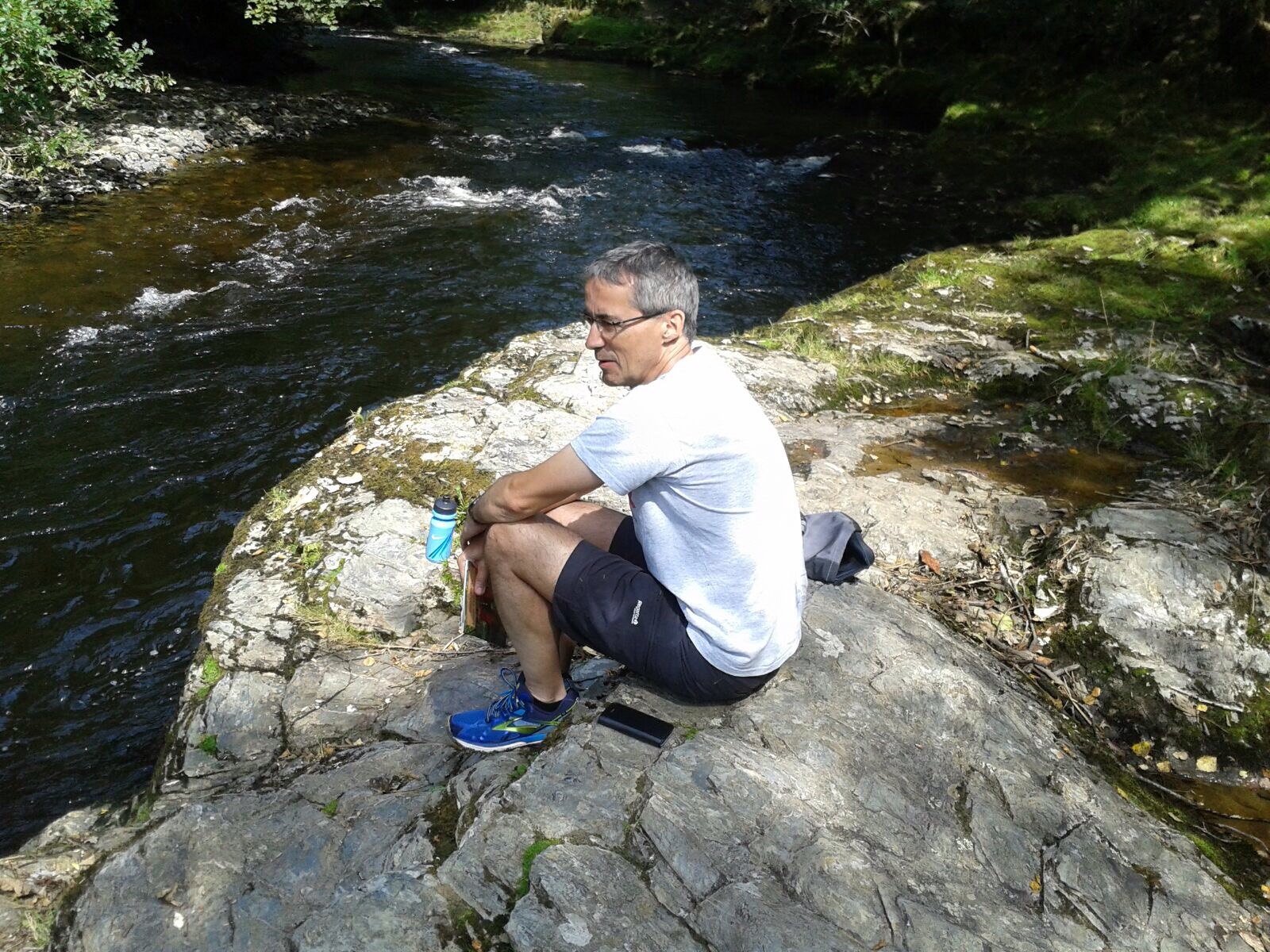
On Sunday we took a walk from Long Ash near Horrabridge down to Double Waters – the aptly named confluence of the Rivers Walkham and Tavy and then back via Grenofen Bridge. At Double Waters we stopped for a while and ate a picnic lunch sitting on a rock next to the river Walkham. It was a marvelous place to watch the waters go by and to contemplate. The waters flowed rapidly past shedding eddies, creating waves in the surface and carrying a constant stream of leaves, sometimes floating sometimes submerged, but always flashing past in an instant never to be seen again – a perfect reminder of the transient nature of existence.

IMG_2990

Stumblings #2

Here are five more random things I thought I would write about:

1) ‘Follow Your Curiosity’
There’s a slightly odd website that I browse fairly regularly called ‘The Art of Manliness‘ which describes itself as ‘a blog about growing up well, aimed at men and their unique challenges and interests’. Some of the blog posts are interesting and fun – about fitness, personal effectiveness etc. – and some are just downright odd – like one on how to survive falling through the ice (such as might happen if you are out ice fishing on a frozen lake somewhere – as you do…). I’ve started listening to the AoM podcast and in one recent episode (AoM podcast #95 ‘Follow Your Curiosity’ with Brian Koppelman) I was struck by two particular things. First, I liked the idea that in life you should not seek to follow your passion, but, rather, you should follow your curiosity. Secondly, I liked a comment that was expressed along the line of ‘Don’t be bound by the assumptions you made yesterday. You can change them’.

2) Frank Chimero and his new newsletter
I keep track of the internet writings of a few particular creative types. In each case, at some point, I have stumbled upon something they wrote that struck a chord in my head and, as a result, added them to my list of people to keep an eye on for more snippets of interest, wisdom and inspiration. On this list is a designer called Frank Chimero. I don’t remember now what it was that he wrote to catch my eye, but since then he’s posted more material that I have enjoyed and so I have continue to follow him. Somehow I have managed to get to sign up for his new weekly email newsletter ‘Frank’s Findings’ – oddly, there doesn’t seem to be a link to this on his website but you can get to see it at tinyletter.com. It has only been running for three weeks but already there has been a great mix of quirky content that I have enjoyed browsing (and if I am honest, it helped to inspire me to start these Stumblings posts on this blog).

3) Am I a scientist?
Although I work as an academic and am, nominally, some kind of marine scientist, it is fair to say that for much of my career I have focussed almost entirely on teaching, management, student recruitment and course leadership. This has meant that the extent to which I have been involved in scientific research in my field of expertise has been pretty limited at times. Sometimes this doesn’t really bother me, but at other times it leaves me with a feeling that I am not a proper academic and don’t have any very strong link to my subject area. Things have improved a bit recently, thanks largely to prompting and support from a particular colleague. A short while back I kind of sat up one day and asked myself the question ‘Am I a scientist?’. The answer was a sort of yes and a sort of no. I ought to be and, nominally, I am, but the thought struck me that if I am actually a scientist then some days I need to go to work and just be a scientist and not try to be a scientist at the same time as being all the other things my job demands me to be. The result was the idea that I would try to have ‘science days’ when I can go to work and ignore all of the other demands on me (like emails from students, requests for help from colleagues) and just be a scientist. I tried it once and it worked brilliantly. I tried it a second time and something really urgent cropped up that wrecked my plan. I suppose the jury is out on whether this little piece of sleight of mind works or not, but I suspect it might and I am going to try to keep hold of the idea.

4) Boyhood
I went to see the film Boyhood in the summer with my younger daughter and it totally blew me away. It is the best film I have ever seen and I came out of the cinema thinking I could (and wanted to) watch it again and again. I am not going to go into detail here. I just want to report that I loved this film; I loved the message, the acting, some of the music, the idea behind it, the fact that the writer/director Richard Linklatter thinks the way he does. I loved everything about it. I mention it here because it has just come out on DVD and I watched it again. It’s still brilliant. I still love everything about it. If you haven’t seen it, get hold of a copy and watch it. If, after watching it, you say something like ‘oh but nothing happened’ (as one person I know did) then all I can say is …, well, actually I don’t think I can put what I would say to you on a public forum!

5) Kurt Wallander/Henning Mankell
I like reading crime fiction but it is quite a while since I read one of Swedish author Henning Mankell’s Wallander novels. I started reading ‘The Man Who Smiled’ recently (I think this is the fourth Wallander novel) and it’s simply great. It’s so nice to slip straight back into a character and get completely hooked by a story.

Stumblings #1

This is the first of what may, or may not, become a series of posts in which I write about five things I stumbled upon in the last week or so. These ‘things’ might be anything: a book I read, a film I watched, something I created, a piece of insight gained. I have no idea whether I will be able to sustain this, what it will become in the future or whether anyone will find it interesting, but if nothing else, I intend to enjoy recognising the five things I stumble upon each week and recording them in this way. Here goes:

1) Accidental Creative Podcasts
I came across the Accidental Creative website a while back and read the first book by it’s author, Todd Henry, towards the back end of last year. Accidental Creative is aimed at ‘creatives’, taking a wide definition of this word along the lines of ‘someone whose work entails them creating value on a regular basis’. I really enjoyed the book and found a lot within it that resonated with my struggles to remain productive and creative. More recently, I started listening to the Accidental Creative Podcast and my decision to include this entry in my Stumblings is specifically inspired by a podcast on ‘Procrastinating on Purpose’ that I listened to on the way home from work one day last week. The basic idea of PoPing is that you should decide what to do at any point based not simply on whether tasks are urgent or important (classic time management approach) but also whether they are significant. Like most ideas of this type, it’s all just common sense really, in this case that it is a really good idea to deliberately spend time doing things that enable you to be more productive in the future (such as developing skills, laying foundations, scoping a project) and that to do this you have to deliberately put off until later other tasks that you could do now but don’t have to. The danger is that you simply do the tasks you can do now, create an illusion that you have been productive but then not enable yourself to work ‘better’ in the future. Anyway, I include the AC Podcasts here not for that specific episode but just as something that I think is generally seeming to have some value for me.

2) Tchaikovsky Symphonies
I grew up to classical music and always had a particular liking for Tchaikovsky. But in recent years (actually more like the last 30 years) I haven’t found time for myself to listen to classical music so much. A couple of weeks ago I went to see the film Birdman with my younger daughter and Tchaikovsky’s music features quite heavily in the soundtrack (a great choice for the film because, for me at least, T’s music is laced with strain, yearning and a feeling of desperation). Subsequently, I decided to listen to T’s later symphonies (surely his best works) and this reminded me how much I liked them and how great they are. As a child I was always most taken by the 5th Symphony, but I have to say that from this recent re-listening, the 4th Symphony is the one that did it for me this time. The music in the first movement seemed to reach right inside me, rip out my heart and then wink mockingly at me. Not everyone’s cup of tea I suppose!

3) Regular Running
This year (well since 2nd January actually) I have been running every day, if only for a mile sometimes. I suspect I will write more about this in the future but, for now, I just wanted to record that there seems to be something different that happens to both your body and your mind when you run daily rather than just running a few times each week. Physically, I can start to see my body re-shaping itself which is interesting. Mentally, I find I am far more ‘level’, quicker to focus on tasks at hand and generally more positive. It’s well known that running induces chemical changes in your body but I hadn’t expected to notice such a difference in my response between running often and running daily. Of course, it might just be me feeling something because I want to feel it. We’ll see.

4) Action v Inaction
This is a simple one. I was musing about diving in and doing something versus thinking about doing something later and the following words popped into my head: “The brief moment for action is inevitably followed by a lifetime of opportunities for inaction”.

5) Whiplash
I went to see this film with my wife and younger daughter. All I want to say is that it is brilliant. I like films that are about something rather than simply a story. Whiplash is about what is and isn’t acceptable when trying to foster genius. It almost forces you to agree with some really unacceptable behaviour on the part of a teacher/mentor. Brilliant acting, brilliant filming, brilliantly playful, brilliantly thought-provoking. Watch it.
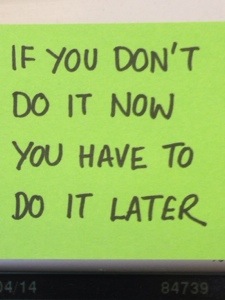
If you don’t do it now you have to do it later

I got stuck at work today. I was supposed to have a meeting lasting the whole morning but, unprecedentedly, it was all done and dusted in about an hour. Now usually a meeting finishing early would be a cause for celebration, providing a whole chunk of unexpected bonus time in which to do something useful. But alas, today I just couldn’t get started on any of the multitude of tasks that were waiting for my attention – marking projects, filling out my Performance Development Review form, revising some degree course web-pages to name the three most urgent.

I do tend to suffer from difficulty getting started at times, experiencing a complete lack of motivation despite having limited time and unlimited tasks, and it can be a real problem. I have tried to analyse why my motivation gets stuck sometimes but there is no real pattern to when things go wrong – it just appears out of nowhere. But a significant part of the problem is that the tasks awaiting me are just somewhat boring and have little direct value for me personally. They are just tedious tasks that need to be done that I don’t really want to do and so sometimes, I simply don’t.

In the end, after a period of frustration, I did get going, and partly this was because I told myself that I would have to do the tasks sometime so it might as well be now. The answers to problems of this type are invariably obvious and simple but it helps to remind yourself of them sometimes, which us why I grabbed a post-it-note, scribbled a few words on it and stuck it on my phone as a constant visible reminder for future times I feel myself getting stuck.

20140428-195900.jpg

If University departments were football teams

At about this time of year, with issues of promotion and relegation beginning to be settled, professional football teams start to make their plans for the next season. As part of this process the manager decides which players with expiring contracts he wants to offer new contracts to, which he will release and which players with ongoing contracts he wants to push out of the door and make available for transfer or loan to other clubs. The result is a rush of ‘retained lists’ and ‘released lists’ signalling to other clubs that Player X is wanted, Player Y can leave, Player Z is available to other teams for a price. At the same time, work begins to recruit fresh talent to plug gaps in the squad, bring in fresh young talent or an experienced old head.

The thought struck me earlier that it would be interesting if a University department operated in the same manner. At the end of the year the Head of Department, or Subject Group Head, would look at the performance of the academics in the subject area, review student feedback, look at research output, look at teaching requirements for the next year etc. and make decisions on who would stay and who had to go. They might decide that the subject area needed to bring in an experienced, already productive research professor, or perhaps several energetic and eager new faces. They might take the chance to cut away the dead wood or offer reduced or improved terms to existing group members.

In such an environment, it would be incredibly different to work in a university. Gone would be any notion of stability. Faces would have to fit, measured productivity would be paramount. Academics would become itinerant mercenaries, loyalty would fly out of the window and priorities might shift at the whim of the management team (actually that bit happens). In my opinion, in such a regime, Higher Education would be completely unattractive place to work for most people. But it would be very, very interesting to see who would end up on the retained list and who would be released and whether, in the end, quality could be improved by a much more ruthless approach to hiring and firing personnel.