Slipping

A few weeks ago I decided to make an effort to keep adding content to this site and set myself a daily reminder to write a blog entry. It didn’t matter what I wrote about as long as I wrote something most days (weekdays at least). For a while I did fairly well, sometimes writing about something I had done or thought about at work, other times about some random topic that had come to mind or about an book I had read or a podcast I had listened to. It didn’t matter that no-one (well, almost no-one) looks at this site – that wasn’t the point. Really, I am writing for myself just as a practice/ regular discipline. I was feeling pretty pleased with myself.

Unfortunately, it looks like I have slipped off the track. The last entry before this one was a week and a half ago. This means that I have ignored 10 days of daily reminders when they pop up on my phone. Actually it is worse than that. I haven’t simply ignored, or not noticed, them. I have clicked a button to confirm that they have been completed so that they have each gone away (only to come back again the next day). I don’t want this to happen. I want to try to maintain a close-to-daily discipline of writing something. Hence this post. Slipping off the track is something that I have always been fairly good at, although perhaps it would be fairer to say that I am pretty good at switching off one track onto another as I am always busy and always trying to accomplish something like this.

I have a few possible topics for upcoming entries. I have just about finished reading another book and will write about that. I want to put down a few thoughts about Aristotle’s ideas on ‘flourishing’, I could reflect on my latest (there I go again) method of trying to get fitter/stronger each morning and I am sure I could write something about where my running is at at the moment. It’s just a matter of sticking with it. I always think that having ideas isn’t too difficult, the difficult part is turning them into action. That’s really what this writing discipline is all about – action, action, action.


Talking to Squirrels

Something potentially worrying started to happen yesterday. With a bit of luck it will turn out to have been a one-off (actually a two-off) event but it’s clearly something I need to keep an eye on, because, get this, I seem to have started talking to squirrels.

First, when I was out on my Saturday morning run (7.2 miles linking together seven different Plymouth parks) and heading down a footpath in Devonport Park a grey squirrel sauntered across from the grassy area to my left. Obviously pretty tame, the squirrel didn’t seem at all worried about the fact that we were on a collision course, but I slowed to allow it across the path in front of me and as I did so I found myself saying out loud ‘after you’ and sweeping my right arm to the side in a ‘you first’ gesture.

Later, walking over to Home Park to watch Plymouth Argyle’s FA Cup match against Grimsby, I looked to my left through a metal fence into Central Park and saw another squirrel sitting a few feet from me. Fortunately there was no-one nearby because for some unknown reason I turned my head towards the squirrel and uttered the words ‘Alright mate’. Almost immediately I was struck by the ridiculousness of what I had just done – not only had I spoken to a squirrel for the second time in one day but, surely worse, I had called it ‘mate’.


Afterwards, in a frantic piece of post-event justification, I found myself thinking how it is not SO unreasonable to speak to wild animals. If I had startled a bird it might have squawked at me, or a dog might have woofed at me etc., so it could be argued that one animal making noise at another kind of animal isn’t such an odd occurrence. Obviously the squirrel couldn’t understand my English words (well I assume it couldn’t!) but then I can’t understand squawkish or woofish either, and I was only be polite and friendly, so there’s nothing to worry about is there? Is there?

Action, Knowledge and Devotion

I am currently listening to a series of lectures titled ‘The Meaning of Life: Perspectives from the World’s Great Intellectual Traditions’ given by Professor Jay Garfield from The Great Courses. I am only a little way in but already I am struck by his introduction to the ancient Indian/Hindu text The Bhagavad Gita. In this, he introduces the three disciplines on ‘yoga’ of Action, Knowledge and Devotion.

As I understand things, and my understanding is certainly not pure and un-mangled by my own thoughts, the idea of the Action Discipline is that one should maintain a commitment to action for its own sake and not as a means to an end. The idea is to disassociate the desire to take action from the possible outcome/reward and focus on simply taking action because this is the right way to live. In addition, it is essential to realise that to choose not to take action is actually a false choice since inaction is really an action not to do something and both the action and the inaction have consequences. So inaction is actually action and should be acknowledged as such. The example that comes to my mind here is that when I do exercises in the morning I should try to simply do exercises in the morning and not be particularly concerned about the longer-term impact these might have on my physique/well-being etc. In other words, I do exercises in the morning because that’s what I do.

The Knowledge Discipline refers to the need to understand the context in which actions are taken and to grasp their consequences. Actions should be taken from a basis of sound knowledge and knowledge should be expanded through action. An important aspect of this is reflection. Contemplation was a word that cropped up.

The Devotion Discipline is the one that, at this time, interested me the most (I have already THOUGHT about action a lot and have no difficulty with a commitment to seeking and using knowledge). The main idea behind Devotion seems to be that actions should be directed towards the greater whole (i.e. towards the cosmic or eternal scale) and not on the self. One should always consider whether an action is being taken with one’s own interests at heart or whether it is for the greater good. This can be applied at a more local level, for example, I might choose to teach a class in a particular way because it is easy for me to do so but I SHOULD be looking to teach it in a way that produces the maximum benefit for the students involved. This may sound obvious but I think it poses an interesting challenge as to always complete actions with this level of devotion to the greater whole would surely make them more difficult, time-consuming etc. I can see that to follow the Devotion Discipline may require a shift in mindset and a fair amount of work but I can also see that it is really the right thing to do.

Action, Knowledge, Devotion – it does seem like a powerful triad.

Days Lost versus Days Gained

The days seem to be rushing past at a rate that far exceeds anything I can remember. Each morning the alarm goes off at 6:55, I wake up thinking ‘here we go again’ and it seems like only moments ago that I last did the same. I’m quite familiar with the feeling that time seems to pass more quickly as I get older, something which I always put down to any given time period, such as one hour, being an ever-reducing proportion of my whole life. I am pretty sure that we perceive the passing of time, at least in large part, as being relative to our lifespan to date. But this new sensation of the days tumbling one after the other with such apparently rapid rapidity feels new, or at least more severe.

I expect that time seems to be passing particularly quickly at the moment because I am busy at work. This is my busiest time of year as far as teaching sessions are concerned and most days have multiple fixed appointments such that there is rather limited freedom to shape the progress of each day. Add to this the fact that I have begun to pack some of my early mornings with exercise and it is easy to see how each day has really become a procession of scheduled activities through which I am passing, one after the other with somewhat monotonous regularity. When I think about all of this I am torn between thinking that the solution is to do less and open up more free space in my schedule or to do even more in an attempt to shift myself into a mindset of constant activity. My instinct is that whilst it always seems tempting to do less and to try to relax, it is probably better to stick with things and/or do more. Like many machines, we seem to be able to keep going better and be more effective if we are constantly in use (accepting that sleep is an essential activity that helps to maintain the machinery).

As I write this another thought comes to mind. I think I have a tendency to wake up and think ‘here we go again’ in a somewhat negative, or regretful, manner. Perhaps I am viewing each rapidly passing day as something that has been lost whereas I could view the arrival of each new day as a cause for celebration. Each day that passes is one less day that I have to live but each morning that I awaken is one more day in which to live. Is the glass becoming increasingly empty or is the glass being refilled on a daily basis? It is all a matter of perspective and I think the trick I need to try to employ is to switch my morning mindset to one of excitement at having successfully awoken to a new day and the opportunities it brings. This post started out being titled as ‘Time is rushing past’ but I think the new title ‘Days Lost versus Days Gained’ is a far better way of capturing what has been in my mind as I have written it. The author and Stoic Ryan Holiday suggests that we should carry with us a constant reminder of our mortality to help steer us towards a ‘seize the day’ mental attitude. I am not sure that I really want to constantly remind myself that this day might be my last but I can see some sense and value in this idea. In a similar vein, artist and author Austin Kleon recommends reading the obituary column of a newspaper each day to provide this kind of reminder and also to draw inspiration about what it is possible to achieve with a human life.

Carpe Diem.

How my arms stopped working

On Saturday, inspired by the Tim Ferris Show Jocko Willink podcast that I listened to last week I decided to start again with a 10 week programme of Bodyweight Exercises. I am repeatedly telling myself that I want to try to get a better level of all-round fitness and strength but always struggle to find the time or a suitable programme to follow. Last year I came across a book and app by Mark Lauren (an ex-US Forces trainer) and, on paper, his course looks well thought out and do-able. In fact, last autumn I completed about 6 weeks of his Basic programme, albeit stretched out over an 8-9 week period but then gave up.

The problem I have with any strength training exercises is that I have practically zero upper-body/arm strength, so I completely struggle with push-ups, pull-ups, dips etc. I remember that last year I found the programme very difficult in this respect, doing less repetitions and easier forms of exercises, and I am pretty sure that it was this difficulty that led me to give up the programme when I did (about the time I was supposed to start doing more-or-less proper pull-ups).

So on Saturday it was a case of starting from scratch with Day 1 of Week 1 which just so happens to be a set of push/pull exercises. The routine involved four exercises – push-ups from a knee-high surface, pull-me ins (holding onto door handles and pulling your body towards the door), seated dips and pull-me ups (pulling myself up to a waist-high bar). Each exercise was done for six 30 minute periods separated by 30 second rest periods aiming for 12 repetitions of the exercise in 30 seconds (so that, in theory, 6 x 12 = 72 repetitions of each exercise are completed). Writing this down does make it seem a lot… Anyway, I dragged myself through the routine although in some cases the number of repetitions I managed was as low as 5 or 6. It was pretty obvious that next time I need to make some of the exercises easier (push-ups from a wall) or lower the target repetitions (aim for 6 x 7 repeats consistently rather than failing to do more).

Immediately afterwards my arms were fine. The next day (Sunday) I could feel various specific muscles in my arms and chests quite a lot. I wouldn’t say they hurt but I definitely knew that I had worked them. Yesterday, my arms pretty much stopped working. In particular, the outer part of my upper arms and the inner part of my lower arms just below the elbow joint were suffused with a burning sensation whenever I tried to move them. Even simple tasks like putting earphones in my ears were VERY painful and difficult to accomplish. It sounds ridiculous and, really, it was ridiculous. I don’t remember things being this bad last time I tried the programme. My arms are a bit better today. I can still feel the muscles that are sore, but things seem to be moving better and I sense a return to normality is in the offing. The snag though is that Day 3 of the routine (I did Day 2 yesterday but that was leg based and okay) is tomorrow, so if my arms have pretty much recovered from Saturday I am going to hammer them again and can’t begin to imagine how they will then feel by Friday…

… and thenI have to do it all over again on Saturday or Sunday!

The Reverse Sansom Effect

I am no scholar of the Holy Bible but I can remember enough from my school days to recall the basics of the story of Sansom and Delilah. Sansom was strong and powerful, breezing through life achieving his goals with his long hair flowing behind him as he went about his business. For some reason that escapes me now, probably something to do with love/envy/greed, somebody decided that they needed to take Sansom out of the running and somehow found out that the secret to Sansom’s strength was the length of his hair. Getting close enough to Sansom to cut off the source of his power was tricky but eventually they managed to get his wife Delilah to betray him by taking some scissors to his locks as he slept one night. Sansom awoke in the morning greatly diminished only to be overpowered by his enemies and that was the end of him. At least, that’s all I remember of the story.

I am REALLY bad at getting my haircut. A year or so back I could easily go 3 months without a haircut, allowing it to grow not to a length which could ever be described as ‘long’ but just to the point where it was obvious that I really needed a haircut to sort out the somewhat unruly mop that sat on my head. The thing about this is that I didn’t like my hair being longer. In fact I positively disliked it in this state. Looking at myself in a mirror it seemed to me that I looked older, more haggard, more tired once my hair had gone past its critical point. So, this year, I have tried to be more efficient at getting my hair cut more frequently, setting out with the intention of a haircut roughly every 6 weeks, and for a while it went fairly well. Sadly, over the last couple of months I have allowed myself to slip back into my old habit and as my hair has grown I have felt myself tiring, ageing and generally becoming less satisfied with myself. Obviously, I know that this has nothing whatsoever to do with my hair length (or does it?) – it just seems that way. Likewise, I am sure that Sansom wasn’t really strong because his hair was long but, more likely, he FELT strong because his hair was how he wanted it to be, like some kind of psychological scaffold upon which his powerful persona was built.

All of this is to report that, this morning, I finally called into the Barbers on my way into work and had my usual ‘Number 3 on the back and sides and short on the top to match in’. The result is that I instantly feel more content, energetic and ready to attack life. I think of this as The Reverse Sansom Effect. Take away Sansom’s hair and you remove the source of his power, take away mine and I awaken a little. There’s only one way to finish this post – it has to be a goofy picture of me post-haircut and raring to go and yes, I am pulling a stupid face…

Here, Now

Last night and this morning on way way home from and to work I listened to an episode of the Tim Ferris podcast by ex-US Navy SEAL and now leadership consultant Jocko Willink. I first came across Willink a year or two back through his book ‘Extreme Ownership’ in which he draws out leadership lessons from his time as a SEAL commander in Iraq (in particular). The basic idea of Extreme Ownership is that when you have a problem to solve you have to completely own it and focus your attention solely on what you can do to resolve it rather than looking to blame others or the circumstances or to look for solutions from others. It’s an idea I like and one that is very much in tune with the Stoic philosophy of focusing only on things that are in your control (or which you have some influence over) and not wasting time and effort worrying about things which you cannot influence. Stephen Covey calls this your ‘Circle of Influence’ as opposed to your ‘Circle of Concern’.

Anyway, in the podcast Willink introduces some of the material in his new book on ‘Discipline’. Much of the podcast involve Willink talking about his training regimes and about martial arts. Whilst there was some content of interest here I found this to be not especially interesting or useful because it is very obvious that what he regards as being beginner level is WAY above the level that a mere mortal could manage (e.g. An exercise routine that involves doing 100 of any kind of exercise such as pull-ups in one go is well beyond most people, let alone when that is only small piece of an overall routine!). But there were some elements that I found more applicable. Willink talks about the importance of getting up early and gives a blue print for how to achieve this – basically 1) go to bed earlier and 2) work hard during the day so that you get really tired and have no trouble going to be early! This might sound like trite advice, but really, when it comes down to it, there is obvious truth in what he suggests and any attempt to make things more complicated is probably just an attempt to get out of rising early in the first place.

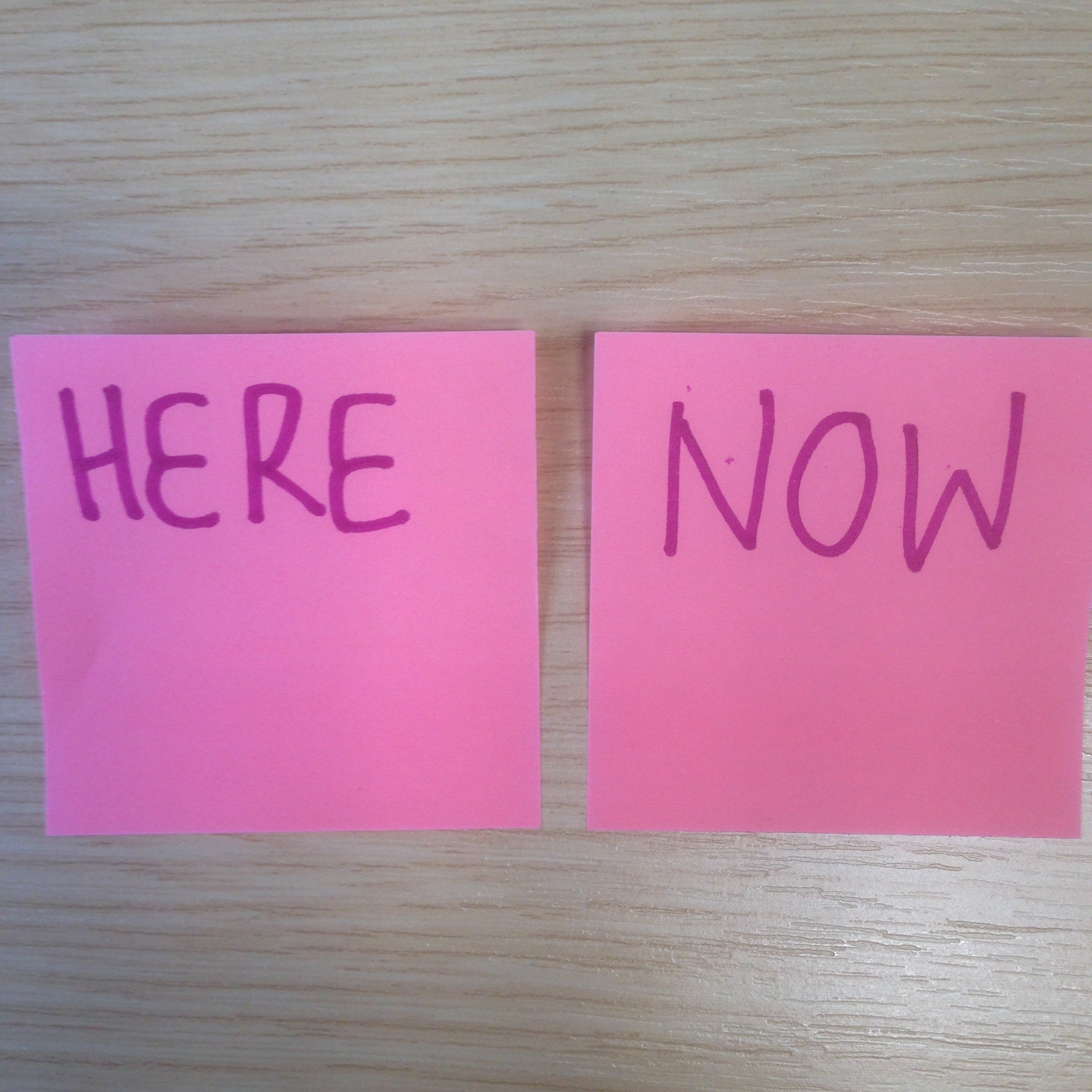
In a similar fashion, Willink has some extremely simple advice about making a change in life or getting started on something. Listening to him speak it is pretty obvious that he is not the sort of person who you would suffer procrastination as an excuse for not achieving something. He cautions against over-thinking things, doing too much research, reading about what you want to do etc. and again, in a definite nod to the Stoic approach, urges ACTION. He answers two questions ‘where should I start?’ and  ‘when should I start?’ both of which can easily derail someone who proscrastinates in the simplest possioble manner…

Where should I start?

HERE

When should I start?

NOW

I have copied these words onto post-it notes which are now stuck on the top of my computer monitor to provide a continual kick up the backside from Jocko:

That’s it for today – I’ve got work to get on with!

Rice Pudding

I have always liked rice pudding, whether it be the kind you buy in tins in shops (i.e. Ambrosia Rice Pudding) or whether the kind that my mother used to make when I was a kid. My memory of the home-made kind is unspecific but definite – the taste, the texture, the brown and crispy skin that I remember not liking particularly. My thoughts of the tinned kind revolve mostly around eating it for breakfast almost every day of a three week cycle touring trip around Ireland with my friend James in the late summer of our first year at university (1984). More recently, tinned rice pudding (or the same product in small plastic pots) has been an occasional food at homes when hunger pangs have struck or when I have felt in need of sustenance after a long run. I like tinned rice pudding but it’s not the same as the home-made kind and for years I have meant to make some (having never made it before). A few years ago I got as far as buying a packet of pudding rice, but that sat in the kitchen cupboard unopened until the use by date was well gone and the rubbish bin became its home…

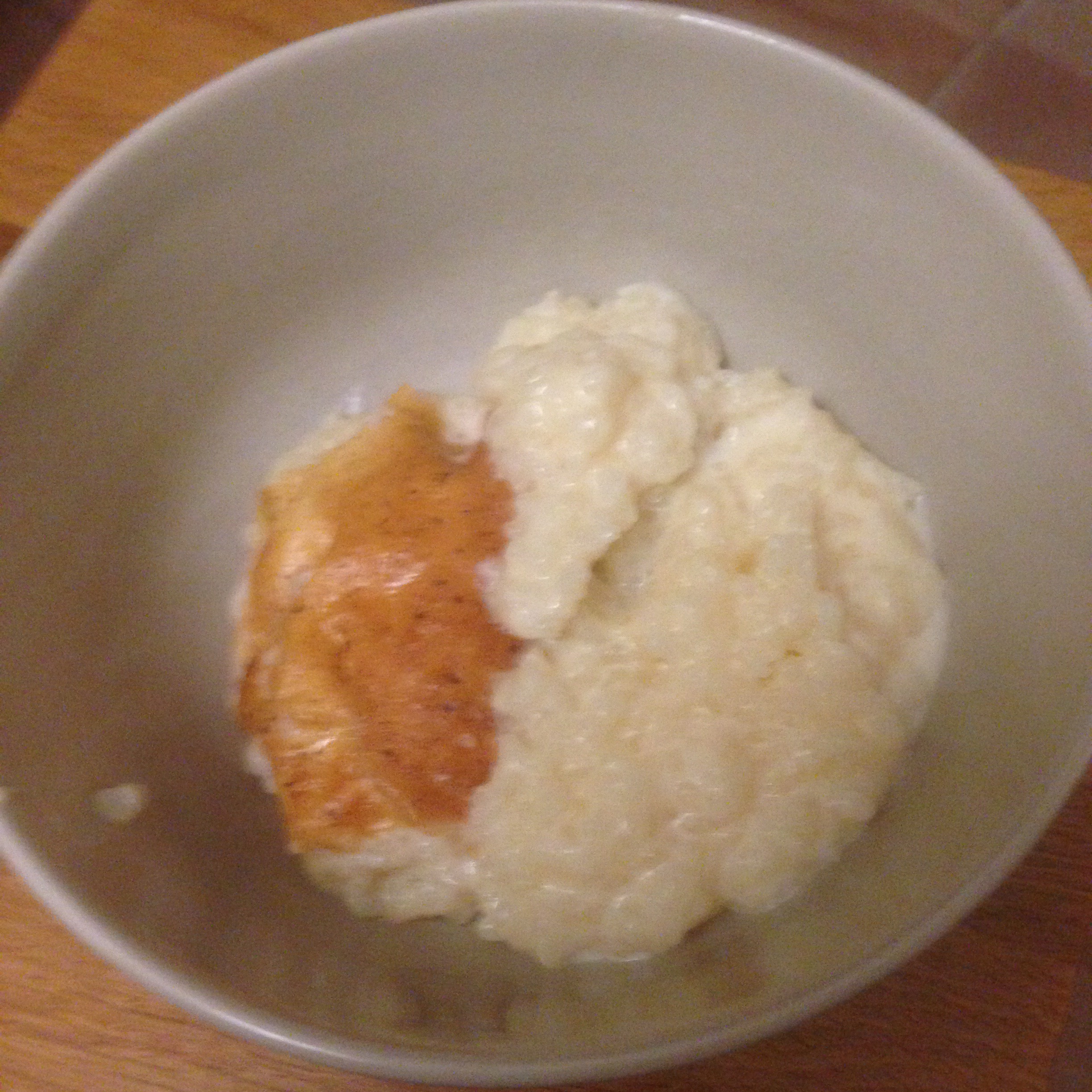
Gripped by a new desire to make rice pudding that came from I know not where, on Saturday I popped to the local supermarket and bought some rice and amazingly, given my extreme talent for thinking about doing things but not actually doing them, at about 5pm I set to work. First, the rice was added to milk and left to stand for 30 minutes. Then, a small amount of caster sugar added (poison alert…) and finally a little nutmeg sprinkled on the top and the mix put into the oven. The recipe I was following suggested a time of 2-2.5 hours at 130 degrees would do the job but by mid evening it was clear that a bit more energy was needed and so the oven temperature went up to 150 degrees and by about 8:30pm the finished pudding came out. Here is proof, albeit rather blurry proof:


I’m pleased to be able to report that my rice pudding was absolutely delicious, both straight out of the oven on Saturday evening and, again, cold on Sunday – just as I remembered it only this time I quite liked the skin. There is absolutely no way that it will be years before I make rice pudding again. In fact, given that I hardly made a dent on the bag of rice I reckon it could be just days until I get busy in the kitchen again.

What my Fortune Cookie said

Yesterday was my 52nd birthday and to make things easy we decided to order take-away Chinese food. For a bit of fun I threw some Fortune Cookies into the online basket when I ordered – at 20p each and with four of us eating it was hardly the most extravagant act of my life.

Once we had devoured the main food, and boy did I devour far too much of it, we broke open the Fortune Cookies. I picked the one that had a green wrapper. I always pick green things when there is a choice out of allegiance to my football team, Plymouth Argyle. Anyway, the message in my Fortune Cookie was “Many successes will accompany you this year” which certainly seemed appropriate wording on my birthday. It should be noted here that the other three Fortune Cookie messages, delivered to my wife, daughter and her boyfriend were definitely NOT as appropriate. So I am now looking forward to the promised ‘many successes’. Notably, the slip of paper in the cookie also listed a set of six ‘Lucky Numbers’. I am not going to write these numbers down here but I AM going to buy a ticket for the National Lottery draw this evening. Wouldn’t it just be incredibly spooky if I end up winning the jackpot!

Simplify

I was musing this morning…

[aside: Is ‘musing’ a verb? Is it actually possible ‘to muse’? I probably mean that I was thinking this morning but ‘thinking’ doesn’t really capture the somewhat day-dreamy type of thinking where I let my thoughts ramble playfully wherever they choose, settling occasionally for a few moments before setting off again like a butterfly flittering between flowers. So, regardless of whether ‘to muse’ is a valid verb in this context, that is what I was doing.]
… Anyway, I was musing this morning and settled on the word ‘Simplify’. I think it absolutely captures the essence of what I need to do as much as I possibly can. I suspect that pretty much every thing that I am involved with, every system or process I use, every group of possessions I own, every place I utilise could benefit from being simplified. I do try to keep things simple. I like to think of myself as a tidy and uncluttered person (or at least a person who would like to be tidy and uncluttered). But I am very conscious that there is so much stuff – stuff I own, stuff I interact with, stuff I have to do, stuff I want to do, stuff I think I should do, stuff I might do if I ever get round to it. Stuff, stuff, stuff. It all needs a good prune. Hack it down, thin it out, clear the decks, get rid. Simplify.