The Happiness (Book) Epidemic

After a day of rain and with the local snowmageddon apparently more or less over we ventured out at the end of this afternoon for a quick trip to Waterstones bookshop. The main purpose of the visit was to look at books about soup (i.e. books with recipes for soups not esoteric books on the history or philosophy of soup – I am not THAT strange) but while in the bookshop it was hard to resist the temptation of a quick general browse. I love looking at books in bookshops but the problem is that I always find at least 10 books that I want to read and then have to fight myself not to buy any, using the knowledge that I already have (probably) 20-30 unread titles sitting around at home waiting for their turn to be opened. So today I was strictly on a look but don’t buy mission.

As I looked around the main thing that struck me is that it seems to be impossible to be a ‘somebody’ these days without writing a book on the topic of happiness, or the related ideas of how to live a good life or how to live a healthy life or even the holy trinity of how to live a healthy, happy AND good life. There are books on happiness by TV presenters, sportspeople, philosophers, food experts, survivalists, etc. – the list goes on. Now a quick glance down through the archive of this blog may well lead you to (correctly) conclude that I am somewhat partial to reading this kind of material and so I am not exactly complaining about this state of affairs. SOME of these books are interesting, approach things from a unique or novel angle, are based on sound research etc. but it cannot possibly be the case that they ALL have something distinctive to say on the topic. There is obviously an epidemic of book writing on happiness with everybody and their neighbours jumping onto the bandwagon to try to grab their own little piece of the the happiness market profit (or perhaps work through their own unhappiness in an attempt to reverse it). Ten years ago, perhaps even just five, the idea of there being a ‘happiness’ industry would probably have been laughed at. Now it is a rich vein for celebrities to mine for £s and $s. I guess they have obviously never come across the research that shows that (lots of) money doesn’t buy happiness, or if they have, they can’t bring themselves to believe it. Perhaps I should be more generous – perhaps they are just trying to help…

I did see one title that I will definitely be getting at some point, a book called (I think) ‘A Good Life: Philosophy From Cradle To Grave’ by Mark Rowlands. I’ve read two books by Rowlands before – ‘Running with the Pack’ (his book about running, mostly with his various dogs) and ‘The Philosopher and the Wolf’ (his book about his life with a wolf and other wolf-dog crosses and the lessons he has learned about life from these animals) and I found both to be absolutely superb, full of proper, deep, philosophical musings. But then Rowlands IS a philosopher and a teacher so it’s hardly surprising that he has interesting things to say.
Stuffed in the Southwest… Storm Damage

Today, the collision between Storm Emma coming up from Portugal and the so-called Beast from the East flowing westwards from Siberia conspired to pretty much bring the southwest of England to a standstill. Actually, the presence of loads of cars on the roads, despite weather warnings and police requests for people to stay at home contributed to the chaos but, obviously, it was the weather that was the key factor.

With roads closed due to snow, black ice, accidents and abandoned vehicles, the icing on the cake was another dose of damage to the railway line at Dawlish, leaving those of us who live to the west of Exeter essentially cut-off for a short while. The railway line at Dawlish is a particularly well known transport infrastructure issue, since it passes along the top of a seawall that was famously torn apart by storm conditions 4 winters ago and rebuilt at some 10s of millions of pounds. Anyone with an ounce of sense would realise that in these days of rising sea levels, increased storminess and more frequent ‘extreme’ conditions, putting a railway line right next to the sea just isn’t a good idea and no amount of repair work is going to solve the problem. Put simply, at some point the line will have to be moved inland…

In addition, today also saw the renewed destruction of the coastal road at Slapton running atop the mixed sand and gravel barrier that forms the beach there. This road was partly destroyed some years ago and rebuilt with a slight inland kink in it at the point of the damage. Judging from the pictures of today’s damage it will take more than a kink to straighten that problem out.

So, bad weather has stuffed the southwest region today. But actually, I would argue that it is Government and politicians who have really stuffed us. Significant money needs to be spent to improve transport infrastructure in the region but, instead, minimum amounts of the country’s money are spent patching things back together whilst oodles of cash are thrown at the HS2 project to build a new fast railway line to the north of the country (and by oodles I mean OODLES) and wasted on other pet political projects (Brexit anyone?). If a fraction of the money spent on some of these other projects was dripped into the southwest, huge and permanent improvements could be made. But this will never happen. It will never happen because the southwest is packed full of old people, farming people, military people and people who aren’t even here but still own loads of the houses. These are all the types of people who tend to vote Conservative and, consequently, almost every seat in the region is allied to that party. The majorities are mostly so great that there is no particular political value in the Conservative Government spending money down here because they will be voted for enough regardless of what they do. There is no particular political value in the Labour Party promising to spend money down here because there is just too much ground to make up and, in any case, they are never going to win many seats in the region. We are left to struggle with an ever-eroding infrastructure because there’s virtually no political mileage for anyone in trying to make a difference. Basically, as the title of this post suggests, we are stuffed in the southwest, and it is hard to see why anything would ever change.

Thanks guys.

Non-Verbal Communication and Critical Thinking

A couple of days ago I enjoyed listening to an edition of the Accidental Creative podcast from 5th February in which regular host Todd Henry interviewed Mark Bowden, author of ‘Truth and Lies: What People Are Really Thinking’ (the podcast is here: Mark Bowden Accidental Creative podcast interview).

The main thrust of Bowden’s work is on how to better read body language and other forms of non-verbal communication (others and your own) so as to be more effective when asking questions or generally in communication. I found the whole podcast to be interesting but a couple of sections particularly stood out, one on using a critical thinking approach to prevent jumping to conclusions about situations and a second on utilizing awareness of your own body language to help resolve (or prevent) conflict in teams.

To help prevent jumping to conclusions, Bowden suggested using a critical thinking model that is captured by the acronym SCAN. As might be expected from its name, the model involves a four-step approach as follows:

S = SUSPEND initial judgement – note that this does not mean reject it but, rather, simply put it to one side for a few moments to allow the next steps of the model to be followed

C = consider/review the CONTEXT – is there anything to note about the context in which the communication/situation is occurring, for example might an audience by tired, hungry or cold. The key point here is to note anything aspects of the context that might offer an alternative to, or modification of, your initial judgement.

A = ASK what else? Basically, gather more data to help evaluate what is really going on.

N = NEW judgement – can you come up with one or more new or alternative judgements

Once the SCAN process has been completed then you can consider your initial versus any new judgements and decide how best to proceed. Bowden suggests that this approach can be used in many communication-based scenarios to prevent making default or snap judgements about what an audience is thinking, but he also highlighted that the model could be used to help consider all kinds of individual scenarios and assumptions. He noted that the SCAN process need not take long at all, just a few seconds in some circumstances but could help to prevent rushing to a default conclusion.

In relation to conflict resolution and prevention in teams, Bowden emphasized the value of modifying your own body language and highlighted how this could impact positively on the group dynamics. His advice was to focus on yourself rather than on the other members of the team and utilize open body language. Doing this can powerfully influence the tone of a room, leading the other team members into a more effective and less confrontational mode of communication. He suggested thinking about open body language as the kind of movements you would do if you came in from the cold into a room with a warm log fire burning – stretching your arms out, moving your upper body etc. to take in the fire’s heat.

I thought that both of these pieces of advice had potential to be useful and had the great benefit of being simple to remember and carry out. I might have to look up the book sometime (although the last thing I need really is another book to read!)

Snow in Plymouth

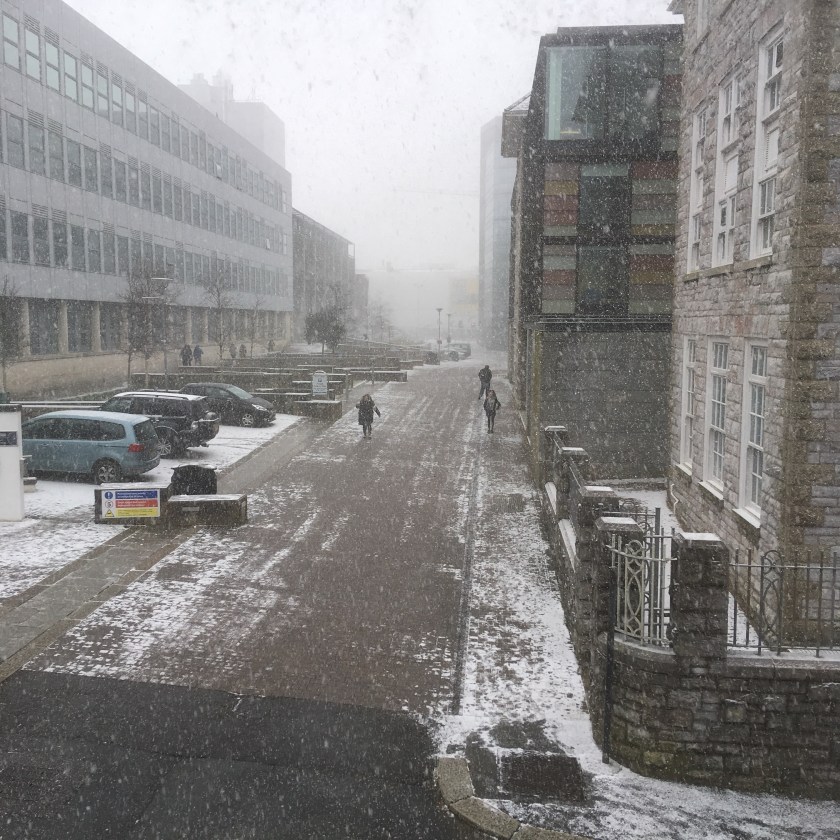
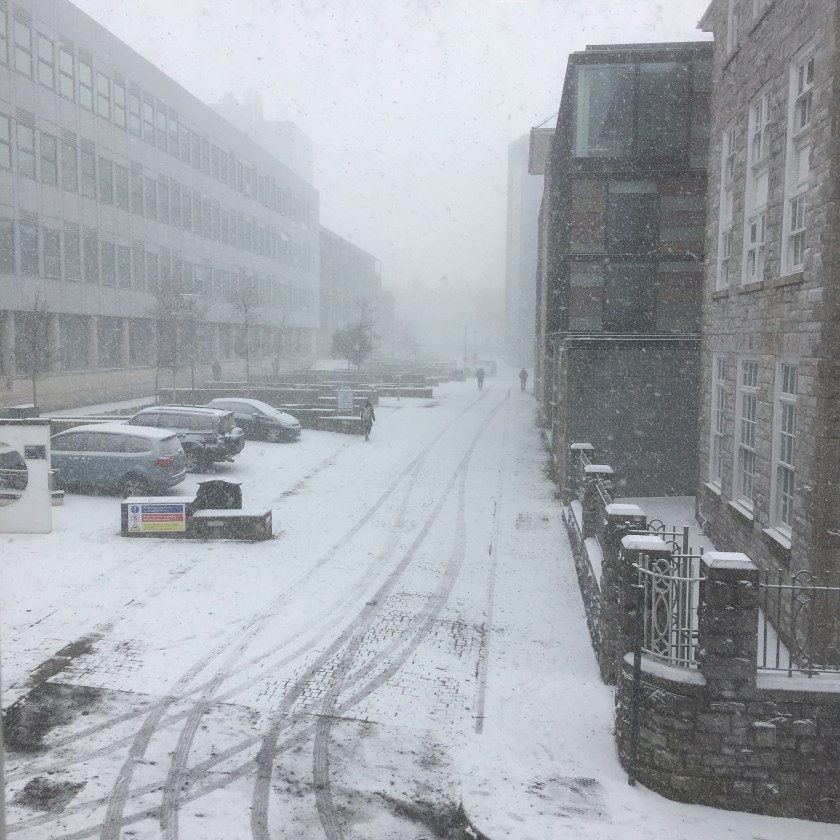
I have lived in Plymouth for 25 and a half years now and in all that time it has only snowed properly just a couple of times (by properly I mean that enough snow falls and settles on the ground so that things turn white and it is just about possible to make a snowball or a midget snowman). For this reason, today is quite a momentous day. Perhaps for the first time ever I walked into work amidst flurries of snow and then within a few minutes of getting there the white stuff began to fall more significantly and the ground became covered. These two pictures show the view from my office window just a few minutes apart at around 10am this morning…

It stopped snowing pretty soon after the second picture above was taken but made a few brief returns as the day progressed. I left work a bit early (all teaching was suspended for two days when the forecast is best described as ‘interesting’) and many of the pavements and side-roads were covered in thin layer of compacted snowy, becoming gradually more crusty and set to be pretty lethal as temperatures drop overnight and it freezes solid.

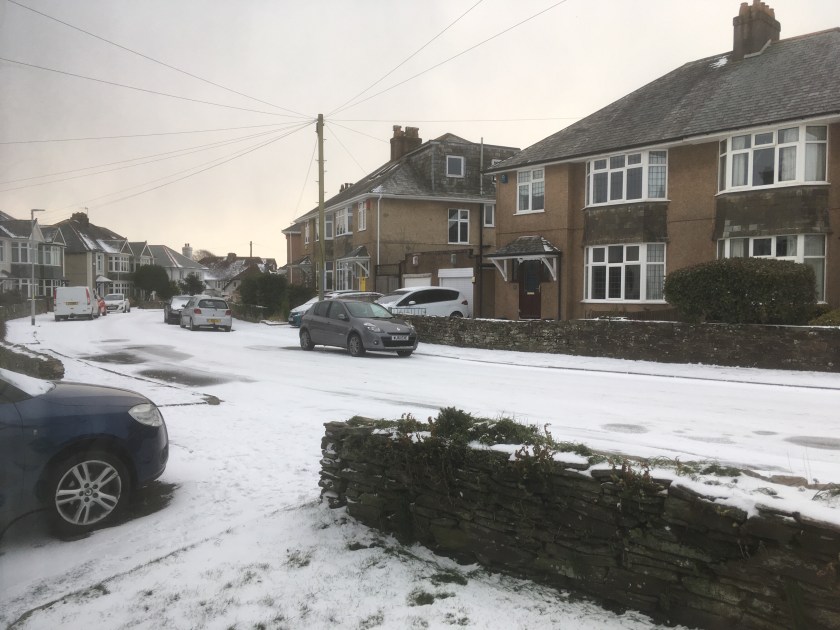
At home, the road outside out house is still snow-covered:

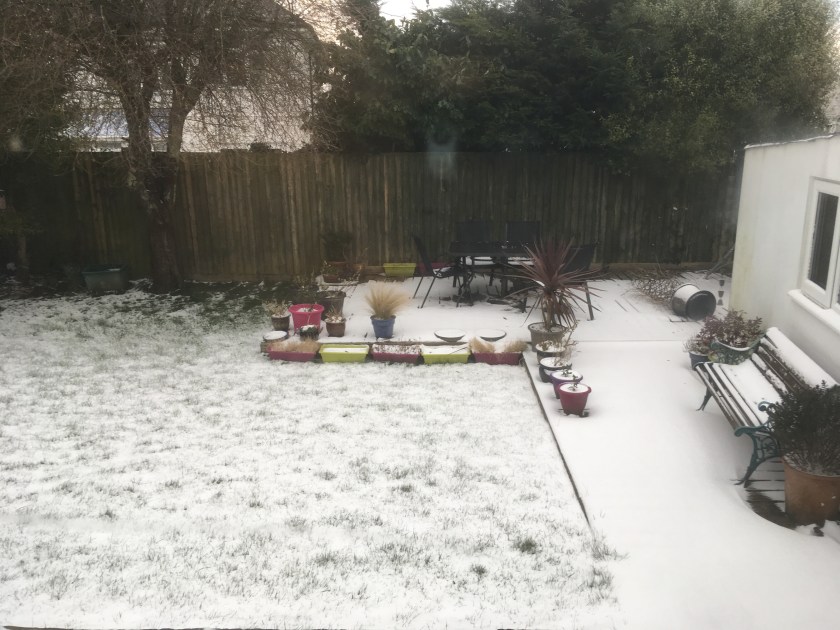
and the back garden has a pleasant wintery look about it:

Apparently there could be more snow tomorrow. In fact, I saw one piece on the local newspaper website that suggested that as much as 20cm could fall. If that happens the weather really will be exceptional and Plymouth will be talking about these few days for many years to come. But it is set to be warmer again on Friday so whatever snow falls or ice forms, it isn’t going to last, here at least.

Meanwhile, I was reading last night that temperatures in the northern Arctic are hugely above the climatological average for this time of year – a monster anomaly that is well beyond anything even the most expert (and pessimistic) climate scientists were expecting. Let there be no doubt, our planet’s atmosphere is changing and we’re starting to see the impacts of this change all over the place…

Habits, Streaks, Daily Blogging… Is This The End?

This morning I found myself thinking about four kinds of stuff: (1) stuff that I do, (2) stuff that I want to do more, (3) stuff that I want to do less and (4) stuff that I make myself do but for no particularly good reason. It seems pretty obvious that I should be actively working to try to do more of (2) and less of (3) and yes, it might be obvious, but that doesn’t make it easy. In fact, such is my utterly perverse approach to things that sometimes it seems as if the more I fixate on (2) the less of it I do and the more I do (1), (3) and (4) instead. Dare I say that I find myself wondering whether I do some things purely so that I don’t have to do things that I say I want to do more in case I find out that I am not very good at them – which is a classic perfectionist procrastination strategy to avoid ever having to be disappointed with your level of achievement… [albeit one that doesn’t work because I AM disappointed with my level of achievement.]

One thing that is certainly the case is that there are some things I force myself to do even though they don’t really have any clear benefit or rationale for being done – category (4) stuff. For example, I have recently developed my slight obsession with keeping ‘streaks’ going, as evidenced by the Streaks page of this blog (morning exercises, science reading, mindfulness meditation, WRITING THIS BLOG, running 25 miles a week). With some of these activities it is fairly easy to see why it is a good thing to do them – exercise and meditation practice both contribute to my overall well-being and, in theory, should make me better able to do all the other things I want to do. However, it can easily be argued that it is not actually essential to do them every day (or every weekday) apart from the goal of firmly establishing them as unshakable habits. I guess habit building IS a legitimate reason to keep doing something – regular science reading and running can be put into this category, they are good things to be in the habit of doing. The problem though, is that there is no real value in heaping pressure on myself to do these things every day or to a certain level. If I only run 22 miles in a week does it really matter? (No) If I miss a day of reading what is the problem? (There isn’t one). The more I think about it the more I can see that having to maintain these streaks is not a source of energy or fun, rather it is a source of completely unnecessary pressure – just another thing to judge myself with.

Of particular interest in this list of streaky stuff is my desire to write an entry on this blog everyday. I do this in the knowledge that almost no-one reads each entry and I tell myself this doesn’t matter because I am writing here just as a means to write something somewhere. But what IS the point of writing in that way? If I want to write then surely it would be better to put more care and thought into writing less frequently so that when I do write I have something more meaningful and carefully structured to say. Or, if I want to just write something everyday why don’t I just write a private journal of some sort? The answer to that question is that I suspect that without any kind of external visibility and accountability I wouldn’t bother to write at all, but doesn’t that tell me something – that writing on this blog is a completely unnecessary diversion away from other activities? So, if I am honest, I guess I have to admit that writing this blog IS about getting noticed by people, even if this only occurs once or twice a day and the people doing the noticing have absolutely no connection with me or my life (in fact in many cases they are probably just trying to drum up traffic on their own blogs). I’m not saying that everyone who visits this blog is like that and I am certainly not judging them, rather I am commenting on my own bizarre confusion. By the way – ‘hello and welcome’ if you are reading this!

All of which is to say that after almost 60 days of writing on this blog once per day I am not at all sure whether I will keep this going. It might be argued that there is a middle ground – just write something every now and again when I have something particular I want to say – but I am not sure that this would work for me and suspect that without a daily habit this blog would die a natural death, as it has done on various occasions in the past. The other possibility is that I come up with a good reason to keep it going, some goal for why I want to put my thoughts out there for others to stumble upon, and not simply write them in a private notebook. I am using good time and energy to write these entries and so if I value myself I ought to have a good reason for using myself up in this way.

So, this entry maybe the last entry on this blog, or it might be the last entry for a while. But it might not be. I suppose we will all find out tomorrow!

Coffee and Walnut Cake

Today I had the pleasure of eating a couple of slices of coffee and walnut cake, one small one with a cup of coffee just before lunchtime and a second this evening. Whenever I encounter this kind of cake I am reminded of an incident that happened back in 1994 when I was staying at Stirling University for the Challenger Society of Marine Science biennial conference. My wife had come along for the trip with me and, on a quiet day, we took the opportunity to catch a train into Edinburgh and spend a day wandering around the gardens, Princes Street and the area outside the castle. Towards the end of the afternoon we dropped into a small cafe and ordered something to drink (probably tea because at that time I wasn’t really much of a coffee drinker – in fact no-one in the UK was much of a coffee drinker back in those days). While we were in the cafe another, older, German couple came in, sat down at their table and made their order. After a little wait, the waitress took them their order – two slices of cake and went away. They looked a bit puzzled and after a short conflab called the waitress back over. Was there a problem? Listening in, not because we were being particularly nosey, it was just a small cafe, we picked up that they were quite happy with the cake they had in front of them but wanted to know where their drinks were. The waitress politely informed them that they hadn’t ordered any drinks. ‘Yes they had’ they replied. So she checked her pad, or they discussed it some more (I can’t actually remember the detail) and, no, they hadn’t ordered anything to drink. But they were still confused – ‘we ordered coffee and walnut cake’… and then it dawned on everyone what had happened.

Free Coffee

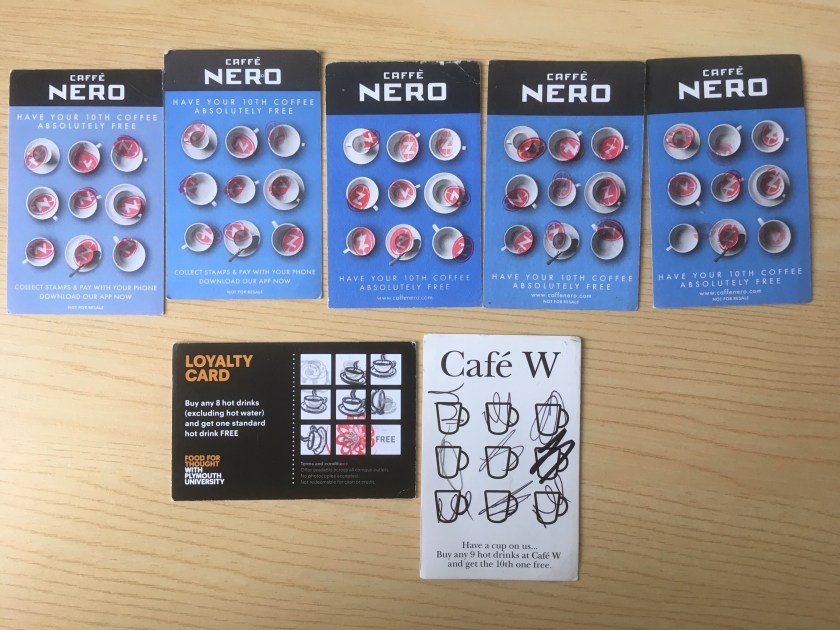
This is quite a funny situation to be in but perhaps also a bit worrying…

At £2.30-£2.40 a pop in Caffè Nero, £1.90 in Cafe W and £1.80 in the University, this represents almost £140 worth of coffee consumption (albeit over several months and partly funded by gift cards given to me for my birthday in October and at Christmas), not to mention a fair amount of time…

…but still…

Reading and Walking

Today, on my way down to the Marine Station from my office for an afternoon session on a first year module ‘Our Ocean Planet’ I found myself with a decision to make. I had not read anything scientific yet, had nothing scientific to read on me and knew I would have little time for scientific reading later on. Why was that a problem? It was a problem because my ‘scientific reading’ streak was sitting at 50 consecutive days and counting and so I was faced with a decision about whether and how to keep it going.

Without any real pre-meditation, as I walked down through the Drake Circus shopping centre I made a sudden left turn and dived into Waterstones bookshop. I had 5 minutes to spare and thought I would just have a quick look to see if there was any popular science book that leapt off the shelf at me. I thought that at least if I had something suitable to read I MIGHT be able to carve out some time to read a chapter but without a book my streak was certainly lost. After a quick perusal of the shelf I settled on ‘Seven Brief Lessons on Physics’ by Carlo Rovelli, a neat little book with seven short chapters each covering some aspect of 20th century physics (relativity, quantum mechanics, black holes etc.). The book had two great virtues that made it suitable for my purpose: 1) the chapters were really short, under 10 pages and 2) it was cheap (£6.99).

With book in pocket I continued on my way, but as I got down to the waterfront and started to skirt around the eastern side of Sutton Harbour I found myself reaching into my pocket, bringing the slim volume out and starting to read the preface. I don’t think I have ever read a book as I walked and this was a particularly risky place to start with the quayside and a drop into water on my right hand side in places and cobbles and uneven surfaces under my feet for much of the way. But having read the preface I found myself piling into Lesson 1 on Einstein’s theory of General Relativity and in a piece of sublime timing I completed the chapter just as I approached the Marine Station. The writing was absolutely perfect for my purpose – beautifully crafted for a non-scientific audience but with a scientific depth that made it a worthwhile read. I had made a good choice.

The sun was shining and the weather calm, crisp and clear so conditions were more or less perfect for my first foray into reading while walking. I did enjoy the experience and I can imagine repeating it again in similar circumstances.

Best of all, my streak remains unbroken, now up to 51 days and, what’s more, I have six more lessons to read so no excuses for not pushing on towards 60!

Getting Going Too Late

Today I have encountered a frustrating issue that seems to crop up fairly often in my working days. To begin with, I struggled to settle into work well and found myself somewhat distracted and not working very efficiently for a good chunk of the morning. Then, this afternoon I found I was fully into the task I was doing and so I now find myself, at about the time that I am wanting to go home, properly immersed in the task and not really wanting to stop working on it. Actually, no, that’s wrong, I really DON’T want to carry on working on it and I definitely DO want to stop working and go home. What I mean is that I am now working efficiently and am tuned into the work task at precisely the time that I am going to (have to) stop working on it, when this morning, when I had more work time stretching ahead of me, I couldn’t settle. This happens quite a lot. I find I just get going towards the end of the afternoon but then have very little time to make good use of my burst of focus and energy.

I have wondered about this before and whether there is any way that I can make better use of what appears to be a natural rhythm to my working day or whether there is something I can do to shift the focus/energy peak earlier in the day so that it has a longer period through which to be useful. How can I create the ‘end of the afternoon’ feel in the morning? Is it a matter of doing things differently earlier in the day or eating differently? Might it simply be that as the available work day starts to shrink I am better able to push myself into a state of focussed activity in an attempt to finish tasks before I go home? I suppose that if it was just me that I had to take into consideration I MIGHT allow myself to carry on working into the evening. I seem to really switch on about 2-3 hours after I have eaten lunch or about 5-6 hours after I arrive at work so it might be that I need to spend a long time ‘warming up’ – that would suggest an earlier start to the day. I don’t know. I’m confused. I’d love to solve this one.

Gavin and Stacey

We started watching the BBC Comedy series Gavin and Stacey tonight, getting through the first two episodes of Series 1 via Amazon Prime. My younger daughter was watching some of the later episodes while she was home over the Christmas break and my wife had seen one of these and thought it looked like a programme we would both enjoy. Hence us watching it tonight. And on the basis of the two episodes we have seen so far it certainly is. All of the characters have their own uniquely funny attributes and seem very well observed and it is a programme that doesn’t try too hard to be funny all the time, instead mixing various flavors of humour with wry observation and even pathos.

When I messaged my daughter to tell her we had started watching the series she asked me to let her know if I start to have a favourite character, a comment which made me ponder 1) who her favourite character is and 2) whether there was a character that she thought I would find particularly amusing. I have to say that although he has only played a small role in each of the first two episodes I have a sneaking suspicion that Rob Brydon’s character ‘Uncle Bryn’ will turn out to be the one. I also have a feeling that we’ll be watching more episodes over the weekend and probably hitting Series 2 before we know it…