
100 greatest books

Over the last couple of weekends The Times newspaper (which I buy on Saturdays only) has run articles on the “100 Greatest Films/Books of the Decade” (the decade in question being 2000-2009). I thought it would be interesting to see which of these films/books I have watched/read – perhaps this is a measure of how “current” or media-savvy I am. So, here goes my list from the 100 Greatest Books:

10: The Da Vinci Code (Dan Brown)
17: Harry Potter and The Deathly Hallows (J.K. Rowling)
18: Bad Science (Ben Goldacre)
22: The Amber Spyglass (Philip Pullman)
25: The Curioius Incident of the Dog in the Night-time (Mark Haddon)
44: Freakonomics: A Rogue Economist Explores the Hidden Side of Everything (Steven Levitt and Stephen Dubner)
48: A Short History of Nearly Everything (Bill Bryson)
54: Eats, Shoots and Leaves: The Zero Tolerance Approach to Punctuation (Lynne Truss)
60: Collapse: How Societies Choose to Fail or Survive (Jared Diamond)
75: The Damned United (David Peace)
91: My Father and Other Working-Class Football Heroes (Gary Imlach)

So that’s 11 of the top hundred – a better return than I managed for the top 100 films (see previous blog post).

There are a couple of others in the list that I’m definitely going to read at some point including:

06: The Tipping Point: How Little Things Can Make A Big Difference (Malcolm Gladwell)
57: Fleshmarket Close (Ian Rankin)

and a few titles that sound like my kind of book so there’s a little scope for my total to go up.

It’s rather alarming to note that my “top book” in this list is Dan Brown’s “The Da Vinci Code” but I should also point out that this was also listed as the No. 1 “worst book of the decade” in the same report. Fortunately, I have definitely not read, and never ever will read, the No. 3 “worst book” – “Being Jordan” by Katie Price.
100 greatest films

Over the last couple of weekends The Times newspaper (which I buy on Saturdays only) has run articles on the “100 Greatest Films/Books of the Decade” (the decade in question being 2000-2009). I thought it would be interesting to see which of these films/books I have watched/read – perhaps this is a measure of how “current” or media-savvy I am. So, here goes my list from the 100 Greatest Films:

06: Slumdog Millionaire
09: The Queen
34: Finding Nemo
42: The Incredibles
71: Monsters Inc
89: School of Rock

That’s it – I’ve seen just six of the top hundred and four of these are films for children (says it all really).

Mind you, I have a couple more on DVD ready to watch:

08: Casino Royale
50: Lord of the Rings: Return of the King

and there are a few others in the list that I’ve nearly watched or thought about watching such as:

23: Man on Wire
39: Lost in Translation
94: An Inconvenient Truth

so it’s not impossible I might be able to creep up to 10% of the list eventually.

New Moon?

There was a peculiar letter in the local paper (The Herald – The Voice of Plymouth) last night. If I could provide a link to it I would do, but it’s not online so I’m going to be cheeky and quote it here in full:

“Lately, as there is a renewed interest in the Moon, may I suggest that next time the astronauts pack their picnic in preparation to jet off to the moon, to also pack some tins of silver paint and paint the damn thing”

That’s it – word for word. It’s a worry to think that not only did someone have that idea but that they actually bothered to send it in to the paper. Mind you, it’s even more worrying to think that the newspaper published it (but now I am wondering where that leaves me for quoting it here…)

Fact or fiction contradiction

The blurb of the book I am reading at the moment includes the following text:

A remarkable story of heroism and adventure, of a boy who had to become a man too soon…. He would become father to his people. He would be Genghis Khan

Now, the last time I checked Genghis Khan was a real person – specifically the fearsome ruler of the Mongol Empire around the year 1200. So, I am rather puzzled than in the front pages of the book there is the following disclaimer:

This novel is entirely a work of fiction. The names, characters and incidents in it are the work of the author’s imagination. Any resemblance to actual person, living or dead, events or localities is entirely coincidental

So how does that work then? Am I expected to believe that it entirely coincidental that the author imagined a character who had the same name, and who took the same role in the same general location as a well-known historical character? I don’t think so. The disclaimer is wrong – the author’s just lucky that Genghis isn’t still alive to take appropriate action against him because from what I have read so far, it wouldn’t be pretty…

How to throw away £6.99 in one easy lesson

On my way into work each morning I walk past a branch of a major DVD rental company. Yesterday, a hand-written sign appeared on the door of the branch along the following lines:

“Donate at least £3 to [charity X] and receive a football worth £9.99”

I’ve been puzzling over the idea that lies behind this notice. If it was true, then everytime someone donates £3 and receives a £9.99 ball, the charity is missing out on up to £6.99 that it could have received if the store had sold the football for £9.99 (which, after all is what the ball is worth) and then given the proceeds to the charity. With the way the scheme is set up, the store or whoever is involved buys the football for amount £Y, gives it away for nothing (net loss to store = £Y), receives £3 in exchange (net gain to charity = £3) which comes from the customer (net loss to customer = £3). If the store had sold the ball for its true value and donated the profit to the charity then the net loss to the store = £0, the net gain to the charity = £(9.99-Y) and the net loss to the customer who bought the ball = £9.99. In the latter case the store gains (+£Y), the charity gains (+£9.99 – £Y – £3) and the customer also gains (they’ve given a bigger donation to charity AND, in effect, gained a £9.99 ball for only £6.99). So, given that my idea seems to be a WIN, WIN, WIN situation why doesn’t it occur? Simple, the ball isn’t worth £9.99 so no-one in their right mind would buy it at that price (I suspect that in fact it’s worth almost nothing), and the notice on the store door is untrue…

It’s a small world

I’m interested in the idea of connectivity and the inter-relatedness of things. I also like maps. So, I found this recent piece in New Scientist, Issue 2704 [15 April 2009] which describes and presents a series of showing various networks of routes across the globe intriguing. Apparently, the most remote place on the planet is on the Tibetan plateau – it would take 21 days (1 in a car and 20 on foot) to get to the nearest city of more than 50,000 people. Hmmmm, I wonder whether anyone has put a geocache there…

How touching…

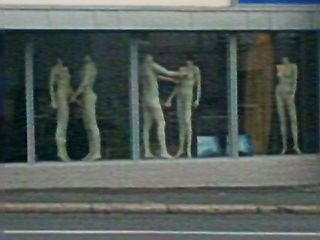
Yesterday evening I was standing waiting for my eldest daughter to return to school after a rounders tournament. Across the road in front of me was a new block of appartments, the ground floor of which had been a surf clothing shop which had rapidly gone bust only to be replaced by a new surf clothing shop (do people ever learn?). Anyway, this new shop isn’t open yet but the owners are clearly getting everything ready because the shop window dummies on which clothes will be displayed were standing in place waiting to be dressed. When I looked carefully I noticed that whoever had positioned these dummies had a sense of humour. I don’t feel that I need to say anymore…  rather I will share with you a snap I took of the scene. It’s not a particularly high resolution shot, but I reckon it’s good enough for you to get the picture 😉

Shop Dummies

Reach for the stars

Listening to a recent Scientific American podcast on my way into work this morning I stumbled upon an item about a project called Galaxy Zoo. This is an internet-based science project that anyone can sign up to help with in which “citizen scientists” (ordinary people) look at pictures of galaxies and classify them by following a sequence of simple questions. This is a highly efficient way of sifting through the mass of galaxy images captured by space telescpes so that scientists can then focus in on particular types of galaxies that they are interested in. It is a good approach because the human brain is really good at visual processing and can perform the classification task more reliably that a computer algorithm. So, if you fancy a bit of star-gazing you can sign up at the Galaxy Zoo website and join in.

Visual Thinking – The Back of The Napkin

Last year I stumbled upon a book called “The Back of The Napkin” by Dan Roam which is all about “visual thinking” and how to use simple drawing techniques to solve problems. I was sitting in a doctor’s waiting room when I picked up a supplement of The Guardian newspaper and saw an article about the book. It looked like the kind of thing that interests me and so I rapidly followed this up by purchasing and then reading the book. I enjoyed it and dabbled with the ideas a bit but that was about it (although I did completely alter the way that I delivered my first year physics lectures as a result). Anyway, the author, Dan Roam, also has a website/blog and I always keep an eye out for interesting bits and pieces that appear on this so I was really pleased when I spotted an entry which links to a 60 minute presentation given by Dan Roam about his visual thinking techniques (here is a link that goes straight to the full presentation – to get this to work I have found that I need to click it once and wait for it to finish downloading and then click it a second time to actually watch presentation). I’ve just watched the whole presentation and it is a really nice introduction to the material covered in the book and has re-inspired me to look at these ideas some more.