The Curried Icelandic Name Game

For as long as I can remember I have wanted to visit Iceland. I’m not sure what the trigger for this was but I do know that I have always had a bit of a fascination with Scandinavian countries. When I was about 11 I had the idea that I would one day live and work in Sweden. It might have been something to do with a feeling that Sweden was a country that seemed very modern with lots of cool science and engineering although I think that perhaps it also had something to do with Agnetha Faltskog (forgive me, I was only 11 at the time). As far as Iceland is concerned, I’m pretty sure my interest was more to do with the volcanoes, lava fields and geysers. Then, perhaps 10-15 years ago, Plymouth Argyle signed an Icelandic player called Kari Arnason and at the same time I started reading the Detective Erlendur novels written by the Icelandic author Arnaldur Indridason which are set in Rejkjavik, and at that point I became just a little obsessed with the child-naming convention that is used in Iceland.

For anyone who is new to Icelandic names, the convention is that a child takes on their father’s given name as their surname but with the suffix ‘sson’ or ‘sdottir’ (or a similar variant) depending on whether they are a son or a daughter. I think that’s such a neat and simple way of doing things, albeit rather patriarchal, but I guess there would be no reason why the mother’s name could not be used instead, thereby nicely sidestepping that problem. Following this approach, I would be called Tim Colinsson (or perhaps Colinason) which kind of works although it doesn’t have quite the same allure as a proper Icelandic name.

But this post isn’t meant to be a lecture on Icelandic naming and if you’re reading this piece and noted its title you are probably wondering exactly when and where the curry part is going to come in to things…

…which brings me on to my discovery.

I have no idea how I made this discovery and I admit that if anyone else had come up with it I would be a bit worried on their behalf… anyway, for some reason I stumbled on the idea of mashing together the names of curry dishes and their ingredients with the Icelandic child-naming convention. By curry names and ingredients I mean the words used in the kinds of dishes served in Indian restaurants and take-aways, things like: Korma, Dopiaza, Bhaji, Madras, Bhuna, Brinjal, Bhindi, Chana, Sag, Tandoori, Vindaloo, Biriyani etc.

So… it’s time to put all of the pieces together and play the Curried Icelandic Name Game. Here are the steps:

1. Select any single word from the curry names and ingredients list
2. Select a second single from the curry names and ingredients list
3. Add ‘sson’ or ‘sdottir’ to the end of this second word
4. Smash the two words you have from steps 1 and 3 together and there you have it – your first Curried Icelandic name
5. Choose another word from the curry names and ingredients list
6. Take your first word (from step 1) and add ‘sson’ or ‘sdottir’ to the end of it
7. Smash the two words you have from steps 5 and 6 together to create your next Curried Icelandic name
Then repeat the process from steps 5 onwards ad infinitum (or more likely until you get bored)

For example:

1. Brinjal
2. Bhaji
3. Bhajisson
4. => Brinjal Bhajisson
5. Korma
6. Brinjalsson
7. => Korma Brinjalsson
5. Biriyani
6. Kormasdottir
7. => Biriyani Kormasdottir
5. Chana
6. Biriyanisson
7. => Chana Biriyanisson
5. Bhaji
6. Chanasson
7. => Bhaji Chanasdottir

Go on, give it a try.

Notebook Thinking

I like to spend a little time each day pondering my thoughts by writing them out long-hand in a notebook. Sometimes an entry is all about one thing, how I am feeling, what I am going to do that day (usually I write earlier in the day rather than later) or something that is bothering me. Often the thoughts are more scattered and random, crashing about from one theme to another with no obvious structure.

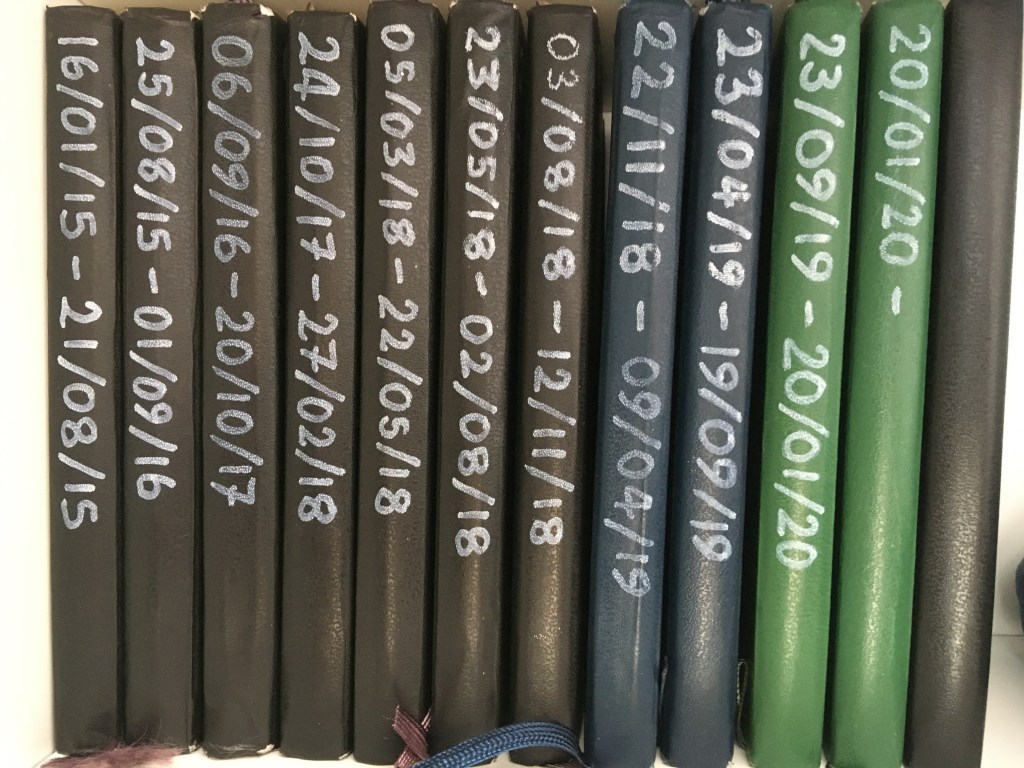
I’m not sure when this habit started but, as can be seen from the picture below, it clearly become established about 5 years ago when I adopted a standard size and type of notebook (Moleskine pocket hardbound, usually squared, sometimes lined). I also have a standard type of pen (Mitsubishi USB185S, usually black, occasionally blue but only for a day or two if my black has run out and I have no replacement handy). I buy the pens in bulk and the notebooks a few weeks in advance – I have my next one ready and waiting. It would now trouble me quite a lot to use a different type of notebook or a different type of pen. I know that’s not a good thing… surprisingly, it doesn’t seem to bother me what colour I have.

I write in full sentences, recording my thoughts in an almost conversational style – just like this blog entry really. I think that this act of writing thoughts out by hand in pen on paper, slowly, is central to the enjoyment and value I get from the exercise. It stops me from racing ahead and forces me to stay with a line of thinking for longer than I probably would otherwise.

Sometimes I just end up with a page or two of writing that doesn’t say anything very much and it seems a bit pointless and forced. Other times I can stay in my groove for quite a long time (maybe an hour if I am well situated with a decent coffee nearby and, perhaps, not where I ought to be doing what I ought to be doing…). On those occasions I can really unlock blocks and constraints in my mind and my life, settling myself down, sifting my thoughts into order, resolving problems and geeing myself up for action. It’s wonderful when that happens.

To my knowledge, no-one has ever read anything I have written in these notebooks. If they have, they have certainly never admitted it. That’s probably just as well – I don’t generally write about deeply personal stuff involving other people although I do quite like to grumble. But I do write about what I am thinking and feeling, the frustrations I have with myself, especially in relation to my ongoing battles with procrastination and my tendency to be always be looking forward to some future time when life is how I want it to be rather than getting on with it now (I’ve ALWAYS been like that) and I am not sure that anyone else should have to suffer by entering that world.

Coffee Shop Loyalty

Today I walked home from work with my elder daughter who had dropped into the city to pick up a few things. On the way back we called into a branch of Costa for a drink and while I was there I picked up one of their loyalty cards. I’ve never bothered with one before because I don’t tend to go to Costa unless I am with another member of my family and since they all have loyalty cards already it hasn’t really been worth me getting one. In any case, I already have loyalty cards for Caffè Nero, Cafe W (in Waterstones bookshop), McDonalds (occasional use) and the University cafes.

Reading the blurb on the card set me thinking about which of the various coffee loyalty cards I hold is the best deal. Costa give you 5 points (worth 5 pence) for each pound you spend so that is, in effect, a 5% return. Caffè Nero and Cafe W are both ‘buy 9 coffees and get the 10th free’ which, assuming you always buy the same coffee, equates to an 11.1% return. The University cafe deal is buy 8 and get the 9th free (12.5% return) and McDonalds gives you a free coffee for six purchased, which is 16.7% return. So, McDonalds is the best deal – but also definitely the worst coffee. Thinking in more detail, Caffè Nero is probably the winner because their deal is such that you can buy 9 cheap coffees (e.g. regular Americano at £2.40) and get a free large fancy coffee (say £3 in value) which works out at around 14% return for a much better product (than McDs). The snag with this argument is that I now don’t drink milky coffee and don’t particularly want a large Americano, I can’t make full use of the deal. Anyway, all of which probably partly explains why Caffè Nero is my coffee shop of choice (with Cafe W also right up there) and Costa isn’t.

The Best Tasting Fruit Ever… Ultramarathon Fruit

At lunchtime today I was talking about fruit to my wife and elder daughter (I have been working at home checking and approving Module Delivery Sheets – the forms that Module Leaders have to complete to request the teaching sessions and rooms that they need for the 2018-19 academic year). There was a difference of opinion about whether the satsumas that they were eating tasted ‘really nice’ or ‘a bit sour’ (for the record I had my regulation lunchtime apple and banana). This set me thinking about the best fruit I have ever tasted and brought me to the realisation that ALL of the best fruit I have tasted was (any of) the fruit that I have eaten while running ultramarathons.

When I ran the Dartmoor Discovery in June 2016 (my first ultra) I found myself absolutely, and as I then thought inexplicably, craving oranges at about the 26 mile mark, and so it was rather remarkable when I passed a supporter of the runners with her car boot open full of goodies who asked me if there was anything I wanted and, when I said ‘oranges’, grabbed a plate of orange segments and offered them to me. Those oranges were the best ever, the juice literally exploding into my taste buds as I crushed them in my mouth.

And then last year, on the Somerset Flat 50 Miler and Mendip Marauder 30 Miler I found that at pretty much every aid station I was drawn first to the fruit pieces – oranges, melon, pineapple, strawberries, water melon. My oh my, just thinking about it makes me start to salivate and feel a tingling sensation in my mouth. The strawberries at Mile 32 of the Somerset Ultra were incredible – popped in whole, crushed in my mouth, juice exploding, unforgettable.

So, for anyone who likes fruit but wants to taste really good fruit or for anyone who doesn’t like fruit and can’t see what all the fuss is about I have one piece of advice – get some fruit, chop it up into bite size chunks, stick it on a plate and go out and run 25-30 miles before sampling it. You might think this is a bit of an extreme way to get more enjoyment out of some of your ‘5 a day’ (or is it supposed to be 7 a day now, I have lost track?) but believe me, you really need to try it. Honestly.

Action Management and Idleness

On my way home from work today I listened to another episode of the excellent Hurry Slowly podcast, this one an interview with writer Oliver Burkeman titled ‘Against Time Management‘. I have previously read Burkeman’s book ‘The Antidote’ and enjoy his column in the Review section of Saturday edition of The Guardian newspaper. He writes on topics such as busyness, happiness and leading a productive life.

In the podcast interview I particularly enjoyed a section in which Burkeman and host Jocelyn Glei discussed how the concept of ‘time management’ is a misnomer – you cannot actually manage time, just utilise it as it passes – and their consideration of whether thinking of time as a resource like money (‘time is money’) is a valid concept (it is and it isn’t – money can be invested, banked, spent whereas time simply passes and has to be used as soon as it is gained). Burkeman argued that it is better not to try to manage time but, instead, to try to think in terms of constraints on what activity you can pursue. These constraints include things like space, money, energy and, importantly, time. He admitted that he didn’t really have a term to describe this approach and struggles to fully describe it. As I walked along thinking about this I turned the idea over in my head – was he simply talking about prioritisation, was it managing activities or something else. In the end I came to the conclusion that ‘Action Management’ was a better description and the goal was to become good at managing your action within the identified constraints. For example, at that point in the day I had ~6 hours of time left before sleep, some energy, a high degree of freedom and a range of things I could or wanted to do – go for a run and have a post-run shower, check the tyre pressures on the car, review a job application that my daughter was making, eat tea, watch a couple of programmes on television, put the bin out for collection in the morning, write a blog entry, meditate for 10 minutes and read something scientific and so my task was simply to navigate my way through the actions necessary to accomplish these activities in a smooth and efficient manner. From now on, in this way, I’m going to try to think in terms of managing my action amidst a suite of varying constraints rather than time management as much as I can and see what effect it has on how I feel.

I also really enjoyed Burkeman standing up for the idea of idleness. By this he meant true idleness not, say, relaxation now to enable better performance in the future. Idleness simply for its own sake. This immediately made me recall a second-hand book that I bought years and years ago (~30) when I was an undergraduate student – Jerome K. Jerome’s book of essays titled ‘The Idle Thoughts of an Idle Fellow’. I still have this book on my bookshelves and I am now going to have to pull it out and dip into it in some idle moments. For some reason, I find the idea of being an Idle Fellow rather appealing!

Endeavour

In the late 1980s and early 1990s I loved watching the TV series ‘Inspector Morse’ based on the series of novels by Colin Dexter (which I have also subsequently read). John Thaw’s portrayal of Dexter’s erudite but somewhat grumpy, crossword solving, beer drinking, opera loving, detective working in Oxford (broadcast shortly after I had been a university student there) gave us one of THE iconic actor/TV character combinations of recent decades. Morse was always accompanied by his trusty Detective Sergeant Lewis and, once Morse left us in the 33rd episode we were treated to many series of the also excellent Lewis (now Detective Inspector). More recently, in a masterstroke of characterisation and historical setting, those of us who fell in love with Morse in the 1980s/1990s have been delighted to be able to follow the early part of his career, as the young Morse (given name: Endeavour) made his first steps as a Detective Sergeant in 1960s Oxford.

In many respects Endeavour is better than Morse. This might just be a product of it being produced in a more modern era (better production technology etc) and showing less signs of the obvious biases of the 1980s (re-watching the original episodes of Morse, as I have been, is an education into the casual sexism of the times). But I think Endeavour is also better than Morse because of the absolutely superb performances of Shaun Evans as the young Morse and Roger Allam as his mentor, Detective Inspector Thursday. Endeavour does a great job of picking up on the development of the various character traits exhibited by the older Morse and providing glimpses of what ‘later’ becomes the back-story of the original character. Morse’s simmering but, so far, unrequited relationship with Thursday’s daughter Joan has the potential to fill in a huge piece of the jigsaw that defines the older man, whose relationships with women are always tainted and constrained by an unexplained pain from earlier in his life.

The 1960s setting is wonderfully recreated. I am sure that there are some viewers who are able to pick holes left, right and centre with the details, but nothing too obvious jumps out at me.

Series 5 of Endeavour finished last night and it is amazing to realise that Endeavour is already up to 23 episodes (Inspector Morse made it to 7 series and 33 episodes and Lewis to 9 series and 33 episodes). Given that the two previous series (in terms of broadcast date, not setting date) both made it to 33 episodes it is tempting to think that there may be 10 more episodes of Endeavour to look forward too – that is the kind of symmetry and detail that the writers of all three series would have appreciated.

Winter is coming… and we’re ready for it

For quite some time now I have been meaning to put a lot more insulation into our roof because one thing our house isn’t, is warm. Months ago I identified some suitable insulation – 20cm thick and not made of glass fibre, so much easier, safer and more pleasant to handle. It was even on offer (3 for 2) which, at £21 a roll and with 8 rolls needed, was a saving not to be sneezed at. But then, at the end of last year, just around the time I was thinking about buying the insulation the offer ended and it went out of stock for home delivery. In an instant the price had rocketed and the convenience gone. Autumn changed to winter, including some exceptionally cold weather, the house stayed cold and the ‘sort out loft insulation’ job remained on my to-do list.

Then, a couple of weeks ago I noticed that the price offer was back on AND home delivery was possible and so despite it already being March and with temperatures rising steadily I put in the order. And on Wednesday of last week the house filled up with rolls of insulation, partially blocking the hallway, sitting waiting for me to move them upstairs. My intention this weekend was simply to cart the rolls upstairs, lift them into the loft and leave them there until a spare half day magically appeared to allow me to unpack them, cut them, lay them out etc. I would have been happy if, today, I could have simply moved the rolls into the loft, but having started to shift them around it seemed much more sensible to begin to lay them. So, for two and a half hours my wife and I scrabbled around in the dusty, dim loft space, cutting and ripping the rolls apart, and packing them into the empty spaces across the top of the existing thin and tatty insulation. I had carefully measured the space in the loft, which was a complex shape due to a bay, and a large boarded platform that we use for storage in the middle, and had figured we would need 8 rolls. Consequently, it was immensely satisfying that it turned out that we needed exactly 8 rolls – no waste, no missed sections and a better fit than I could ever have imagined.

It may now be Spring and Summer will soon be on its way but Winter is coming. Winter is ALWAYS coming – and we can now be smug (or should that be snug) in the knowledge that we are ready for it.

My Little Plantlet – One Month On

Just over a month ago I wrote a post here about my attempts to grow a new houseplant (My Little Plantlet). I am pleased to be able to report back now that my plantlet seems to be going from strength to strength. The small new leave that had just emerged at that time has now grown much bigger, a second new leaf (bringing the total to four) has also sprouted and there is already a tiny shoot which promises to deliver a fifth leaf in the near future:

In the picture above you can see the two original leaves lower down, the largest (third) leaf angled towards the camera position, the fourth leaf already larger than the original two retreating away from the camera and the tiny little shoot reaching upwards at the top of the stem. The plantlet seems now to be fairly resilient and the stem is thickening a little.

I am not sure that I have ever had so much success with plants (I should write another post soon about the way my IKEA succulents are expanding rapidly on my office windowsill) and I can’t help feeling that I have somehow absorb some magic biological powers from now being in the School of Biological and Marine Sciences at work.

Time Tracking

After a minor meltdown on Monday morning, when I found myself struggling to do anything much despite having plenty to do, I have since found myself tracking how I have been using every piece of my time, allocating it either to a particular activity (perhaps allocated in advance to a specific area of work or to a meeting) or to a general collection of activities (e.g. ’email’, ‘small stuff’). I have also been classifying each time block as either ‘work time’ or ‘self time’. I have been taking 30 minutes as my basic unit of time such that I have 48 blocks of time to allocate in each day. Some of these blocks are allocated in advance, some are allocated retrospectively, but ALL are allocated. Thus, for example, today, the hours between 00:00 and 7:00 were pre-allocated to ‘Sleep’, 07:00-07:30 to ‘Exercises’, 07:30-08:30 to ‘Run’, 08:30-09:30 to ‘Shower/Breakfast etc.’ And 09:30-10:00 to ‘Travel to Work’. Later in the day, 15:00-17:00 was pre-allocated to ‘School Management Group’ [a meeting] and knowing that this frequently over-runs, 17:00-17:30 was tentatively allocated to ‘Meeting over-run’. Periods of time in between these pre-allocated blocks and the hours beyond 17:30 were either allocated as I went along or are still to be allocated later today.

In this way I have been able to get a good picture of what I am actually up to, but more importantly, adopting this approach seems to have made me more efficient. It is as if knowing that I am going to have to allocate each time block to something has forced me to make sure I have something genuine to allocate it to – I guess I do not want to be left having to retrospectively allocate blocks of time to ‘Nothing useful’, ‘Procrastinating’ etc. In this way I have, perhaps, stumbled on a kind of ‘external accountability’ mechanism that is helping to keep me on task and forcing me to always make a deliberate choice about how I am going to use the next block of unallocated time. I didn’t set out doing this with any particular expectation that it would be useful and, of course, I haven’t really been doing it long enough to really judge whether it is of value to me, but so far this process of playing with time tracking feels like it could be useful and, surprisingly, is turning out to be quite fun.

I am intending to couple this idea with better pre-allocation of larger blocks of time to the kind of deep-work, creative projects that I just never seem to get round to. I am pretty sure that the reason for me not getting round to them is NOT because I don’t have time for them but, rather, because I have a tendency to allow smaller stuff to fill up all the space and make me feel busy. I am hoping that this kind of time tracking might help me to hold myself to a commitment to these more creative projects, where real value lies, and make me better at resisting the allure of ‘busy work’.

So, that’s now 18:00-18:30 = ‘Blog entry’. What’s next?

Hurry Slowly Podcast

I am quite an avid listener to podcasts, usually on my walk to and from work and generally on topics relating to creativity, leadership, productivity etc. A couple of days ago I stumbled on a new podcast (for me at least) called Hurry Slowly. This podcast is curated by Jocelyn K. Glei, an author who I have come across through an excellently written and beautifully crafted series of books published under the 99U brand. Glei has now turned her attention towards podcasting and in each episode she interviews an expert/author about a topic related to the podcast theme of ‘[being] more productive, creative and resilient through the simple act of slowing down’. All of which is right up my street.

So far I have listened to two episodes (the first two episodes) from October 2017.

In the first episode (10th October 2017) she talks with Jason Fried, the co-founder and CEO of Basecamp about the scheduling systems he has developed within his business and the strategies to protect time (both work and personal time) that he employs. I was particularly struck by his system of running his business in 6 week sprints during which just a one or two projects requiring the full 6 weeks together with a few small (e.g. 1/2 day) projects were the sole focus of effort. At the end of each sprint everyone takes a week or two to take stock, today up loose ends, recover and decide on the activity for the next sprint. A key part of this technique is that 6 weeks is long enough to provide a substantial amount of time but short enough not to be daunting and seem endless. In addition, the projects chosen have to be complete pieces of work with clearly defined end points and not simply ‘6 weeks work on longer-term project X’. He described this system in the context of his whole company work structure but I found myself thinking about how/whether something similar could work for an individual and, if so, what the optimum time span might be in my case, whether it was necessary for it always to be the same, how it would work in a job like mine that has specific bursts of activity at different times of year. A second thread of the discussion that interested me was on his thoughts about the importance of properly disconnecting from work when at home. I have thought about this before and I am not someone who is glued to my work email all evening but I do still find myself drawn to check up on things when I am at home. Fried gave plenty of convincing arguments against doing this and it is certainly something that I am going to consider some more.

The second episode I listened to (17th October 2017) was an interview with author Florence Williams about the benefits that getting out into nature can have on cognitive performance and general well-being. Again, this was not a new topic to me but the podcast certainly made me think about my activity and I was left wondering whether I could find a way to get myself somewhere where I can see a view more often from my office environment (for example, how quickly I could get myself to Plymouth waterfront to take in some sea air, see some waves etc). It also made me want to explore the idea of bringing the outside into my office using oils from hinoki trees because when Glen and Williams talked about this it really made me want to smell what they were describing.

Hurry Slowly is now (just) up to its 20th episode so I have 18 to catch up on. It is a great feeling, like when you discover a new author and realise there is a whole new body of work to get through over time. I am definitely going to be working my way through the Hurry Slowly podcasts and related to this discovery I am also intended to add a list of podcasts and other websites that I visit for inspiration, to this site.