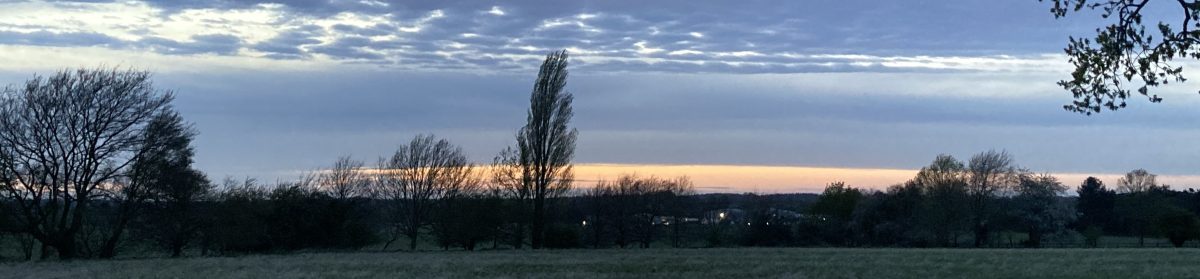
Noctilucent clouds are a rare type of cloud that comprise ice crystals so high up in the atmosphere that they reflect sunlight to the surface of the Earth long after sunset. It seems that noctilucent-like clouds are sometimes observed a few days after space shuttle launches – the shuttle launch creates eddies that carry water into the thermosphere (90-500km altitude). Similar clouds were also recorded as being observed in the days following the Tunguska blast (in Siberia) in 1908. The similarity between the two sets of observations has led to a suggestion that the Tunguska blast was caused by a wet, icy comet crashing to Earth rather than a dry, stone asteroid as had previously been thought. The story is described in New Scientist, Issue 2715 [04 July 2009]
Category: Other Science
For posts about science (but not meteorology and/or oceanography)
Bad Science
Time for another book-related entry (I seem to be on a good run with my reading at the moment). I’ve just finished reading Ben Goldacre’s book “Bad Science”. Goldacre is a medical doctor and writer/journalist who has written the “Bad Science” column in The Guardian newspaper for several years (and also maintains the Bad Science blog where you can find out more about Goldacre and the book). I first became aware of his work a few months ago when a fellow user of a Plymouth Argyle (football club) fans website drew my attention to his writing (yes, football fans come in all shapes and sizes and, on PASOTI, the discussions can roam towards absolutely any topic you could think of from time to time). Intrigued by what I had heard, I bought “Bad Science” (the book) and so had a thoroughly enjoyable week’s worth of reading about how the media often twist scientific studies and findings when they report them (usually because of ignorance) and, more importantly, how this scientific naivity is utilised by unscrupulous pseudo-scientific practitioners to promote personal agendas and, ultimately, sell products (pills, diets, alternative therapies etc). The book does a brilliant job of dissecting lots of examples, in some cases revealing that what most of us take to be the case is actually more likely to be the reverse. One example of this is that most people think that increased intake of antioxidants provides some measure of protection against various forms of cancer; in fact, the scientific evidence suggests that the opposite might be true. Goldacre doesn’t simply rant though, he carefully explains the importance and uncertainties associated with various types of clinical trial, statistical procedure and outlines at some length the placebo effect such that the reader is left able to make up their own mind about the arguments he presents. However, it must also be said that if it’s a good rant that you want then Goldacre does do good rant…
In my opinion, anyone who is interested in science in general and health, nutrition and alternative therapies in particular, should read “Bad Science”.
Clathrates good, clathrates bad?
There have been quite a few articles and news items over recent months describing the climate change danger posed by methane clathrate. Methane clathrate is a special combination of methane molecules trapped within ice crystals – apparently it looks like dirty ice, feels like sorbet and bursts into flames when touched with a flame. Methane clathrate forms when organic matter decays and releases methane which permeates through rocks and ends up somewhere where the temperature is approximately 0 °C and the pressure is ~50 atmospheres. When this happens ice crystals form that trap the methane molecules. The required conditions occur underneath permafrost and on the seabed at depths of 200-400 metres.
Most of the articles I have read about methane clathrates focus on the concern that if permafrost warms up, the ice crystals may melt and huge amounts of methane (a very potent Greenhouse gas) may suddenly be released. That’s bad news for climate change, really bad news…
However, a recent article in New Scientist, Issue 2714 [27 June 2009] (and Editorial) suggests that it may be possible to extract the methane from methane clathrate fields and then use this as an energy source. So, we can replace our dependence on the fossil fuels of coal, oil and natural gas with a new dependence on a new fossil fuel – methane. I guess that it is better to use the methane productively than to simply warm up the world until it burps out into the atmosphere and, intriguingly, one of the methods being explored for extracting methane from clathrates is to pump carbon dioxide into the clathrate field where it displaces the methane. This means that we may be able to store carbon dioxide safely out of harms way (thereby limiting Greenhouse gas emissions) and at the same time produce a source of energy. Neat.
Actually, for some time I have been wondering (not seriously) whether methane clathrates were made by humans at some past time when we had a problem needing to dispose of Greenhouse gases such as methane in a safe and secure way. Back then, someone might have had a neat idea to pump methane into the permafrost and encourage clathrate formation, thereby removing the methane and helping to prevent past global warming… well, it’s not impossible.
UK weather in the 2080s – or maybe not
Last week, New Scientist, Issue 2714 [27 June 2009] ran a short news item highlighting a new set of climate projections from the UK Met Office for the 2080s (oddly defined as the years 2070-2099). These are presented as a series of maps showing changes in summer mean temperature and summer and winter mean precipitation across the UK based on a 5km grid. The Met Office website also introduces the material and provides a link to the dedicated UK Climate Projections 09 website where the maps can be found. The New Scientist piece points out that some climate scientists feel that the projections are useless, and or misleading, because such fine resolution projections are bound to be upset by processes occuring at the local scale. There is also doubt that the climate models used to make the projections can handle areas of blocking high pressure well enough to make them useful.
So, the projections may or may not be useful or useless depending on who you believe! Nevertheless, I thought I would take a look at the maps and see what they tell me about the likely conditions in Plymouth in the 2080s (I have only just done the mental arithmetic, but I’ll (probably not) be 115 years old in 2080 which has depressed me a little). Anyway, for what it is worth, it looks like it’s going to be 3-4 degrees Celsius warmer and about 40% less wet in the summer and about 10% wettter in the winter…
Microseisms rumble on
Back in the early 1990s when I was finishing off my PhD I was given office space in the Unit for Coastal and Estuarine Studies (UCES) at the then University of Wales, Bangor (in Menai Bridge). This unit was a centre for applied (contract) research and was based on a small island (Ynys Faelog) in the Menai Straits that was reached by a causeway. Anyway, sharing the building was a retired professor, Jack Darbyshire, who used to beaver away on his own little projects and delighted in collaring me to talk about one of these (relating to the formation of beach cusps). The primary area that Jack was interested in was microseisms (tiny earthquakes) that are picked up in seismographs. I can’t actually remember what it was about microseisms that interested Jack so much (he wasn’t the easiest person to understand being something of the classic mad scientist with an added very strong north Wales accent) but I was interested to see microseisms pop up again in New Scientist, Issue 2710 [30 May 2009]. Apparently, when ocean waves break they cause the crust to “hum” and they generate microseisms the intensity of which is related to the size of the storm waves. There is now an idea to look back at the extensive seismometer records that go back for almost a century to see whether there are detectable changes in this wave “noise” that can be used to infer changes in storm patterns due to climate change. This is of interest because the seismometer records go back further in time than good wave measuring systems. Perhaps I should have listened to Jack Dervyshire more carefully all those years ago.
Sink or sink – there’s little choice in the Maldives
The Maldives are a set of low-lying islands in the Indian Ocean. 80% of the islands are less than 1 metres above sea level and the highest point is only 2.3 metres up. But sea level has risen 52 millimetres in the last 15 years, the Intergovernmental Panel on Climate Change has predicted a rise of up to 59 centimetres by 2100 (not including glacial melting) and the most extreme predictions put sea level at 25 metres above current levels by 2100. So, it doesn’t take a genius to work out the for the Maldives it is not a cae of sink or swim but rather a case of sink – the only uncertainty relates to how long it will take to go under. It could be 50-100 years (IPCC) but it could be much, much sooner. What is to be done? There are various plans afoot that range from building artificial sea walls or a raised island to house the population or puting buildings on raised platforms. An article in New Scientist, Issue 2707 [09 May 2009] discusses the problem facing the Maldives and reveals that the current government there is also contemplating what, to me, seems like the most logical approach, namely to divert a large amount of the islands’ income from tourism into a fund to buy land elsewhere in the world to which the Maldive islanders can relocate at an appropriate time int he future.
Green conflict
I grew up in Bridgwater, Somerset, a town on the muddy banks of the River Parrett that flows out into the muddy expanses of the Severn Estuary. The Severn Estuary is famous for its huge tidal range (peaking at 13m) and for it tidal bore and consequently the Parrett also has a high tidal range and its own (somewhat smaller) bore which I did actually get to see once. Even when I lived in that region (and I am talking 25-30 years ago) there was talk of building a tidal barrage across the Severn to generate electricity and although no such barrage has been built, the idea of building one resurfaces from time to time and is particularly topical in our current fossil fuel dependent world.
Predictably, the idea of building a tidal barrage across the Severn is controversial, particularly in terms of the impact of any such scheme on wildlife and ecosystems and so whilst the environmental lobby might be expected to support such a scheme to generate energy from a renewable source, the environmental lobby might also be expected to oppose a scheme. This conflict is nicely set out in a recent article in New Scientist, Issue 2704 [18 April 2009]. Do we go for large schemes that generate lots of power but have obvious big impacts on the environment or do we stick with small schemes to minimise impacts but end up without much gain in energy generation or is there a middle ground? This is a question that is going to keep cropping up and my gut instinct is that there isn’t a one-size-fits-all answer.
Record ripples
Years ago I did quite a bit of research trying to develop computer models for the formation of sand ripples. These models took individual (model) grains of sand and moved them around repeatedly according to a set of simple, sensible rules. For example, sand grains that were sitting at the top of bumps moved further forwards than grains in lower, and so potentially more sheltered, positions. When it comes to research I do have a tendency to follow my instinct and at that time I had an idea that if you leave a set of ripples to develop over really long timescales they just get bigger and bigger. However, in practice, it would look like they had stopped growing because once they become large any noticeable change in their size takes absolutely ages to show up (apart from my intuition there is also some other evidence from mathematical models that this might be true – up to a point).
So, I was interested to read in New Scientist, Issue 2703 [11 April 2009] about some wind-blow ripples that have been found on the Puna plateau in Argentina which are up to 2.3 metres high and 43 metres long (which is three times the height and two times the length of the previous record ripples). I don’t know any details, but it does seem to me that the Puna plateau is exactly the sort of place where ripples might be able to develop unhindered for really long time periods, so these massive ripples provide me with some reassurance that my instinct was correct. Apparently, there may be even bigger ripples on Mars…
Now it’s the turn of Antarctic ice
After months of reading reports of ice melting in the Arctic, the media attention seems to have switched to the southern hemisphere with a series of stories about changes to the ice in Antarctica. I guess it makes sense that the focus of attention would be in the northern hemisphere at the end of the northern hemisphere summer and then switch to the southern hemisphere at the end of the southern hemisphere summer (just about now). New Scientist, Issue 2703 [11 April 2009] carries a short item on the collapse of an ice bridge that connected two islands to the Wilkins ice shelf which has left the shelf vulnerable to the action of the ocean. The observations (from satellite images) show that ice shelves can very quickly become unstable. However, it is not just short timescale changes that are in the news, as the same issue of New Scientist has an article about the changes undergone by Antartica’s ice over millions of years. The article describes how ice cores have revealed huge fluctuations in the ice over geological timescales. The findings are important for climate modelling and the initial suggestion is that rates of sea level rise in the near future could be larger than currently predicted.
Remaining on an Antarctic ice theme, New Scientist, Issue 2705 [25 April 2009] reports on new research which offers an explanation for why Antarctic sea ice seems to be growing in extent even though global temperatures are warming. Apparently the answer lies with the hole in the ozone layer which results in changed weather patterns around Antarctic which have created stronger cold-air storms which have enhanced sea ice formation in certain regions. The report notes that as the ozone hole closes this effect will die away and Antarctic sea ice should start to do what it ought to do in a warming world, namely, melt.
Reach for the stars
Listening to a recent Scientific American podcast on my way into work this morning I stumbled upon an item about a project called Galaxy Zoo. This is an internet-based science project that anyone can sign up to help with in which “citizen scientists” (ordinary people) look at pictures of galaxies and classify them by following a sequence of simple questions. This is a highly efficient way of sifting through the mass of galaxy images captured by space telescpes so that scientists can then focus in on particular types of galaxies that they are interested in. It is a good approach because the human brain is really good at visual processing and can perform the classification task more reliably that a computer algorithm. So, if you fancy a bit of star-gazing you can sign up at the Galaxy Zoo website and join in.
 Tim O'Hare