Reading and Walking

Today, on my way down to the Marine Station from my office for an afternoon session on a first year module ‘Our Ocean Planet’ I found myself with a decision to make. I had not read anything scientific yet, had nothing scientific to read on me and knew I would have little time for scientific reading later on. Why was that a problem? It was a problem because my ‘scientific reading’ streak was sitting at 50 consecutive days and counting and so I was faced with a decision about whether and how to keep it going.

Without any real pre-meditation, as I walked down through the Drake Circus shopping centre I made a sudden left turn and dived into Waterstones bookshop. I had 5 minutes to spare and thought I would just have a quick look to see if there was any popular science book that leapt off the shelf at me. I thought that at least if I had something suitable to read I MIGHT be able to carve out some time to read a chapter but without a book my streak was certainly lost. After a quick perusal of the shelf I settled on ‘Seven Brief Lessons on Physics’ by Carlo Rovelli, a neat little book with seven short chapters each covering some aspect of 20th century physics (relativity, quantum mechanics, black holes etc.). The book had two great virtues that made it suitable for my purpose: 1) the chapters were really short, under 10 pages and 2) it was cheap (£6.99).

With book in pocket I continued on my way, but as I got down to the waterfront and started to skirt around the eastern side of Sutton Harbour I found myself reaching into my pocket, bringing the slim volume out and starting to read the preface. I don’t think I have ever read a book as I walked and this was a particularly risky place to start with the quayside and a drop into water on my right hand side in places and cobbles and uneven surfaces under my feet for much of the way. But having read the preface I found myself piling into Lesson 1 on Einstein’s theory of General Relativity and in a piece of sublime timing I completed the chapter just as I approached the Marine Station. The writing was absolutely perfect for my purpose – beautifully crafted for a non-scientific audience but with a scientific depth that made it a worthwhile read. I had made a good choice.

The sun was shining and the weather calm, crisp and clear so conditions were more or less perfect for my first foray into reading while walking. I did enjoy the experience and I can imagine repeating it again in similar circumstances.

Best of all, my streak remains unbroken, now up to 51 days and, what’s more, I have six more lessons to read so no excuses for not pushing on towards 60!
Coffee Ripples

My teaching at the Marine Station for the ‘Our Ocean Planet’ module finished early this morning and so on my way back through town I took a few minutes to stop for a coffee and to work through and write down some thoughts I have been having about the need for me to find more time for creative projects (aka research) at work. Amongst these projects is a piece of work I would like to do looking at the development of bedforms (sand ripples) in time-varying flows – these might be sand ripples formed by the wind or sand ripples on the seabed formed by currents, including reversing currents such as tides and, perhaps, waves (although the spatial scales are quite different and so the details of the sediment transport processes might be very different and require a different model). This is an area of work that I was into yonks* ago. I have a pretty clear idea of the approach I want to take, I just need to knuckle down and try things out.

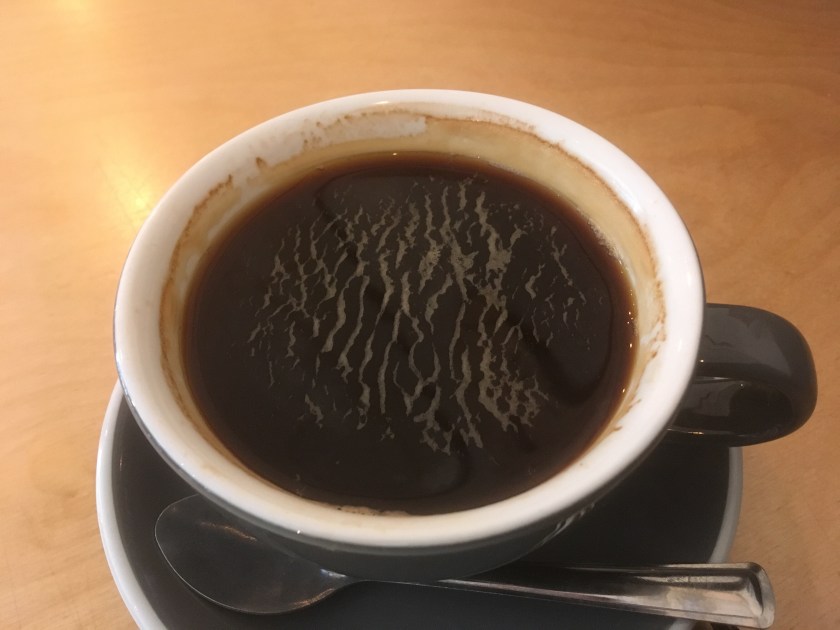
Anyway, I was sitting there writing in my notebook about creative projects and ripples with my cup of coffee (Americano) in front of me on a small table. This table had a bit of a wobble and I guess I was moving my body in some manner that caused the table to rock gently from side-to-side. I only realised this because when I looked up and looked at my coffee I was confronted with a pattern of lines (like ripples) in the surface…

These lines were aligned with the direction that the table was rocking (i.e. the table was rocking left-right as I looked at it and the pattern in the coffee was aligned front-back). It was a lovely, and fortuitous, example of pattern formation in nature of exactly the kind that I was thinking about. To try to extend things further I turned the coffee cup through 90 degrees and then deliberately set about rocking the table. I was hoping to make a new set of lines appear but at 90 degrees to the previous ones. The experiment was only partially successful. I broke up the existing pattern and saw some signs of new lines appearing…

…but I think my deliberate rocking was more forceful than my accidental rocking and I didn’t quite have the patience to make things work really nicely. Apart from anything else the coffee was getting cold and so I started to drink it. I think in my second picture you can see signs of a new pattern of lines aligned with the cup handle this time, but they haven’t completely redistributed or replaced the previous pattern.

This post nicely demonstrates both the pleasure and peril of being an inquisitive, scientifically-minded person. On the one hand, there is a rich world to discover in every single thing you do. On the other hand, it becomes impossible to simply sit and enjoy a cup of coffee without asking questions about what is going on!

*yonks = many years in case you have not come across this term before

Psychic Scientific American

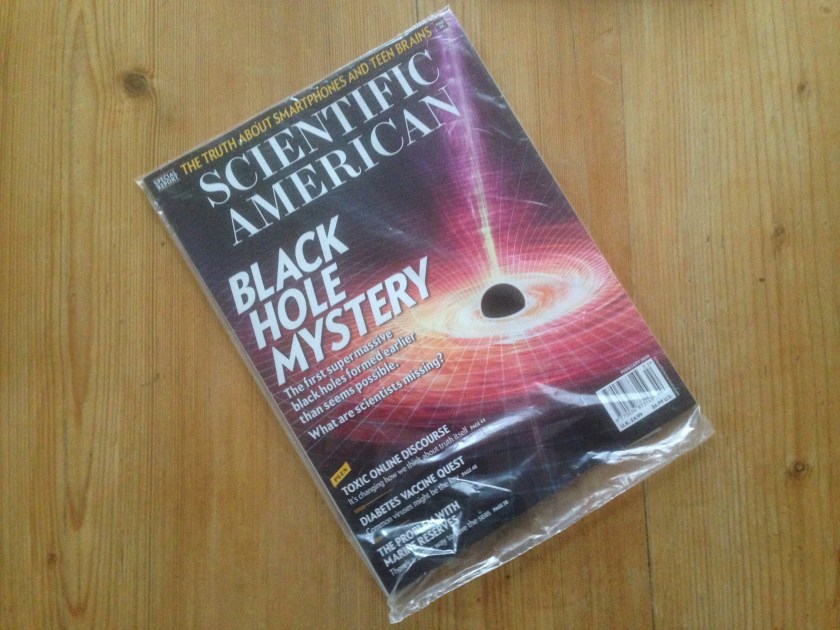
Over the years I have subscribed to Scientific American magazine on a couple of occasions, most recently since January 2016. I enjoy reading about a broad range of scientific endeavours and see it as part of my effort to keep generally up-to-date with what is going on in the world of science.

I like to treat reading Scientific American as a discipline, reading each month’s edition from cover to cover and making sure that I do not skip articles or news items just because they are not about something I am obviously interested in. The trouble with this approach is that on occasion I find myself getting behind and then I start to wonder whether it is worth the money for the subscription and whether the fact that I am behind is an indication that I am not really as interested in the content as I would like to think I am (or, as a scientist, should be). I ended up in this position in late summer last year when I somehow managed to be at least three months behind and it was in response to this that I tried to get into the habit of reading about six pages each day to catch up. Six pages is about the length of most of the more substantial articles, or a half to a third of the front part of the magazine (letters and smaller news items) or the entire back part (book reviews, pieces from the archive and a couple of one-page columns). This approach worked fairly well although I never quite got caught up.

More recently, over the Christmas/New Year break I turned scientific reading into one of my ‘dailies’ and, as a result, I swept through the December 2017 edition and, yesterday, completed the January 2018 edition. This meant that FOR THE FIRST TIME IN MONTHS I had caught up. I had read the last part of the January 2018 edition on 12th January and had no Scientific American reading in place to do (but I do have articles from two recent copies of the Royal Meteorological Society magazine, Weather, to get through).

What do you think turned up in the post today, making a big thump as it hit the hall floor? Yes, you’ve guessed it, the February 2018 edition…

The Breathing Earth

One of my favourite things is to stumble upon interesting bits and pieces – cool graphics, neat ideas, words of wisdom etc. – and earlier this week I came across this little animation called The Breathing Earth. It’s a composite of monthly cloud-free geostationary satellite images of the Earth wrapped onto various map projections. The title refers to the changing appearance of the Earth’s surface through the year, with waxing and waning ice cover and north-south migrating tropical vegetation which gives the impression that the Earth is breathing with the seasons. It’s simple, but a neat visualisation of the continuously changing face of our planet.

On Giants’ Shoulders

I’ve mentioned before in previous book-related posts how I quite often find my reading material in the charity shops of Mutley Plain (Plymouth). Well one such book that I bought some time ago but have only just got round to reading was Melvyn Bragg’s “On Giants’ Shoulders: Great Scientists and their Discoveries. From Archimedes to DNA”. This book was produced to accompany a Radio 4 series in which Bragg (a non-scientist) talked to various scientists about the lives of a selection of famous scientific figures from history (including Archimedes, Galileo, Newton, Laviosier, Darwin, Poincare, Freud, Curie, Einstein, Crick and Watson) about the nature of their work and about the nature of scientific genius.

I found this book a really interesting read and also quite inspiring (it made me want to be a better scientist). It made me think quite deeply about what it means to be a scientist and to contribute to scientific knowledge. Good stuff.

Here comes the cold

The world is getting warmer right? Wrong – at least wrong if you are looking at global temperatures over the next 10 or 20 years. New research reported at the UN’s World Climate Conference has suggested that the world is entering a natural cooling trend associated with cyclic changes in the atmosphere and ocean currents in the North Atlantic (known as the North Atlantic Oscillation and the Atlantic Meridional Oscillation). The danger is that people might see this cooling as an excuse to take their eyes off the longer term global temperature trend which remains upwards. Early evidence of cooling may have come in the form of increased sea ice cover in the Arctic this summer in comparison to the extreme lows of the last couple of years. The research is described in New Scientist, Issue 2725 [12 September 2009].

Time for Plan B – Geoengineering

There has been a huge amount of coverage of the need to cut Greenhouse Gas emissions as the primary route to slow down, halt and eventually reverse the current global warming trend and rightly so. However, in the background there have been a number of suggestions for actions that mankind could take to directly counter-act global warming. Such measures are collectively known as geoengineering and include such things as the direct removal of carbon dioxide from the atmosphere (e.g. by planting trees or fertilising the oceans) and reflecting incoming solar radiation away from the Earth (e.g. by using mirrors in space or changing the land surface to make it more reflective). These measures have not recevied much public attention, partly because they are all really, really expensive, partly because no-one knows how effective they would be and partly because by discussing the ideas in public we might distract attention from the goal of reducing Greenhouse Gas emissions.

Now, the tide has turned a little. A recent report produced by the Royal Society has highlighted the need to urgently begin considering geoengineering as a Plan B to reducing emissions. The report works through various geoengineering ideas examining their affordability and effectiveness and suggests that there should be a major shift of funding into geoengineering research. The report was widely publicised in the media at the beginning of September and the geoengineering debate is nicely summarised in New Scientist, Issue 2724 [05 September 2009].

Royal Society – Science in the News

Earlier this week my attention was drawn to the Royal Society’s “Science in the News” web-page. This provides a really neat daily summary of the science stories that are in the national media with links to all of the various web-pages. This looks like a really neat site and one which it would be well worth visiting regularly. I’ve added the link to the Other Science list over there on the right

Methane from the Arctic seafloor

Methane is a powerful greenhouse gas, so the addition of methane to the atmosphere is bad news for global warming and climate change (froma human perspective). Recent observations suggest that warming of the waters of the Arctic Ocean is triggering the release of plumes of gas (mostly methane) from beneath the seafloor into the ocean water column. So far there is no evidence that the gas is entering the atmosphere but some of it is converted to carbon dioxide which raises the acidity of the water. There is a brief report on this in New Scientist, Issue 2722 [22 August 2009] and a more lengthy piece, complete with a spectacular picture, on the BBC Website [18 August 2009].