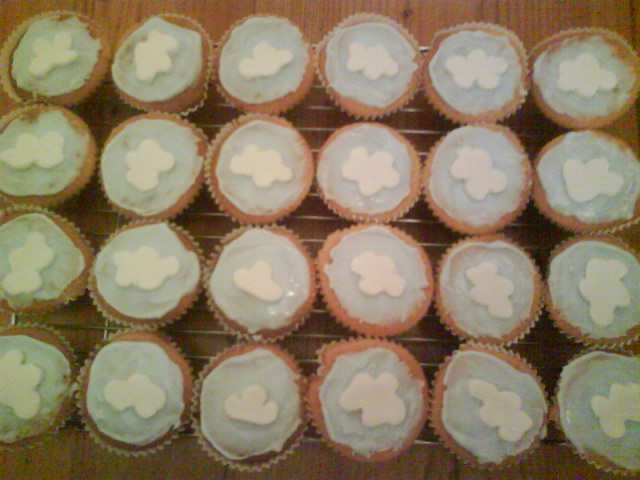
Cloud cakes

Anyone who has ever been a student on one of my courses will know that I do like to introduce the occasional gimmick or two – whether it be my use of a light sabre as a pointer in my “forces” lecture, sounding a bugle to highlight particularly important physical principles or … (further examples not disclosed so as not spoil the surprise for current students over the coming weeks!). Last week I think I surpassed myself though. At my first meteorology lecture of the year a few weeks ago one of the students came in with a plate of cakes that he was selling to raise money for a student group he is involved with. That put an idea in my head and with these particular lectures taking place late on a Friday afternoon I thought that a nice surprise for the students wouldn’t go amiss. So I spent last Thursday evening in the kitchen baking, but not just baking any old kind of cake. With last week’s lecture being all about clouds, it seemed appropriate to bake some cloud cakes. These were then taken into work and given out to the students towards the end of the lecture when I got to the section on exotic clouds.

You’re thinking I’m bluffing here don’t you? You want to see evidence don’t you?

So here you go… proof that I really am mad!

CloudCakes
My cloud cakes, each one with a pale blue sky background and a little piece of fluffy Cumulus!

Properly versus twice

Yesterday I attended the sixth of seven “Essential Leadership Skills” staff development courses that I am following. This one was on “Enabling People to Perform”. During the event the course leader gave a quote (without original source) that appealed to me…

Why do we not get time to do things properly when we do get time to do things twice?

To my mind this nicely captures a common problem that occurs in the workplace. things quite often have to be done more than once because they have to be completed in a rush and the outcomes are incomplete or in some way lacking. How better it would be to always make sure that there is enough time to do a job properly and, as a consequence, only have to do it once.

It won’t be pretty as the climate changes

Earlier this week I helped to assess some presentations given by final year Ocean Science degree students. The presentations were the endpoint of a year-long integrating case study module in which small groups of students work together to tackle a realistic consultancy-type project relating to their degree area. Several of this year’s topics related to future changes that are likely to occur in coastal regions as a result of climate change and, in particular, sea level rise (for example, there was one project on the threat to the main south-west railway line at Dawlish and another on the need to protect or re-route the coastal road at Slapton [both locations in Devon, UK]). Anyway, I don’t want to go into details about these projects but there was one thought that struck me very firmly as I reviewed the material in front of me, namely that because significant sea-level rise is going to occur and because there will be significant impacts on infrastructure such as railway lines, roads and housing, developed coastal areas ARE going to change and it’s not going to be pretty.

There was one picture of Dawlish showing the railway line, which runs along a seawall, with nice “safe” houses perched up on the hills behind the low-lying coastal strip. It is inevitable that at some point in the not too distant future the seawall will crumble, the railway line will be lost and the low-lying area will be inundated, but the houses further back an up will be okay. The thought that struck me though was that no-one will come along and landscape the eroding and flooding coastal strip; no-one will tidy up the damage, remove the old buildings, the concrete blocks and the twisted metal etc. So once we start to lose coastal infrastructure of this type (and lose it we will) there will be a region that, for want of a better description, will look like some kind of war-zone and this, in turn, will lead to abandonment of the surrounding safer/higher areas because who will want to live next to a wasteland?

But this is only looking at a local scale… Also this week I read an interesting article in New Scientist Issue 2697 (28 February 2009) on how human civilisation will have to adapt and change to live in a warmer world. While large parts of the globe may become unable to sustain existing populations, other parts (e.g. northern latitudes) may become more suitable for human habitation either as a result of changes in temperature, rainfall, soil condition etc. I’ve been comfortable with the idea that the world will change as climate changes, but it had never struck me before that along with the serious environmental consequences, it won’t be pretty.
The most fun you can have with 31 small pieces of paper?

Every week this term I am taking a couple of one hour sessions with first year students that are designed to improve their understanding of basic statistical concepts – you might know this already because you might be one of those students (or you might be saying to yourself  “so that’s what it’s all about”). This week’s session (Number 5 in a series of 9) is all about exploring the difference between population statistics (i.e. statistics obtained when the whole population has been measured – such as the mean height of all students at the university) and sample statistics (statistics obtained when it is only possible or practical to measure a subset of the whole population – such as the mean height of 100 randomly chosen students at the university). Usually it is only possible to measure sample statistics but what we really want to know are the corresponding population statistics.

So, the session involved taking an entire  population of measurements (the 31 maximum daily August temperatures in Plymouth in 2003 as it happens) and calculating the mean and standard deviation for this population. Then small samples of varying size (2, 4, 8 and 16 values) were selected randomly from the population and the sample mean and standard deviation for the sample were calculated in each case. When you do this lots of times you find that the statistics obtained with the small sample sizes vary a lot and can be a long way off the population statistics but when the sample sizes are larger there is less variation and the values are close to the population values (which is a fairly obvious result but still a nice one to demonstrate). Anyway, the fun part revolved around how the students obtained their random samples from the population. To do this I gave small groups of students a strip of printed numbers (1 through to 31) which they ripped up into 31 small pieces of paper (each with one number on) then folded (to obscure the numbers) and then randomly picked however many numbers they needed. It is such a simple process but at the end of a busy day (for them) it was a joy to watch them all merrily ripping up their paper strips, mixing up the numbers, drawing them out and then doing the calculations. They were smiling and laughing and joking when they messed things up and I was instantly struck by the thought that this must undoubtedly be the most fun you can have with 31 small pieces of paper. Unless that is, you know otherwise…