Time Tracking

After a minor meltdown on Monday morning, when I found myself struggling to do anything much despite having plenty to do, I have since found myself tracking how I have been using every piece of my time, allocating it either to a particular activity (perhaps allocated in advance to a specific area of work or to a meeting) or to a general collection of activities (e.g. ’email’, ‘small stuff’). I have also been classifying each time block as either ‘work time’ or ‘self time’. I have been taking 30 minutes as my basic unit of time such that I have 48 blocks of time to allocate in each day. Some of these blocks are allocated in advance, some are allocated retrospectively, but ALL are allocated. Thus, for example, today, the hours between 00:00 and 7:00 were pre-allocated to ‘Sleep’, 07:00-07:30 to ‘Exercises’, 07:30-08:30 to ‘Run’, 08:30-09:30 to ‘Shower/Breakfast etc.’ And 09:30-10:00 to ‘Travel to Work’. Later in the day, 15:00-17:00 was pre-allocated to ‘School Management Group’ [a meeting] and knowing that this frequently over-runs, 17:00-17:30 was tentatively allocated to ‘Meeting over-run’. Periods of time in between these pre-allocated blocks and the hours beyond 17:30 were either allocated as I went along or are still to be allocated later today.

In this way I have been able to get a good picture of what I am actually up to, but more importantly, adopting this approach seems to have made me more efficient. It is as if knowing that I am going to have to allocate each time block to something has forced me to make sure I have something genuine to allocate it to – I guess I do not want to be left having to retrospectively allocate blocks of time to ‘Nothing useful’, ‘Procrastinating’ etc. In this way I have, perhaps, stumbled on a kind of ‘external accountability’ mechanism that is helping to keep me on task and forcing me to always make a deliberate choice about how I am going to use the next block of unallocated time. I didn’t set out doing this with any particular expectation that it would be useful and, of course, I haven’t really been doing it long enough to really judge whether it is of value to me, but so far this process of playing with time tracking feels like it could be useful and, surprisingly, is turning out to be quite fun.

I am intending to couple this idea with better pre-allocation of larger blocks of time to the kind of deep-work, creative projects that I just never seem to get round to. I am pretty sure that the reason for me not getting round to them is NOT because I don’t have time for them but, rather, because I have a tendency to allow smaller stuff to fill up all the space and make me feel busy. I am hoping that this kind of time tracking might help me to hold myself to a commitment to these more creative projects, where real value lies, and make me better at resisting the allure of ‘busy work’.

So, that’s now 18:00-18:30 = ‘Blog entry’. What’s next?
Reading and Walking

Today, on my way down to the Marine Station from my office for an afternoon session on a first year module ‘Our Ocean Planet’ I found myself with a decision to make. I had not read anything scientific yet, had nothing scientific to read on me and knew I would have little time for scientific reading later on. Why was that a problem? It was a problem because my ‘scientific reading’ streak was sitting at 50 consecutive days and counting and so I was faced with a decision about whether and how to keep it going.

Without any real pre-meditation, as I walked down through the Drake Circus shopping centre I made a sudden left turn and dived into Waterstones bookshop. I had 5 minutes to spare and thought I would just have a quick look to see if there was any popular science book that leapt off the shelf at me. I thought that at least if I had something suitable to read I MIGHT be able to carve out some time to read a chapter but without a book my streak was certainly lost. After a quick perusal of the shelf I settled on ‘Seven Brief Lessons on Physics’ by Carlo Rovelli, a neat little book with seven short chapters each covering some aspect of 20th century physics (relativity, quantum mechanics, black holes etc.). The book had two great virtues that made it suitable for my purpose: 1) the chapters were really short, under 10 pages and 2) it was cheap (£6.99).

With book in pocket I continued on my way, but as I got down to the waterfront and started to skirt around the eastern side of Sutton Harbour I found myself reaching into my pocket, bringing the slim volume out and starting to read the preface. I don’t think I have ever read a book as I walked and this was a particularly risky place to start with the quayside and a drop into water on my right hand side in places and cobbles and uneven surfaces under my feet for much of the way. But having read the preface I found myself piling into Lesson 1 on Einstein’s theory of General Relativity and in a piece of sublime timing I completed the chapter just as I approached the Marine Station. The writing was absolutely perfect for my purpose – beautifully crafted for a non-scientific audience but with a scientific depth that made it a worthwhile read. I had made a good choice.

The sun was shining and the weather calm, crisp and clear so conditions were more or less perfect for my first foray into reading while walking. I did enjoy the experience and I can imagine repeating it again in similar circumstances.

Best of all, my streak remains unbroken, now up to 51 days and, what’s more, I have six more lessons to read so no excuses for not pushing on towards 60!

Getting Going Too Late

Today I have encountered a frustrating issue that seems to crop up fairly often in my working days. To begin with, I struggled to settle into work well and found myself somewhat distracted and not working very efficiently for a good chunk of the morning. Then, this afternoon I found I was fully into the task I was doing and so I now find myself, at about the time that I am wanting to go home, properly immersed in the task and not really wanting to stop working on it. Actually, no, that’s wrong, I really DON’T want to carry on working on it and I definitely DO want to stop working and go home. What I mean is that I am now working efficiently and am tuned into the work task at precisely the time that I am going to (have to) stop working on it, when this morning, when I had more work time stretching ahead of me, I couldn’t settle. This happens quite a lot. I find I just get going towards the end of the afternoon but then have very little time to make good use of my burst of focus and energy.

I have wondered about this before and whether there is any way that I can make better use of what appears to be a natural rhythm to my working day or whether there is something I can do to shift the focus/energy peak earlier in the day so that it has a longer period through which to be useful. How can I create the ‘end of the afternoon’ feel in the morning? Is it a matter of doing things differently earlier in the day or eating differently? Might it simply be that as the available work day starts to shrink I am better able to push myself into a state of focussed activity in an attempt to finish tasks before I go home? I suppose that if it was just me that I had to take into consideration I MIGHT allow myself to carry on working into the evening. I seem to really switch on about 2-3 hours after I have eaten lunch or about 5-6 hours after I arrive at work so it might be that I need to spend a long time ‘warming up’ – that would suggest an earlier start to the day. I don’t know. I’m confused. I’d love to solve this one.

Coffee Ripples

My teaching at the Marine Station for the ‘Our Ocean Planet’ module finished early this morning and so on my way back through town I took a few minutes to stop for a coffee and to work through and write down some thoughts I have been having about the need for me to find more time for creative projects (aka research) at work. Amongst these projects is a piece of work I would like to do looking at the development of bedforms (sand ripples) in time-varying flows – these might be sand ripples formed by the wind or sand ripples on the seabed formed by currents, including reversing currents such as tides and, perhaps, waves (although the spatial scales are quite different and so the details of the sediment transport processes might be very different and require a different model). This is an area of work that I was into yonks* ago. I have a pretty clear idea of the approach I want to take, I just need to knuckle down and try things out.

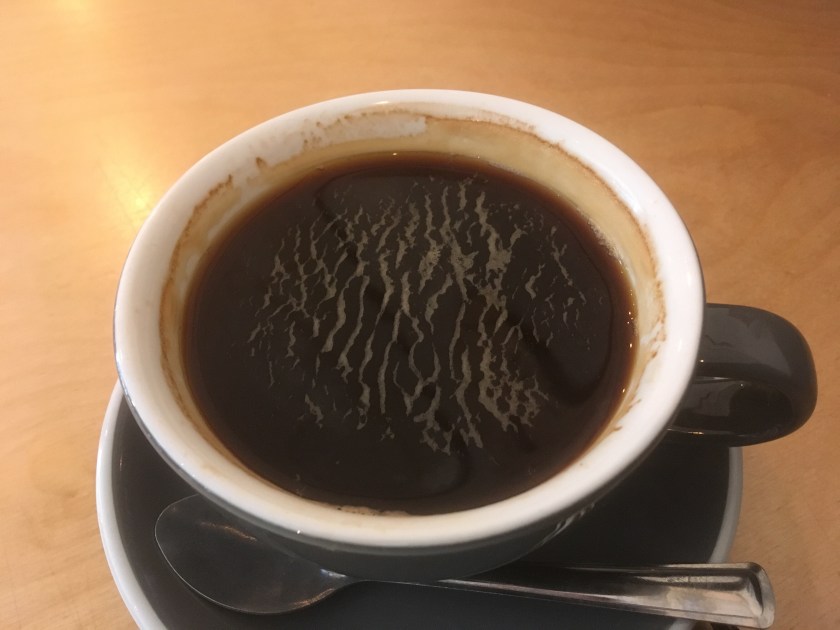
Anyway, I was sitting there writing in my notebook about creative projects and ripples with my cup of coffee (Americano) in front of me on a small table. This table had a bit of a wobble and I guess I was moving my body in some manner that caused the table to rock gently from side-to-side. I only realised this because when I looked up and looked at my coffee I was confronted with a pattern of lines (like ripples) in the surface…

These lines were aligned with the direction that the table was rocking (i.e. the table was rocking left-right as I looked at it and the pattern in the coffee was aligned front-back). It was a lovely, and fortuitous, example of pattern formation in nature of exactly the kind that I was thinking about. To try to extend things further I turned the coffee cup through 90 degrees and then deliberately set about rocking the table. I was hoping to make a new set of lines appear but at 90 degrees to the previous ones. The experiment was only partially successful. I broke up the existing pattern and saw some signs of new lines appearing…

…but I think my deliberate rocking was more forceful than my accidental rocking and I didn’t quite have the patience to make things work really nicely. Apart from anything else the coffee was getting cold and so I started to drink it. I think in my second picture you can see signs of a new pattern of lines aligned with the cup handle this time, but they haven’t completely redistributed or replaced the previous pattern.

This post nicely demonstrates both the pleasure and peril of being an inquisitive, scientifically-minded person. On the one hand, there is a rich world to discover in every single thing you do. On the other hand, it becomes impossible to simply sit and enjoy a cup of coffee without asking questions about what is going on!

*yonks = many years in case you have not come across this term before

The Great Wave Off Kanagawa… in Mutley

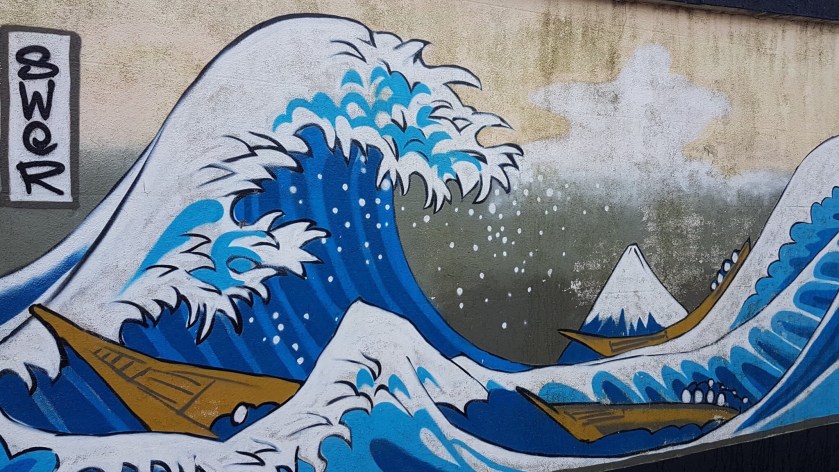
Yesterday morning, at the end of a lecture I gave on Waves and Tides, I showed a picture of Hokusai’s famous work of art The Great Wave Off Kanagawa. My lecture was being observed by one of my colleagues (every year we have to observe and be observed) and she remarked afterwards that there was a Plymouth version of The Great Wave painted onto a wall in the Mutley area of Plymouth. After a short discussion we established roughly where this mural was and I was surprised to find that it is on a road that I have driven along many times. My colleague said they thought they had a photograph of it and just now they have tagged me into a tweet that they have posted with their picture. It’s absolutely tremendous – a graffiti style rendition of the great work in bold colors, somewhat simpler than the original but capturing the same scene and sufficiently similar to be immediately recognizable but not so similar that it is simply a copy.

Here is the picture – I am absolutely going to have to make a special trip there soon to find the building a take a picture or two of my own…

Board Games… It’s Work, But Not As We Know It

I spent this afternoon at work in what is perhaps the most unusual manner of any afternoon that I have spent at work, in a room overlooking Plymouth Sound with 60-70 first year students all playing board games. These students are one week into their four week ‘Our Ocean Planet’ module in which they design and present an artifact to communicate a marine science-related issue. Artifacts can include posters, videos, TED-style talks, campaigns, blogs and …. board games. So, the idea of the session today was for the students to spend 2-3 hours playing one or more games in their groups, evaluating their experiences and having a think about what works well and what doesn’t. Alongside this of course, they were working together as a team and getting to know each other.

It was a really interesting experience to watch them at work. Groups of (mostly) four students (mostly aged 19-20) clustered on individual tables (per group) chatting away, reading rules, setting up, playing games through – thoroughly social, thoroughly engaged in their activity, clearly treating the session seriously and getting something out of it. This, on a Friday afternoon when the sun was shining outside and when no-one would actually have picked them up on not being there.

My role, along with that of the other tutors present was to help them along, to encourage, to join in, to pose questions about what they were doing.

Perhaps the most intriguing thing of all was the fact that for most of the session, certainly for the first hour or so and for some groups as much as three hours, there was almost none of the continual interaction with smartphones that is so prevalent everywhere these days. For a few tens of minutes, these students put down their tech and became immersed in cardboard pieces, counters, rule booklets etc. and, critically, each other. They became truly social animals and it was blindingly obvious that they enjoyed it.

I expect that on leaving the session most slipped almost immediately back into their internet-connected, social network-driven existences, but I do I hope that the little glimpse of real reality that I saw in action this afternoon continues to blossom in their lives.

Meet Spike

This morning I gave a once-per-year lecture session on ‘Creating a Website’ as part of the ongoing Marine Science Communications module ‘Our Ocean Planet’. In this session I talk about how easy it is to produce a website these days using platforms such as WordPress and I use a few of the websites that I have produced over the years as examples. Amongst those example websites was, of course, this one.

I have written before about how I don’t write the entries on this blog for anyone in particular. I know that there is almost no audience looking at this blog on a regular basis. I am simply using writing these blog posts as a way to maintain a discipline of writing something everyday. Of course, I would be lying if I didn’t admit that I’d like to think there could be an audience, at least for the occasional post that I write that actually says something interesting or useful (if these even exist), but that is different from writing in the expectation that anyone out there is at all interested in what I have to say.

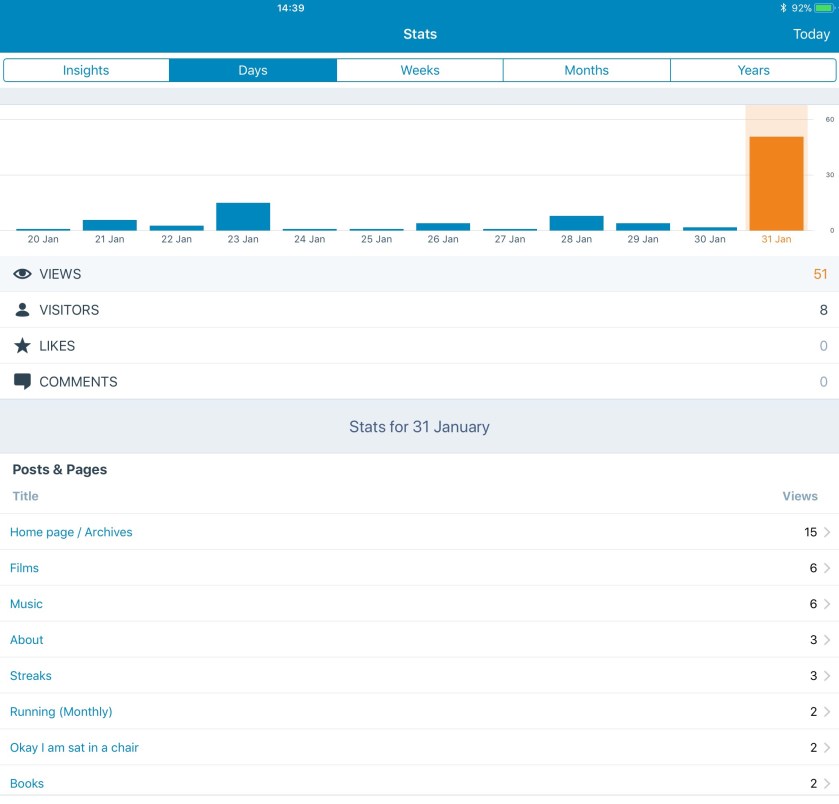
Today though, suddenly, this site has attracted a few readers, as evidenced by the spike in visits and views shown below:

These numbers are still small, but against the background of the visits and views for a ‘normal’ day the spike in activity is huge. It is also, of course, artificial. These visits and views have only occurred because I was using this site as an example in my lecture this morning. They simply show that there were a few students in the audience who were either interested enough, inquisitive enough or perhaps just plain nosey enough to visit and dig a little deeper. They very probably took a quick look and left rapidly never to be seen again which is, of course, absolutely fine because that just returns me back to normality. But who knows, it’s possible one or two might come back again in the future in some random moment when they are at a loss for something to do and wonder what I might be writing about, whether anyone is still sat in a chair, whether beetroot is still on the menu or whether I have finally managed to come to enjoy marking.

It has been nice to see Spike today, but he’s only passing through and will be gone tomorrow.

Marking and Running

I spent today at home marking student courseworks from my second year Meteorology module. Regular readers of this blog (yes, I know, there’s no such thing really) might recall at least one previous post that I have written moaning about how much I hate marking and mostly I just want to say it again – I hate marking. In fact, I really, really, really detest marking. Of course the completely ironic thing about this feeling is that most of the students who produced the work that I am marking hated having to produce that work. Some of them probably really, really, really detested having to produce it. Which makes us kind of even I suppose, although it seems a bit unfair that they each only have to suffer once whereas I have to suffer as many times as there are students. Sometimes I think we should enter into a pact. I’ll not set them any work to do, they won’t have to do it, I won’t have to mark it and we’d all be happy. Sadly, of course, such a beautifully simple and elegant solution is not allowed. Marks there must be and, in truth, it is through having to do assessed pieces of work that most of the learning happens which is, after all, the whole point of studying a subject at University.

As I get older I try to see the positive side of things and so I have to ask myself what the positive side of a day spent at home marking might be. The answer is actually rather simple. On a day when I go to work I spend approximately 40 minutes getting to work in the morning and another 40 minutes getting home again at the end of the day. I have a two mile walk (usually – tomorrow it is three because I am starting at the Marine Station) which takes me between 30 and 35 minutes but there is always some time lost at either end going through doors, taking off my coat etc. All of which means that by staying at home to mark I get back 80 minutes of my time, and what can I do with 80 minutes? I can run 8 miles. Which is exactly what I did at the end of this afternoon – 8 miles down and around Mannamead (Thorn Park, Mutley Park) across Mannamead Road along Seymour Road and up and down a few hills, back across to Mutley Plain, down into Hyde Park and Central Park, past Argyle’s ground and home after a few twists and turns along the way – a route that seems to have become my go-to route over the last few weeks – 8 joyous miles in the misty, drizzly half-dark which more or less cleansed my mind of the horror that it had been through for most of the rest of the day (I exaggerate a little).

Marking and running. Without one I wouldn’t quite have had the opportunity for the other and probably wouldn’t have enjoyed it as much either. In the end then, it was not such a bad way to spend a day after all.

‘Our Ocean Planet’ gets underway

Today is the first day of a module that I help to teach called ‘Our Ocean Planet’. It is completely different from other modules I work on because 1) it only lasts 4 weeks and is the only thing that the students who are taking it do for those weeks and 2) it has very little technical content. The idea of the module is for small groups of students to pick an issue relating to the oceans and develop some kind of ‘product’ designed to communicate the issue to a wide audience. In the past we have had groups produce talks, books (for various age groups), websites and quite a few games. It’s quite a fun and interesting module to be involved with because no two groups are the same and at the outset there is no knowing what direction any particular group will take both in terms of the topic/issue that they cover and the vehicle through which they choose to communicate it.

This year I am involved in two ways. First I will be ‘looking after’ four of the working groups (each with four students), although this going to be a somewhat lighter touch than in the last couple of years as there is only one formal meeting with each group each week. Secondly, I volunteered to give a few lectures to provide some background information on the oceans, aimed mostly at the students on the module who are not covering any marine science in the rest of their course. On the module we have students from various marine science and marine biology degrees but also some from geography, geology and environmental science and also some from English and creative writing. I gave the first of my lectures this morning, titled ‘Geography of the Oceans’, and covered the general distribution of the oceans on the planet, the shape and form of the seabed in different domains (continental margins, deep ocean floor, ocean trenches and mid-ocean ridges) and talked a little about the dynamic nature of the seabed and the Earth’s crust more generally (plate tectonics, seafloor spreading). The session seemed to go okay and I was pleased that I got the timing about right (this is always tricky when giving a session for the first time despite years of experience – partly because the more teaching you do the more comfortable you become just talking around a topic and this can mean that you take more time on topics than planned).

This afternoon the students have been out on and around Plymouth Sound taking photographs of the water and, in particular, litter and pollution in the water, and tweeting their pictures and thoughts about what they see. Later on they will be analysing this data to get a look at the bigger picture.

The real fun starts in a couple of days time when the groups start to properly form and, panicked by the short timescale available to them (3 weeks), start to decide on their topics and how they are going to communicate them. It would be nice to see some novel topics this year and some creative approaches to the communication side of things. We shall see.

Timetabling Mania

The academic year structure here in Plymouth is such that there are two teaching Semesters, one that runs from the start of the year in September through to the end of January (12 weeks before Christmas/New Year and 3 weeks after) and then a second one that runs from roughly the beginning of February through to May with a break over Easter. This means that currently we are towards the end of Semester One with a new set of modules due to start in Semester Two in just over a week’s time.

One of my roles as Deputy Head of School is to be the School Timetabling Coordinator. This basically means that I have to sit in between the academics planning and teaching modules and the Central Timetabling Unit (CTU) who schedule them. Every communication with the CTU is supposed to go through me which is basically a way of restricting the ability of academics to moan and grumble at the CTU and puts the onus on me to filter requests for changes to the timetable, push academics to find ‘local’ solutions and, at times, moderate the language they have used when making timetabling requests/demands…

I have only been doing this timetabling role for about a year but it is apparent that timetabling work comes to a head at a few specific times of year. There is a huge flurry of activity towards the end of February when academics have to complete ‘Module Delivery Sheets’ detailing what sessions they want/need for their modules in the following year (so at least 6 months ahead), followed immediately by a huge amount of work for me to review, check and approve all of these requests. Then there is another burst of activity in the summer when there is a two week period for checking the draft Semester One timetable followed not long afterwards by a similar period for the Semester Two timetable. At that point, say mid-September, everything is supposed to be set for the year and the assumption made is that nothing will change from then onwards. In fact, it is not simply an assumption. Rather, there is now an INSTRUCTION that nothing can be changed without various levels of approval, sometimes from pretty senior people in the university.

I mention this today because in the last couple of days I have suddenly been hit with a plethora of timetable change requests from my colleagues to process. Some of these are completely straightforward but others are really quite incredibly complex and I have a not insignificant amount of work to do to try to work out the best tactics to use to ensure that the request makes its way smoothly through the CTU. Almost all of the requested changes could have been highlighted weeks if not months ago which is the thing that makes all of this sudden activity really rather frustrating. My day today has been completely hijacked by this work. It is as if (some of) my colleagues have awoken from a trance to realise with a jolt that they need to think about what they are doing in a week’s time, despite having known about and been able to think about these things for ages and ages. In truth, of course, they are busy people, but as someone who likes to know that there are no nasty shocks around the corner I do find it hard to comprehend how anyone could work in this manner.

Today, timetabling mania has been particularly bad. I am hoping that tomorrow and, indeed, next week, will not see a repeat. I cannot really afford to lose more time to this. My timetable doesn’t permit it.