
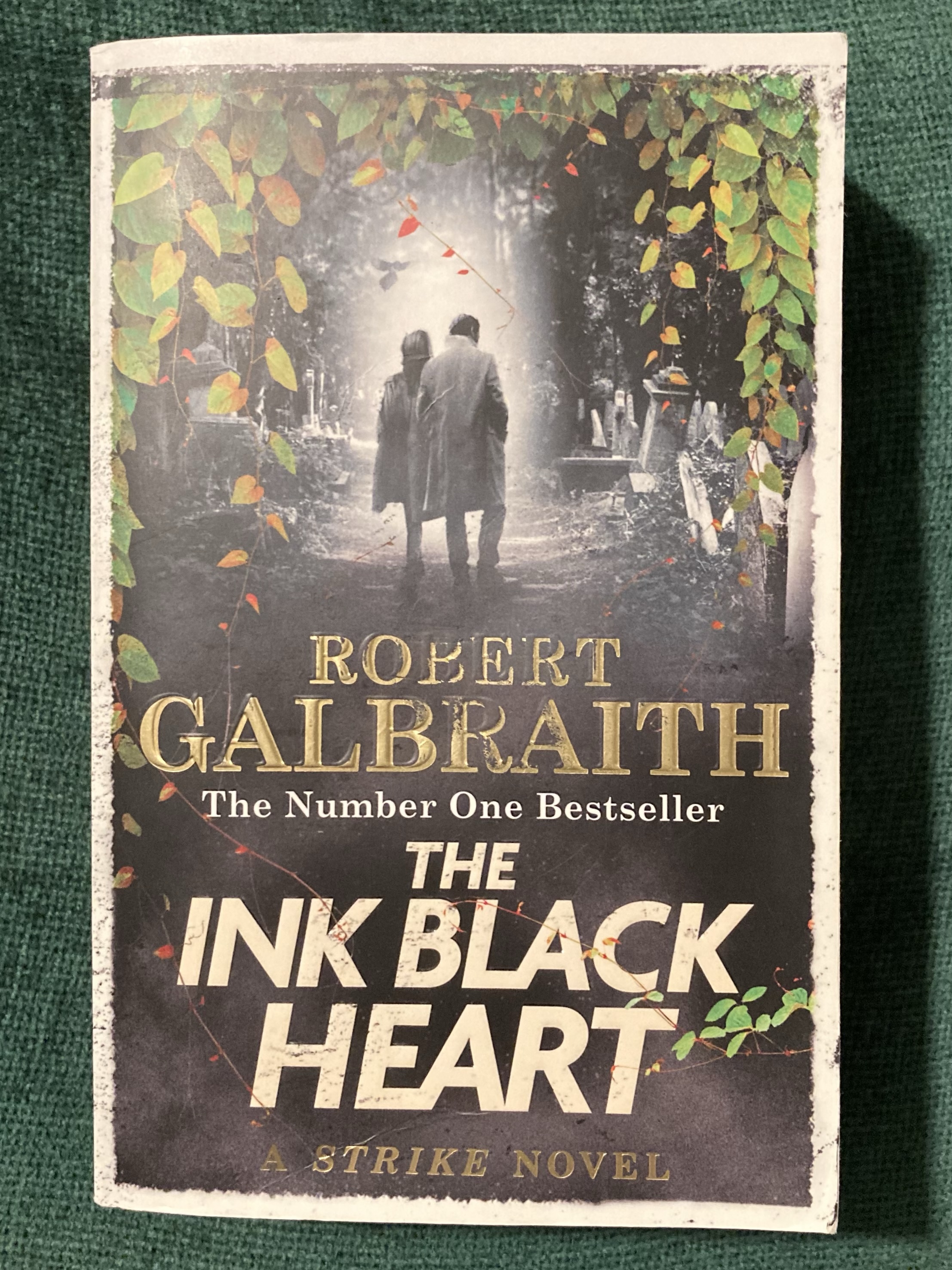
Oh J.K. Rowling (a.k.a. Robert Galbraith)… Why oh why do you seem to be obsessed with writing ever longer lengthier novels?
The Ink Black Heart is the sixth novel in the Cormoran Strike series, written by J.K. Rowling under the pseudonym Robert Galbraith. The plot follows Strike and his former assistant, now professional partner, Robin Ellacott, as they try to get to the bottom of a complex and grisly crime – the murder of the co-creator of a highly successful online cartoon series (The Ink Black Heart of the book’s title) in the very graveyard in which the cartoon is set. The story plot is typically convoluted, throwing in lots of characters, many of whom are suspects at some point, with all of the action happening alongside the ongoing will-they-won’t-they saga of Strike and Robin’s frustrated relationship.
Compounding this complexity, the plot is made even more complicated to follow by the fact that large chunks of the dialogue between some of the characters takes place via online messaging threads. This throws up two issues for the reader. First, because the characters involved in the online messaging conversations hide their identity behind anonymous usernames it is some way into the book before you know who is talking to who (obviously, this is deliberate). Secondly, it is an (impossible?) challenge to work out how to read up to three parallel conversations between different pairs or groups of, sometimes overlapping, individuals. I can understand why the Rowling/Galbraith chose to write these sections in this way – the chat threads take place within an online game that is based on The Ink Black Heart cartoon – but I felt it made reading the book unnecessarily hard, and at times rather frustrating, work.
I should come clean… In general, I’m not a fan of long books. I like to feel that I am making reasonably rapid progress through a novel and that I won’t get stuck on the same book for more than a few weeks. So with The Ink Black Heart extending to around 1200 pages it took me a while to summon up the courage to make a start on it. However, it wasn’t simply the length of The Ink Black Heart that set me off on the wrong foot, because I’ve also had a long-standing gripe about the way that Rowling’s books seem to get longer and longer with each new one that comes out. This happened with the Harry Potter series, in which the first three titles were quite short, easily-tackled, but still satisfying stories, as the later volumes became progressively more ‘doorstop-like’ each time one appeared. I still enjoyed all of these books, but when I read them I really felt that Rowling’s writing could perhaps do with a good dose of editing… [hark at me, calling out one of the most successful, if not the most successful, writers of modern times.]
Rowling’s tendency for bloated writing is something that I think is particularly apparent in the Strike novels. I do enjoy reading them, but I can’t help but wonder whether it is really necessary to drape Strike and Robin’s relationship across quite so many pages. I think it’a all a bit tedious, and find myself almost screaming at the pair of them to just get on with it. [For balance here, I should say that both my wife and my elder daughter completely disagree with me on this point!] There is also a lot of description of minute details of events that have no bearing on the plot, which is fine if you like that sort of thing (i.e. not being allowed to get to the heart of the matter as quickly as you would like), but stretches my patience close to breaking point. I suspect that The Ink Black Heart could probably be half its present length and still be a great read (and obviously a better read in my opinion).
Perhaps, in the future, Rowling/Galbraith could write two separate books that can be read in parallel – one housing all of the crime/sleuthing-related action and then for those that can be bothered to read it, a second volume that takes a microscopic look at the trials and torments of the relationship between Strike and Robin. At the end of each chapter of the first volume the text could read something like this:
Reader:
If you want to get straight on with the exciting action to discover just how the shocking realization that Strike and Robin have just made takes them one step closer to uncovering the identity of the killer that lives in their midst, then turn the page and read on.
But if, instead, you’d like to lose the thread of the story and forget exactly who said what to whom as you read another account of Robin’s misapprehension of Strike’s words to her in their last conversation and Strike’s desperate attempts to convince himself that getting closer to Robin can’t possibly be the obvious conclusion of them spending almost every waking hour together, then switch over to the companion volume where things might eventually get ever-so-slightly slushy.
Sizzling sleuthing or risky romance? You decide…
 Tim O'Hare