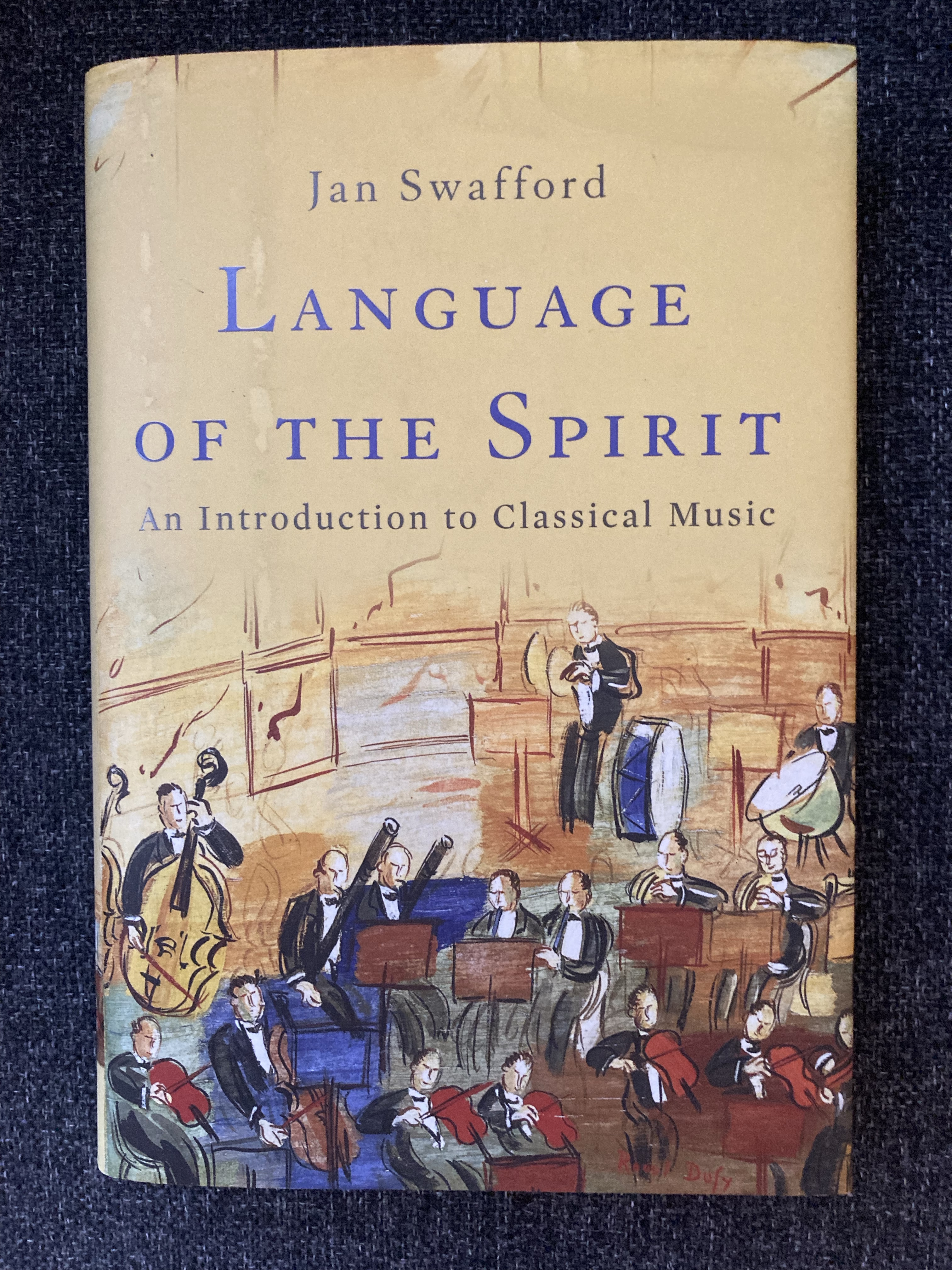
I started reading Jan Swafford’s Language of the Spirit – An Introduction to Classical Music back in June 2023 and finally completed just a fortnight ago. It would be tempting to conclude from this that it was a book that I struggled through but, in fact, nothing could be further from the truth.
I grew up in a household that was full of classical music, from the long, purpose-made shelf unit in the living room that was stuffed full of vinyl records, to the assortment of musical instruments that my father acquired and dabbled with (flute, trumpet, clarinet, mandolin, violin). Apparently, when my brother and sister and I were very young, we would be accompanied on our way to bed by our personal favourite pieces of music, presumably each one being some piece that we had reacted to positively at some point. I don’t recall what my sister’s piece was, but I do know that my (older) brother’s piece was a movement from Schubert’s ‘Trout’ Quintet and mine was the rather stirring ‘March Slav’ by Tchaikovsky (so it is probably no coincidence that Tchaikovsky later became one of my absolute favourites).
I had piano lessons from the age of about six and then at around nine years old I began to learn the ‘cello (because apparently I had shown an interest in learning it, although I can’t say that I remember that and I suspect it was more because it was an instrument that my father wished he had been able to learn). I was never that great at the piano, and stopped after passing my Grade 6 exam, but playing the ‘cello certainly became a big part of my life all the way through my teens and well into my 20s. Over the years, I played in various ensembles and orchestras, in particular leading the ‘cello section in the Somerset Youth Orchestra, the Somerset County Orchestra, Oxford Sinfonietta and Bangor University Orchestra and being on the first desk of the ‘cello section for the annual summer gatherings of the Somerset Chamber Ensemble/Orchestra. It’s fair to say that I was a pretty good ‘cellist – although better known, I think, for my expressive playing than for a robust technique (or any kind of technique at all really – practice and I have never really been comfortable bedfellows in any area of activity…).
I always enjoyed orchestral music the most, especially music composed from around 1850 through to perhaps 1930 – the romantic and late-romantic periods – music full of emotion, passion and angst. My mother used to call the kind of music I liked best ‘troubled music’, which I guess is fair: Brahms, Tchaikovsky (and assorted other Russian composers of that time), Wagner, Sibelius, Richard Strauss, Mahler – that kind of thing. Unlike a lot of musicians, I never went much for some of the classical greats like Bach and Mozart, especially the latter, whose music (am I allowed to write this?) I tend to find rather boring.
In Language of the Spirit, Jan Swafford, a US-composer and music academic, provides a wonderful journey through the classical music canon, from early single-line chants, through all of the great names, and right up to the present day and the post-modernists. The book is mostly written on a one-composer-per-chapter basis, with most chapters being perhaps six to eight pages in length. In each case, Swafford outlines what makes each composer’s work distinctive, and provides a little detail of about their life, their influences and their major works, which brings me to the reason why it has taken me the best part of two years to finish the book…
Just for fun, I decided at the outset that I would listen to every piece of music that Swafford had picked out as being important or a good example of some aspect of a composer’s works. This meant that for each chapter I created a playlist with something like 8-15 pieces requiring multiple (many in some cases) hours of listening – Spotify was my friend! In the end, I managed to listen to every single piece that was highlighted or recommended (including several full operas) except for one piece by Stockhausen that I couldn’t find (but based on the Stockhausen works that I did listen to I can’t say I am too upset about that).
I listened to lots of music that I already knew well, lots of music that I thought that I knew well, and even more music that I didn’t know at all, some of it major works by major composers. I had a few surprises, particularly enjoying the music of Schumann (who I have never paid that much attention to in the past) and Grieg (who I always thought was a bit lightweight), and despite not really enjoying most of the noise that was described as atonal and/or post-modern, there was something about the work of Philip Glass that I enjoyed more than I feel I should have done.
Having now finished reading the book, and having listened to the last piece (John Adams’ Shaker Loops), I was spurred on to re-arrange the furniture in the small bedroom that I use as a kind of home office/personal den so that I could fit in some nice wooden CD shelves that we have struggled to find a good home for recently, and I unboxed all of the CDs (not just classical) that have sat out of sight since we packed them up last summer before having our kitchen re-modeled.
If you don’t know much about classical music but want to know more then I thoroughly recommend Swafford’s book. It is written for a general reader and gives a lot of interesting background and insight into a huge range of music. Alternatively, if you are like me, and know (or think you know) a lot about classical music already, then Language of the Spirit is a great stimulus to rediscovering old favourites and discovering new ones (and also discovering ‘music’ that you will never want to hear again for that matter – but each to their own of course!). Reading Language of the Spirit didn’t convert me into a Mozart-lover – I’m still very much in the ‘troubled music’ camp – but it did broaden my knowledge and has given me a number of composers to explore further. I also discovered that rather than being the somewhat over-sentimental ‘slush-fest’, that I recalled it being from when I played it with the Somerset Youth Orchestra over 40 years ago, Rachmaninoff’s Second Piano Concerto is indeed a rather special piece of music.
 Tim O'Hare